HAHAHA FUCK SpaceX just launched a nuclear powered satellite.
Sounds like this particular satellite is tiny and doesn't have a lot of tritium on board but HOLY SHIT this is a bad precedent.
HAHAHA FUCK SpaceX just launched a nuclear powered satellite.
Sounds like this particular satellite is tiny and doesn't have a lot of tritium on board but HOLY SHIT this is a bad precedent.
This is exactly the kind of news I want to see after spending a whole day reading and writing about Kessler Syndrome (specifically about SpaceX and Kessler Syndrome) right before I go to bed. Fuuuuuuck.
There's no way I can even read all the comments on this, so let me just reiterate: Is one small satellite with a tiny tritium battery something to worry about? No.
Is this a bad precedent? Probably, yes. This is the part that scares me: I really don't know if there is a regulatory line between tritium beta-emitting nuclear powered batteries and full fission-powered nuclear reactors on satellites. And if that regulatory line exists anymore under Trump. No idea.
Yes, I am very very aware of the Kosmos 954 disaster (you can learn more about it from this powerful podcast: https://www.cbc.ca/arts/operation-morning-light-podcast-soviet-satellite-exploded-traditional-dene-land-1.6650994)
Knowing SpaceX's safety record, and having seen pieces of their "fully demisable" spacecraft on the ground, I know they lie, and I know they make engineering mistakes. They are already changing the atmosphere with frequent reentries and making Low Earth Orbit much more unsafe. I do NOT want them launching nuclear reactors into Low Earth Orbit.
@sundogplanets ohhhh my
@sundogplanets lucky thing that spacex doesn't have a reputation for blowing rockets up when sending things to orbi—
*pressing hand to ear* I'm getting reports that…
@sundogplanets I am suddenly reminded of the "Plainly Difficult" youtube channel that talks about nuclear disasters...
@sundogplanets I'm sure Sam knows, but for those who don't, various groups are developing "batteries" that use semiconductors to generate electricity, but using beta decay (which generates electrons or positrons) instead of photons as a power source. Electrons have a low mass and are electrically charged, so shielding is trivial - it takes very little material to stop them. You get a small amount of power but with a very long lifetime.
@sundogplanets I read "plutonium" in the article. Please tell me they don't plan to let those satellite disintegrate in the atmosphere??
@benjamin @sundogplanets It's confusingly worded but the plutonium bit is talking about the voyager craft. This one uses tritium.
@chris108 @sundogplanets ok gotit. Thanks.
Reassuring on the danger (not on the pollution or Kessler risk...)
@sundogplanets hopefully it's expensive enough where it only makes sense for special situations
@sundogplanets Deep in the article it says that the commercial tritium power source was authorized under an executive order signed by Trump in 2019.
@sundogplanets it occured to me just now that nuclear powered AI data centers in space are a terrible idea for humanity but an AWESOME idea for AI, if AI wants to negotiate it's survival from the high ground.
@sundogplanets we *are* talking about a statistical output generator that was trained on the complete works of every sci fi writer ever. Statistically, "I would hold earth hostage to survive" is a likely output from any bot trained thusly.
@sundogplanets what could POSSIBLY go wrong???
@sundogplanets did they have to get approval for this before launching?
@fullywoolly @sundogplanets and, importantly, who presumes to authorise on everyone else's behalf? Space programs are a disaster on this front. My sky is not the business of any other country's government, and barely even my own countries' governments. This practice reeks of the same foul scent as when the petro lobbyists robbed us of customary rights that we'd held, as pedestrians, since prehistory.
@libroraptor @sundogplanets oh I absolutely agree. I never wanted our sky to be polluted with the satellites in the first place. But given my experience with aerospace, I would have expected some government bodies signed off on this. Wouldn't know who as I've never worked with space proper. Neither here nor there since it's already up there.
I wouldn't be surprised if it is related to DOGE cuts or a buyout here and there ... The petrol lobby is probably taking notes.
@fullywoolly @libroraptor @sundogplanets
'"BOHR demonstrates that safe, compact, and regulatory-approved nuclear power systems are ready for routine commercial deployment," Cabauy said.'
From the article. Can anyone point us to the standards for that "regulatory-approval"? Like is there an assessment of launch failure or the results of unintentional re-entry?
@mycotropic @libroraptor @sundogplanets nice find!
@mycotropic @libroraptor @sundogplanets https://arstechnica.com/space/2026/07/miami-based-city-labs-achieves-a-first-for-commercial-nuclear-power-in-space/
> Commercial nuclear-powered space missions face regulatory hurdles, and BOHR was the first commercial nuclear mission to pass through the Federal Aviation Administration’s new nuclear launch approval process. The FAA authorized City Labs to launch the BOHR mission last September.
@fullywoolly @libroraptor @sundogplanets
Well thank Bob they didn't send the Betavoltaic Orbital Low-Reliability (BOLR) version!
@fullywoolly @sundogplanets my guess is that it was the same approval process that DOGE went through before taking a torch to USAID
@sundogplanets I guess I'm being naive when I ask whether there's any regulation on this kind of thing...?
If there is I'm guessing the fine they'd get hit with isn't nearly as much as the potential profit from doing it anyway 🙄
@teadrinker @sundogplanets depends where you launch from; in the US that’s regulated by at least three or four different agencies, but if you have friends in high places, those regulations are not much of a restriction
@teadrinker @darkuncle @sundogplanets i am constantly diminished spiritually & mentally by the fact that Elon Musk will never ever simply fade into the obscurity he deserves bc he has all the money on the planet & so people just have to do stuff he says. I hate this world.
And yet he still never really looks very happy or healthy? And he has more money than he'll ever need and can buy whatever he wants and still isn't content. Bring on post-capitalism please
@teadrinker @itsmeholland @sundogplanets the things that matter most cannot be purchased at any price
@darkuncle @teadrinker @itsmeholland @sundogplanets
I wish rich and greedy people would understand this.
@grb090423 @teadrinker @itsmeholland @sundogplanets it’s something that most of us only learn the hard way, if at all … great wealth tends to obscure rather than clarify issues of the soul
@darkuncle @teadrinker @itsmeholland @sundogplanets
Yes... "If at all" indeed. 😔
@teadrinker @itsmeholland @darkuncle @sundogplanets if anyone needed therapy vs whatever the fuck it is they’re doing to feed the big hole in their soul…
Blame City Labs, not SpaceX. The headline is clickbait, too. It's a testbed tritium power supply; it doesn't power the satellite.
And I wonder what the rest of the 80+ objects in the payload were for?
BOHR (Betavoltaic Orbital High-Reliability) satellite, built by Florida-based City Labs.
Battery uses tritium, whose beta decay is directly converted to electricity.
Small demo unit.
Funded by DoD.
Has various applications on Earth as well with very low amounts of tritium.
https://citylabs.net/technology-overview/#tritium
https://en.wikipedia.org/wiki/NanoTritium_batteries
@AkaSci Thanks! I'm not worried about this particular satellite, but with the way things are going in orbit, how long before SpaceX asks for one million nuclear powered AI data centers??? This just seems like a terrible precedent....
@sundogplanets
Note sure how big a tritium battery is needed to produce 100 kW to 1 MW, needed for orbital data centers.
Voyager carried 3 of these RTGs to produce 0.47 kW of power. Different, inefficient (6.5%) technology, used Pu-238.
Perhaps, tritium batteries will be useful for lunar bases and maybe for aux power on satellites.
https://en.wikipedia.org/wiki/MHW-RTG
https://en.wikipedia.org/wiki/NanoTritium_batteries
@sundogplanets
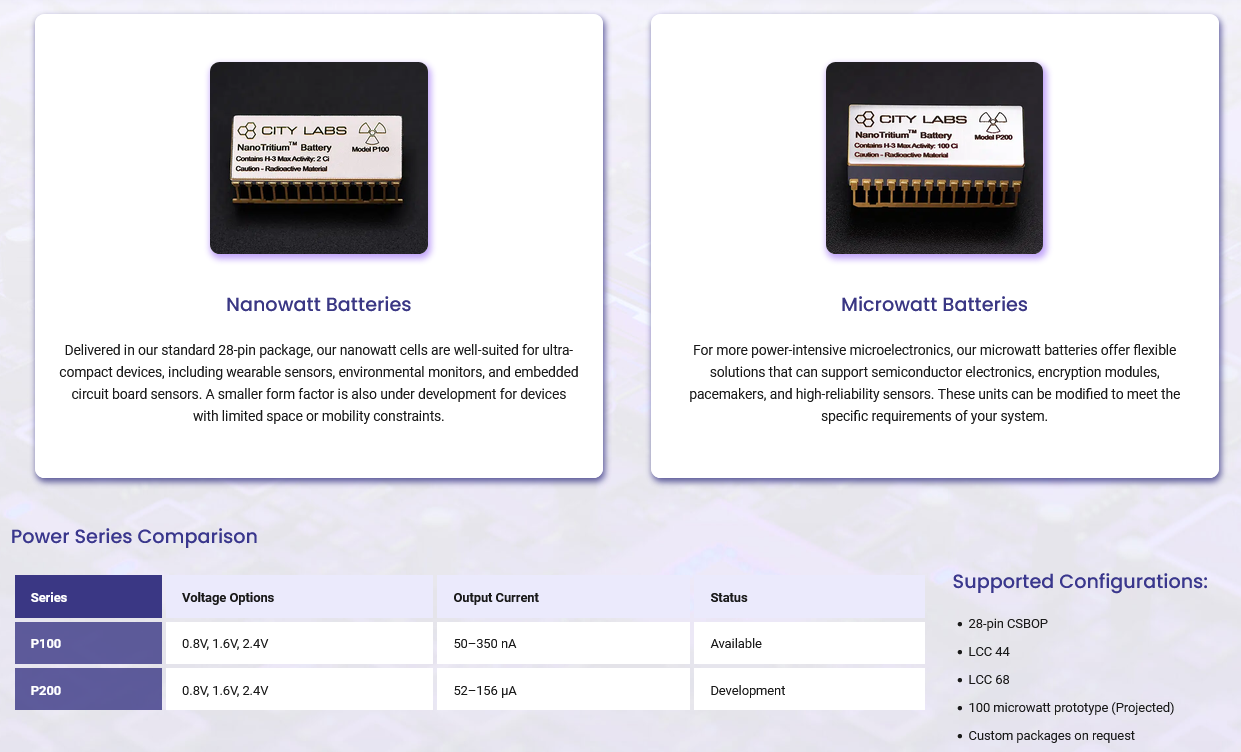
The output power of current NanoTritium batteries from City Labs is less than a microwatt. A microwatt battery is under development with 50x more power.
Presumably, they can chain 100's of them to reach 10's of milliwatts.
So, probably has niche applications that need continuous but low power.
So, not clear how they will scale up to 100's of kilowatts.
@AkaSci @sundogplanets I saw the announcement and thought: it is one of their BS stories to fleece uneducated investors and "stock analysts". Gets publicity, but in real terms it is meaningless.
@AkaSci @sundogplanets The Soviets used RTGs for a lot of uncrewed lighthouses. They’ve been the origin of a surprising (to me, anyway) number of orphan source events. Combined with more efficient light sources, this seems like it could be a much less risky option to replace them.
@AkaSci @sundogplanets so, the world's first antique pacemaker battery in space?
@AkaSci @sundogplanets city labs looks specialized to work with tritium though per their website, and they have a rather small crew, so yeah, it seems that if nuclear power does get used heavily in space it isn't going to come from these people
also, denser nuclear isotopes would probably be preferable from a power standpoint if you're moving from betavoltaics to a thermal system
"dense" isn't what i want to hear about re-entering debris, so hopefully, it ends here
@AkaSci @sundogplanets RTGs also throw out a lot of waste heat relative to their electricity generation. Handy for a space probe heading to the outer solar system, less great for a satellite already requiring a lot of cooling. So this actually seems useful in some realms but I can’t see this as anything SpaceX would use in one of their satellites.
@AkaSci @sundogplanets
They can't!
It's very weak radiation.
You'd need to scale up x200,000,000,000 to get about 100 kW.
They used to tritium with phosphor in tiny tubes for watch back lights as it's much safer than radium. The phosphor on the radium wears out while the radium is still dangerous.
Plutonium is much better for power, but not in orbit due to extreme toxicity/radiation.
Nuclear in orbit makes no sense. Sunlight + batteries is cheap & safe.
How do you cool a data centre in space?
@sundogplanets
NASA has plans to use tritium batteries at microwatt power levels for microsensors on the moon.
https://www.nasa.gov/general/autonomous-tritium-micropowered-sensors/
@sundogplanets RIP
@sundogplanets
Of course, Canada knows a thing or 2 about the risks nuclear powered satellites pose.
https://en.wikipedia.org/wiki/Kosmos_954
Let me guess he’s going to power his data center with nuke.
Now they need to figure out how to radiate the energy.
@sundogplanets
Um, it's tritium. Timex used it to make the hands of a wristwatch glow in the dark back in the 70's, and it's still used in watches and other consumer goods today
It's a beta emitter, with a short half-life, so it's not really dirty bomb material.
This is in no way a defense of SpaceX/StarLink's abuse of LEO, but most of the materials on any satellite are more damaging to health when they burn up than tritium is, and tritium is lighter than air (it's heavy hydrogen, after all), so is one of the few things that won't come down.

@RealGene @sundogplanets did you read the whole post even
@sundogplanets
Tritium has a half-life of 12ish years and, more importantly, the beta particles (electrons) can only travel a fraction of an inch in air and cannot penetrate the dead layers of your skin.

@virtuous_sloth @sundogplanets I was going to ask about it: what happens when this satellite fell back to Earth.
I am Brazilian and we had a huge accident with cesium one or two years after Chernobyl