RE: https://mastodon.social/@esoastronomy/116844620404236120
Ok well maybe my hideous SpaceX million sat simulations *aren't* wrong. I just couldn't believe it was that bad. But yeah, this is pretty much what I get too.
RE: https://mastodon.social/@esoastronomy/116844620404236120
Ok well maybe my hideous SpaceX million sat simulations *aren't* wrong. I just couldn't believe it was that bad. But yeah, this is pretty much what I get too.
Both SpaceX & Reflect Orbital have filed with the US Federal Communications Commission for permission to launch.
Our response to the FCC, together with the UK’s Royal Astronomical Society and the International Astronomical Union, was based on this study 👉 https://www.eso.org/public/news/eso2607/
📹 F. Kamphues, ESO/M. Kornmesser
SpaceX plans to launch 1 million satellites for space-based data centres.
This diagram shows the satellites that would be visible above our VLT:
⚪ invisible satellites in Earth’s shadow
🟠 2000 satellites brighter than magnitude 7
🔴 200 satellites brighter than magnitude 5
2/4
📷 ESO/O. Hainaut
🚨 Beyond the limit 🚨
New ESO study finds that current proposals to launch 1.7+ million satellites into orbit would have devastating consequences for astronomy.
The most extreme proposals come from SpaceX & Reflect Orbital
1/4
📷 F. Kamphues, ESO/M. Kornmesser
#astrodon #astronomy #astrophysics #space #science #environment #pollution
Happy Canada Day! I really shouldn't complain about too much rain while others are in severe drought and catching fire, but wow there are mushrooms everywhere and I am starting to worry about hoof-rot in my goats. It feels more like Vancouver winter than Saskatchewan summer...
If you live in Canada, you are living on Treaty land or unceded Indigenous land. Here's one program helping settler landowners like me share their land in the original spirit of the treaties: https://treatylandsharingnetwork.ca/
Orbital spaceflight missions to watch for in July 2026 (w-firm dates)
1-CASC/Long March-4C/Jiuquan/Unk
1-SpaceX/Falcon-9/VSFB/Starlink Group 17-46
2-Northop/Katalyst/PegasusXL/Marshall Is. Range/Swift Rescue Mission
2-ULA/Atlas-V/Cape/Amazon LEO(LA-08)
2-CASC/Long March-8A/Wenchang/Unk
3-SpaceX/Falcon-9/Cape/Starlink Group 10-50
4-CASC/Long March-6A/Taiyuan/Unk
7-SpaceX/Falcon-9/VSFB/Transporter-17
9-SpaceX/Falcon-9/Cape/Starlink Group 10-42
10-CASC/Long March-10B/Wenchang/Demo
10-SpaceX/Falcon-9/VSFB/Starlink Group 17-48
13-SpaceX/Falcon-9/VSFB/Starlink Group 15-14
14-Roscosmos/Soyuz/Baikonur/Soyuz MS-29
17-Rocket Lab/Electron/Mahia/Loxsat-1
The NSF-DOE Vera C. Rubin Observatory at Cerro Pachón in Chile commenced science operations today.
Over the next 10 years, the Rubin Observatory will take hundreds of images of the Southern Hemisphere sky, every night, for a survey called the Legacy Survey of Space and Time (LSST) and create the most comprehensive, cinematic record of the Universe in history.
https://rubinobservatory.org/news/action-rubin-lsst-begins
Check out these earlier threads for more info -
https://fosstodon.org/@AkaSci/114150485502312076
https://fosstodon.org/@AkaSci/114731082323927544
1/n
Does anyone have good recommendations f resources for book authors to learn about book publishing contract basics? #WritingCommunity #amWriting
Just in case collisions in orbit aren't depressing enough, here's a super excited, cheery article with so many incredibly enthusiastic quotes from many astronomers about the start of full operations for the Vera Rubin Observatory! And I got to provide the doom-quote about satellites causing serious loss of data (I also provided lots of excited, enthusiastic quotes about science! But doom-quote won I guess...) https://skyandtelescope.org/astronomy-news/vera-c-rubin-observatory-begins-its-long-awaited-all-sky-survey/
SpaceX is owned by the richest dude in the world, a demonstrably horrible person. And SpaceX effectively controls orbit right now.
There are also dozens of other companies planning to launch even more satellites into already-crowded orbit. (Another company I've never heard of just filed today for another 100,000 satellites https://spacenews.com/orbital-files-plans-for-100000-orbital-data-centers/. Fuck.)
Our future ability to make use of incredibly beneficial satellites is entirely in the hands of selfish, horrible billionaires.
The Conversation article above describes a collision scenario more in detail. It takes months to catalogue new debris from collisions, and in the the mean time, additional collisions can happen. That potential collisional runaway is the Kessler Syndrome, the worst-case scenario in orbit (explainer here: https://theconversation.com/too-many-satellites-earths-orbit-is-on-track-for-a-catastrophe-but-we-can-stop-it-275430)
The CRASH Clock is not a countdown to Kessler, but any major collision in orbit, especially in Starlink's super-dense orbit, will be an extremely bad day.
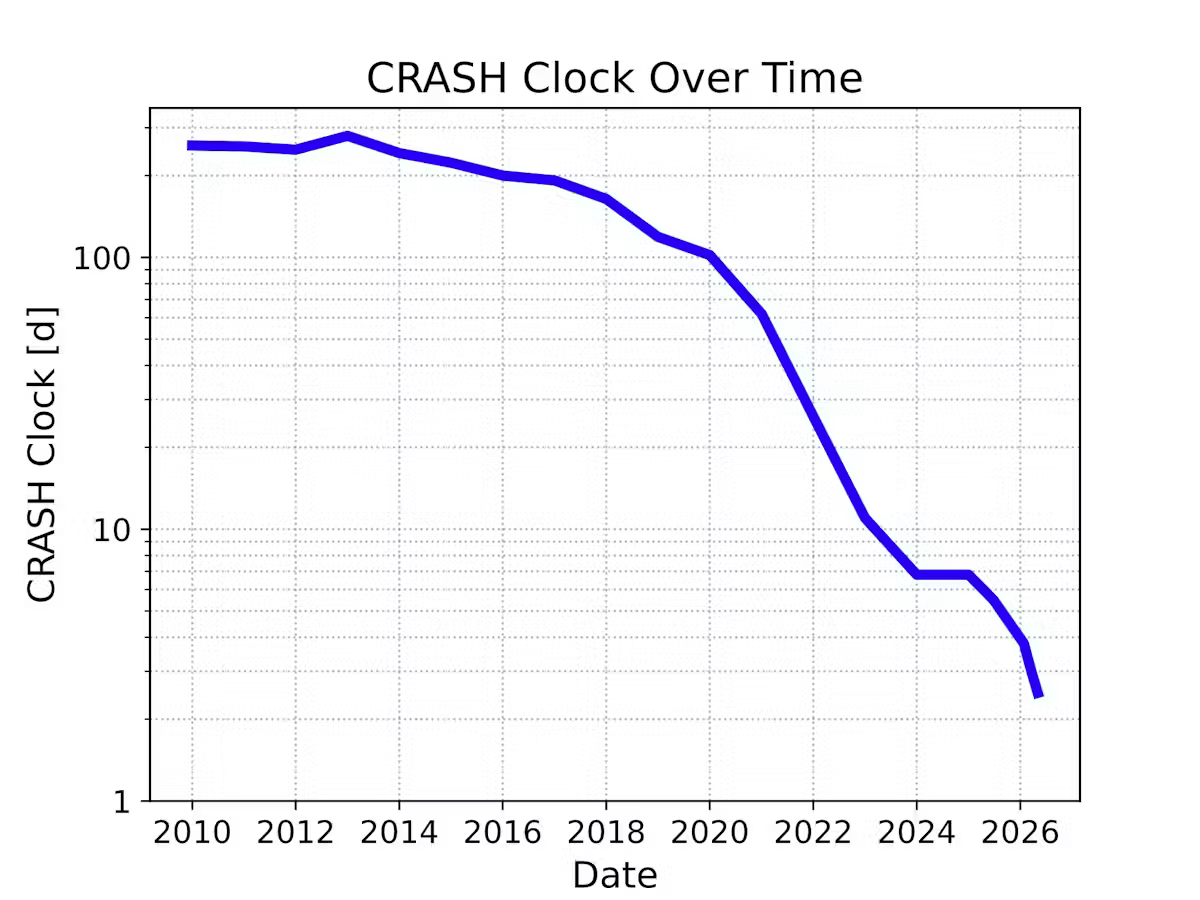
We originally wrote this paper nearly a year ago. As of last June, the CRASH Clock was at 5.5 days. It's now down to 2.5 days. It was 168 days in 2018, pre-Starlink.
It just keeps dropping as we launch more satellites into orbit.
This metric shows how completely dependent we are on continued perfect operations in orbit. 2/3 of all satellites today are Starlinks, and they performed 300,000 collision-avoidance maneuvers last year. They have done it perfectly so far. How long can that continue?
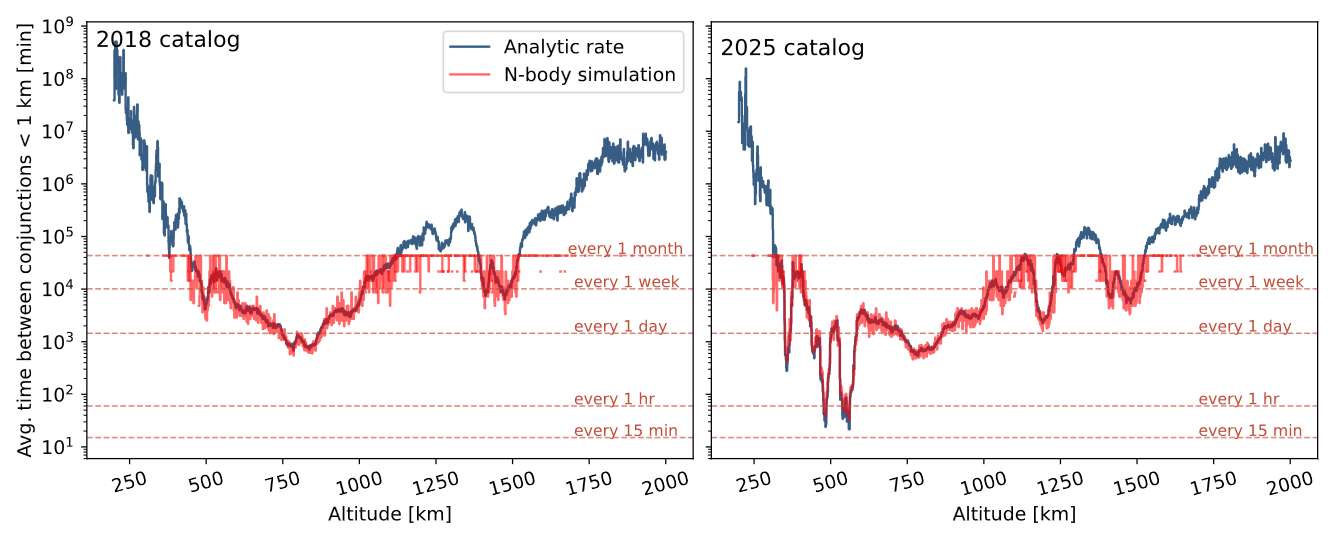
The CRASH Clock (which is an acronym, I apologize deeply) is our metric for how dangerous orbit is. We download real orbits for everything (satellites, rocket bodies, tracked debris) and calculate how long it would be for a collision to occur if no orbital maneuvers happen.
This is a worst-case calculation. What if everyone suddenly lost control due to a solar flare, a bad software update, or someone hacking Starlink? How long do we have to regain control?
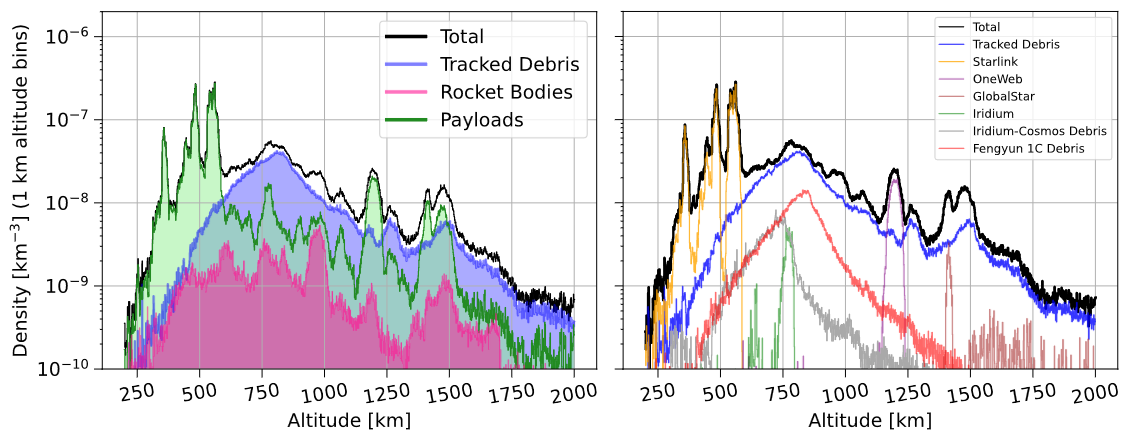
Everything in Low Earth Orbit is travelling at essentially the same speed. So you can take this density plot, and turn it in to a close encounters plot. The heart of the paper is doing that calculation in two different ways, one analytic, and one numerical.
In Starlink's orbit, the densest part of orbit, close encounters closer than 1 km happen every half hour or so. 1km sounds like a large distance, but remember the speeds are 7 km per SECOND. That is scary-close.
This paper took forever to publish. All the co-authors are astronomers, so we initially started with astronomy journals, and they didn't like it. Not astronomy-enough, I guess. So we tried a space journal instead. Here's the article from Acta Astronautica: https://www.sciencedirect.com/science/article/abs/pii/S0094576526004091
And here's the non-paywalled version on the arXiv: https://arxiv.org/pdf/2512.09643
You may remember I wrote a bunch about this months ago when we first put it on the arXiv. Now it's peer-reviewed, and officially DONE.
The CRASH Clock paper is now peer-reviewed! So to celebrate, my co-authors and I wrote an explainer article (because how better to celebrate one article than by writing another... oh academia...)
It's now published in The Conversation Canada: https://theconversation.com/a-new-crash-clock-measures-the-chance-of-satellite-collisions-and-its-ticking-down-fast-283481
Daily intersectional reminder that restrictions on certain groups of women are restrictions on all of us. A ban on trans girls in sports puts every woman’s womanhood and girl’s girlhood up for public critique: Are your shoulders too wide? Or your forehead too large? Are you too tall? Or maybe too muscular?
Time and time again, these bans work as restrictions on the types of femininities and bodies which are seen as women, and most often they deny the womanhood of queer women and women of color.
Dang I drive into town for the morning to get the new astronomy department outreach telescope from campus, and my email is just exploding with things I should share.
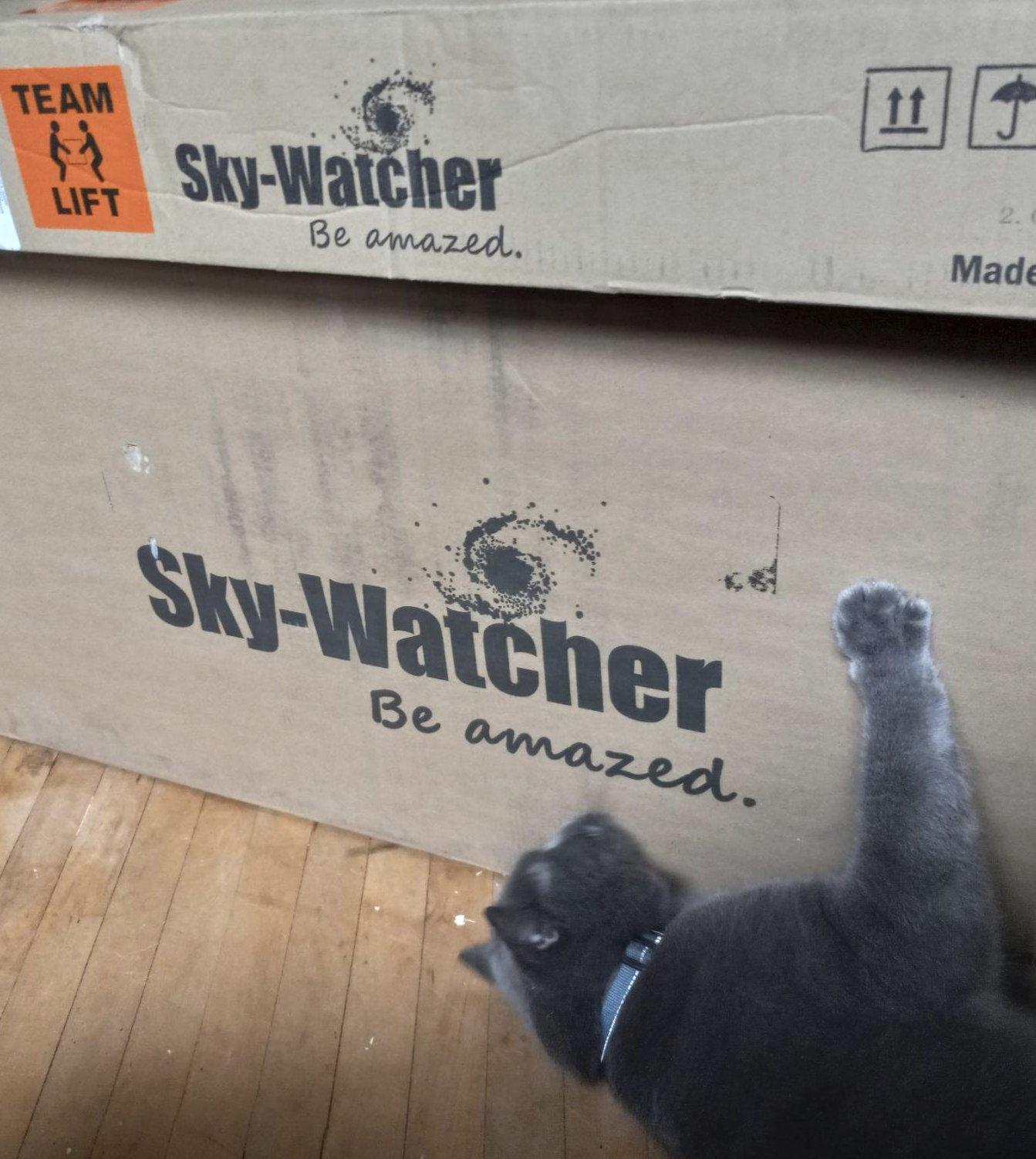
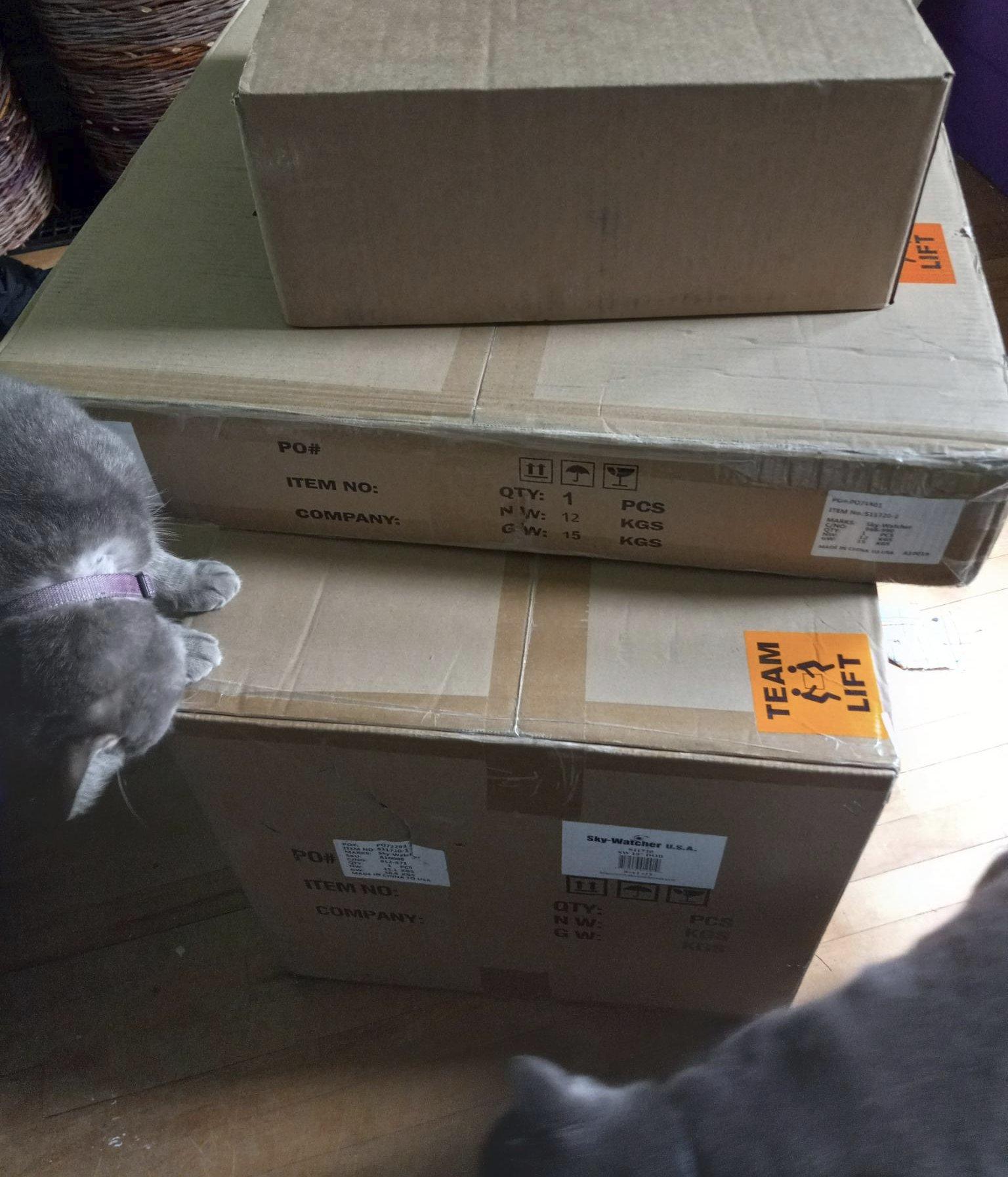
But first, my cats seem very excited about the telescope. However, I have a strong suspicion that they are only interested in the boxes...
I had a stretch goal of getting the telescope assembled today, and setting it up on a friend's front lawn for solar viewing for anybody who's interested before and after the small town Canada Day parade tomorrow, but it's looking like 100% clouds all day...