Login
You're viewing the fosstodon.org public feed.
  • Nov 14, 2026, 6:03 PM

    been reading "how complex systems fail" by richard cook, 18 short points from a doctor who studied why things break in hospitals. it was written in the late 90s and it reads like a postmortem of every outage i've ever been part of.

    the one that hit me: there's no such thing as a root cause. catastrophe needs several small failures lining up, each harmless on its own. "root cause" is mostly our social need to point at someone. yesterday the us grounded every flight for hours and the official answer was "old equipment." sure. and also everything else that quietly had to go wrong at the same time.

    my other favorite: complex systems always run in degraded mode. everything is a little broken all the time, and it works because people keep patching it on the fly. that's not a bug report, that's my homelab's biography.

    the uncomfortable takeaway is that safety isn't a part you buy. it's something people create every day, and the "fix" after an accident usually just adds more complexity for the next one.

    https://how.complexsystems.fail/

    #complexsystems #sre #safety #systemsthinking

    💬 41🔄 318⭐ 11

Replies

  • 💬 2🔄 0⭐ 2
  • Nov 14, 2026, 6:35 PM

    @ezrasf man, it took me a few minutes and a bit of googling to figure out “channeling your inner.” then the handle clicked. i’d blame my english for the delay, but that would mean settling on a single root cause. 😄

    💬 1🔄 0⭐ 0
  • Nov 15, 2026, 12:41 PM

    @pablo my bad, I saw your post in English and made assumptions about your exposure to American expressions

    💬 0🔄 0⭐ 0
  • 💬 0🔄 0⭐ 0
  • 💬 0🔄 0⭐ 2
  • Nov 14, 2026, 8:17 PM

    @pablo I like this thread, thanks. I was thinking that small-c communities keep systems going all the time, and breakdowns might occur where communities and trust fail.
    💬 0🔄 1⭐ 4
  • 💬 0🔄 0⭐ 5
  • 💬 0🔄 0⭐ 3
  • 💬 1🔄 0⭐ 0
  • Nov 15, 2026, 12:25 AM

    @Workshopshed i’m familiar with it, but i’ve only skimmed it. one thing i’m curious about: were there any cases where someone spotted the chain forming in real time? it’s always easier to see how the pieces fit together after you know the ending.

    💬 1🔄 0⭐ 0
  • Nov 15, 2026, 10:47 AM

    @pablo I think there were cases where the test pilots highlighted things which were either fixed or more commonly, not, to deviating results

    💬 0🔄 0⭐ 0
  • 💬 0🔄 0⭐ 0
  • 💬 0🔄 0⭐ 1
  • 💬 1🔄 2⭐ 1
  • 💬 0🔄 0⭐ 0
  • Kynx
    Nov 15, 2026, 12:38 AM

    @pablo I think I read this first after an upgrade I’d written for a legacy system started sending client shipments to seemingly random addresses. It took a week to sort. That was two decades back. I’ve learnt, the industry hasn’t.

    But there _is_ a root cause in most cases. It has a name like Nadella or Duffy. With the latter it’s not old copper, it’s not a dodgy contractor. It’s not even the AI rollout. It’s the man at the top. Duffy by name, Duffy by nature.

    💬 0🔄 0⭐ 1
  • Nov 15, 2026, 1:47 AM

    @pablo

    In aviation, accident investigators frequently refer to the "swiss cheese" model. Fly though one hole in the cheese, and you'll likely survive. Two holes line up, and your chances go down. Once several holes have lined up - typically none of them a major failing of aircraft, pilot, airport, etc - and you're doomed. After that, every decision becomes life or death with no remaining margin for error. The NTSB's job is identifying each of the contributing holes.

    💬 0🔄 0⭐ 6
  • GinkgoGiantGinkgo@mstdn.party
    Nov 15, 2026, 1:53 AM

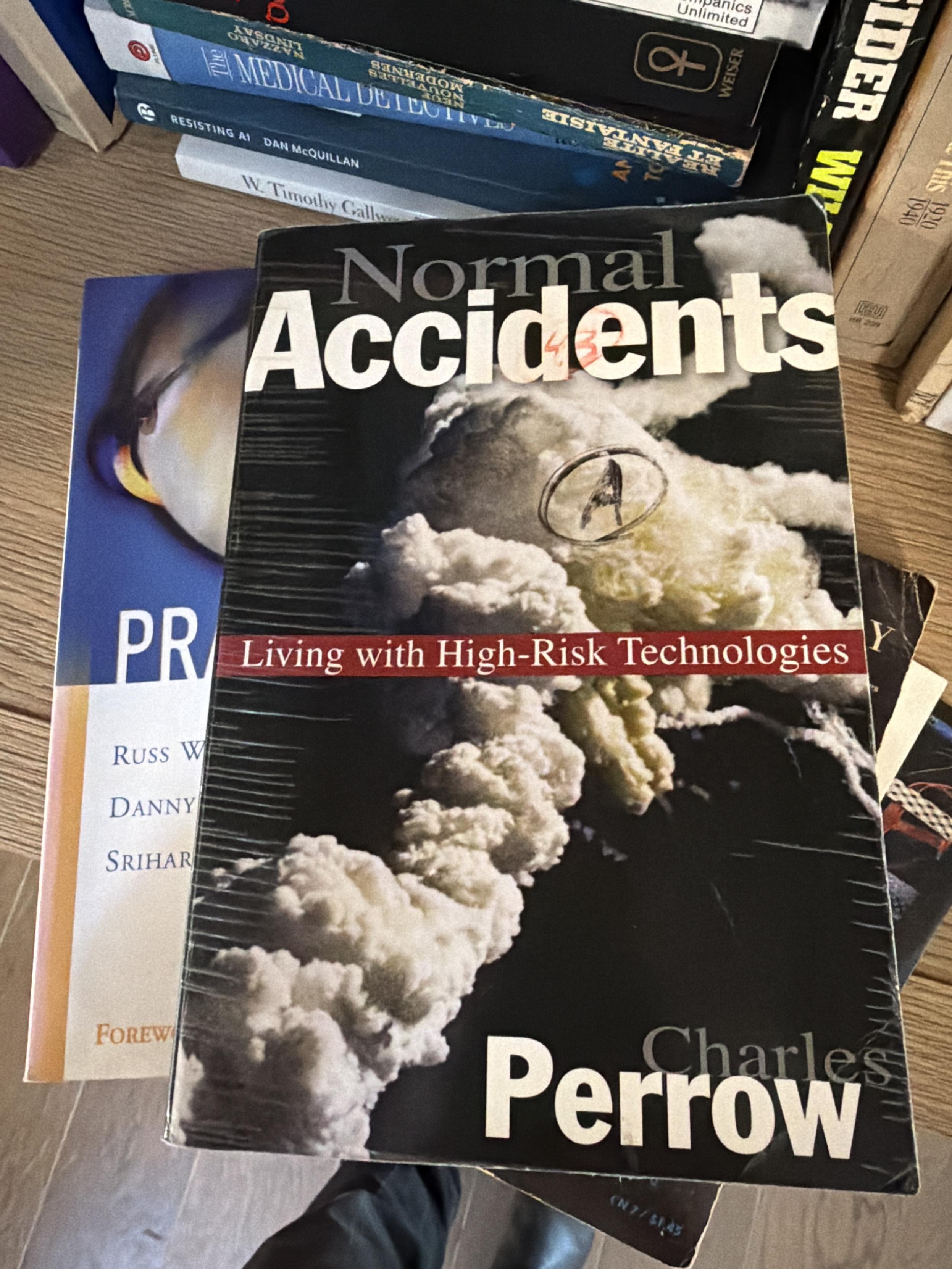
    @pablo I recommend: “Normal Accidents: Living with High-Risk Technologies” by Yale sociologist Charles Perrow, which analyses complex systems from a sociological pov. "Normal" accidents, or system accidents, are inevitable in extremely complex systems. Multiple failures that interact with each other will occur, despite efforts to avoid them. 3 conditions make a system likely to be susceptible:
    • The system is complex
    • Is tightly coupled
    • Has catastrophic potential
    en.wikipedia.org/wiki/Normal_A

    💬 0🔄 0⭐ 3
  • Nov 15, 2026, 2:57 AM

    @pablo

    I agree with all that and would add that, somewhat tangentially, this is a fairly comprehensive argument in disguise for why the "trolley problem" is a totally useless mental experiment.

    It places moral analysis on a single actor in a complex system in an entirely ridiculously contrived scenario.

    💬 0🔄 5⭐ 11
  • Nov 15, 2026, 2:57 AM

    @pablo @misty oh, is this where “complex systems always run in degraded mode” comes from? It has been a tenet of my design philosophy but i could never find the source for my colleagues!

    Somehow i haven’t read the book yet. Added to my list.

    💬 1🔄 0⭐ 3
  • 💬 1🔄 1⭐ 0
  • 💬 0🔄 0⭐ 0
  • Nov 15, 2026, 2:57 AM

    @pablo A few years ago, we had a runner die out in the wilderness from heat stroke, and, yeah, there were several things he did badly, any of which would probably have kept him alive had he done it differently. It’s almost always a cascade…

    💬 0🔄 0⭐ 1
  • 💬 1🔄 0⭐ 1
  • 💬 0🔄 0⭐ 0
  • Nov 15, 2026, 3:29 AM

    @pablo
    Thank you for posting this. I’ve read “How complex systems fail” several times, but not often enough!

    I just set a repeating reminder to read it again every five years.

    💬 0🔄 0⭐ 1
  • Nov 15, 2026, 4:12 AM

    @pablo I always thought a proper root cause analysis should (aspire to) find all the factors that contributed to the situation. That is to say, just because we use the phrase "root cause" doesn't mean there's only one.

    Then again people certainly do love to find somebody to blame....

    💬 0🔄 0⭐ 2
  • Nov 15, 2026, 4:48 AM

    @pablo Heh heh heheh why would we be talking about this tonight it’s not like any complex systems are failing right now <extreme nervous laughter>

    💬 0🔄 0⭐ 0
  • Nov 15, 2026, 9:44 AM

    @pablo a belief I hold, which I’ve not had reason to change, but I’m open to changing, is that a lot of “complexity”, especially in software systems, is not necessary and can be engineered out. It’s not generally cheap or easy to do that, and not all can be removed, but there is latitude to choose and reduce complexity.

    … for me, a cause is “we didn’t do that. we lived with continuous heightened complexity.” That might be a rational choice, but I think it is a choice, and I’d like it to be acknowledged more often.

    💬 1🔄 2⭐ 2
  • Nov 15, 2026, 3:24 PM

    @benjohn @pablo entirely circumstantial but it seems to me like the only places this works is where there’s a benevolent dictator making those tradeoffs, keeping the thing afloat.
    💬 0🔄 0⭐ 0
  • 💬 0🔄 0⭐ 0
  • 💬 1🔄 0⭐ 0
  • 💬 1🔄 0⭐ 0
  • 💬 0🔄 0⭐ 0
  • 💬 0🔄 0⭐ 0
  • 💬 0🔄 0⭐ 0
  • 💬 0🔄 0⭐ 0
  • 💬 0🔄 0⭐ 0
  • 💬 0🔄 0⭐ 0
  • Nov 15, 2026, 2:27 PM

    @pablo "... complex systems always run in degraded mode. everything is a little broken all the time, ..."
    Absolutely true. 30% of my job is spreading the message that fast detection and remediation of problems is even more imporatnt than testing to make sure everything is perfect before release.

    💬 0🔄 0⭐ 1
  • 💬 0🔄 0⭐ 0
  • 💬 0🔄 0⭐ 1
  • Nov 15, 2026, 3:51 PM

    @pablo There is no doubt in my mind that the FAA issue was an intentional system failure. Who would install new software on a nationwide system on a Friday afternoon without a backup in place unless they knew what would happen. Then they could spend more taxpayer $ to hire a company who gave a contribution to Duffy's son-in-law. Or they could blame Biden and dump the whole mess on the incoming Dems.

    💬 0🔄 0⭐ 0
  • Nov 15, 2026, 4:09 PM

    @pablo Thanks - that's a very compact and insightful assessment. Building and maintaining "safety culture" is a vital part of keeping people engaged and resilient. While this is aimed specifically at powerplant staff, most is generally applicable and worth a look nrc.gov/docs/ML1303/ML13031A70 [INPO 12-012 Traits of a Healthy Nuclear Safety Culture]. One trait I keep coming back to is Respectful Work Environment.

    💬 0🔄 1⭐ 3
  • Nov 15, 2026, 5:23 PM

    @pablo “complex systems always run on degraded mode. everything is a little broken all the time, and it works because people keep patching it on the fly.”

    This is the key insight behind what is now called Safety-II Thinking. Lots of excellent research in the safety community over the last couple decades; still diffusing its way through various industries and subcultures, but it’s a real game-changer.

    💬 0🔄 0⭐ 0
  • 💬 0🔄 0⭐ 0
  • Nov 15, 2026, 8:19 PM

    @pablo Feeling a bit of synchronicity because I read an article about the European medieval conception of clockwork not as a fully autonomous operation but one that requires constant maintenance and adjustment, and what this implied about cosmology, the social positioning of maintenance work, etc. jhiblog.org/2026/10/19/clockwo I also posted a cliff notes thread of extracts: writeout.ink/@ljwrites/1175128

    💬 0🔄 1⭐ 0
  • Nov 15, 2026, 8:21 PM

    @pablo At the risk of being so simplistic I'm reductive, this is why I want appliances with no bells and whistles. (Screw you, refrigerators with ice dispensers.) Smartphones, which so many of use as all-in-one entertainment systems, actually perform better than they should given all of the different file types they're asked to support. That, or we've become grateful for semi-functional garbage.

    💬 0🔄 0⭐ 1
  • Nov 15, 2026, 10:47 PM

    @pablo To that last paragraph: Working at a large web hosting outfit I learned that in order to run a service continuously without change for a large number of users, there was constantly something that needed to be done, all the time. And then the changes, of course, new features, new products, all that, but even without those, a lot to do, silently in the background, without the customers noticing. Even complete platform migrations.

    They may have noticed, though, that the customer web application database performance improved significantly over time with a new platform, better storage, and tighter control of comment spamming and stupid db-stressing applications. I created so many table indexes by hand that stupid Wordpress and others didn't, and a colleague wrote and optimised a very clever POST request filter that recognised and blocked spam comments. All without obvious changes to the service provided.

    💬 0🔄 0⭐ 0
  • Nov 16, 2026, 10:07 AM

    @pablo The last point is the one I see most. Every postmortem ends with "add a check" or "add an approval step". I can't remember one that ended with "remove something".

    A year later the checks are the complicated part.

    💬 0🔄 0⭐ 0
  • Nov 16, 2026, 2:11 PM
    @pablo

    > everything is a little broken all the time, and it works because people keep patching it on the fly.


    So true 🫠
    💬 0🔄 0⭐ 0
  • 💬 0🔄 0⭐ 1
  • Nov 17, 2026, 1:00 PM

    @pablo A lot of time things that claim to be a "root cause analysis" stop just as the questions get interesting. Like, "Well, what went into the business decisions that led to this situation?"

    💬 0🔄 0⭐ 0
  • Nov 18, 2026, 8:04 PM

    @pablo
    Yup

    nearly all my life
    I suffered with the myth
    of the delusion of root-cause failure
    &
    it haunts me to this day

    💬 0🔄 0⭐ 0
  • Nov 19, 2026, 2:22 AM

    @pablo I think not understaffing and not firing everyone who knows what they are doing reduce your risk and frequency of failure. I am guessing that is either in the book, or only omitted because at the time nobody thought it needed to be pointed out.

    💬 0🔄 0⭐ 0