Login
You're viewing the functional.cafe public feed.
  • Nov 12, 2026, 12:22 AM

    its javascript.

    its because of javascript.

    its because we let js devs own all of computers.
    there wasnt enough js in the browser so they added more.
    there wasnt js on servers, so they made node
    there wasnt enough node, so they deploy it in fleets using k8s
    all that overhead for k8s plus running node plus more js in the browser

    💬 9🔄 6⭐ 0

Replies

  • Nov 12, 2026, 12:25 AM

    now we have ai writing javascript.
    and its really really bad, and horribly inefficient.
    we are collectively firemarshall bill here

    Image attached toot
    💬 4🔄 1⭐ 0
  • 💬 5🔄 10⭐ 37
  • 💬 1🔄 0⭐ 3
  • 💬 2🔄 0⭐ 6
  • Nov 12, 2026, 2:45 AM

    @drwho @Viss @dbendit you've 219 minutes left right now, whatcha doing with it?

    Me? Gonna finish pooping; take a shower, and spend it chatting with my wife, and asking her the same question.

    💬 0🔄 0⭐ 0
  • 💬 0🔄 0⭐ 1
  • 💬 0🔄 0⭐ 5
  • 💬 0🔄 0⭐ 3
  • 💬 0🔄 0⭐ 7
  • 💬 1🔄 0⭐ 8
  • Nov 12, 2026, 2:05 AM

    @Viss I suppose the industrialization of being confidently wrong with LLMs probably didn't help either but this is a JS thread lol

    @dbendit

    💬 0🔄 0⭐ 3
  • Nov 12, 2026, 2:14 AM

    @dbendit @Viss I was going to say, not just "JavaScript" but very specifically it's React that is the biggest everything that is wrong with the modern web.

    On the one hand its defaults are insanely bad performance, and on the other hand how something so bad can be the dominant stack speaks loudly of underlying problems in technology that, even if JavaScript ceased to exist tomorrow, something else would go horribly wrong because making it better isn't a priority for corporations/capitalism.

    💬 0🔄 0⭐ 3
  • 💬 0🔄 0⭐ 3
  • Nov 12, 2026, 1:05 AM

    @Viss

    Old saw:

    As hardware gets smaller, faster & cheaper, software gets bigger, slower & more expensive.

    Yeah, everything has to be about lowering the bar for hiring, not raising the bar for education. The simplest languages win the popularity contest.

    💬 1🔄 0⭐ 0
  • 💬 1🔄 0⭐ 0
  • 💬 1🔄 0⭐ 0
  • 💬 0🔄 0⭐ 0
  • 💬 0🔄 0⭐ 0
  • Nov 12, 2026, 5:20 AM

    @Viss Is it JavaScript, or is it the 58 MB of minified scripts that the devs deem appropriate to load just to show me today’s winning lotto numbers

    💬 1🔄 0⭐ 0
  • 💬 0🔄 0⭐ 0
  • 💬 0🔄 1⭐ 0
  • 💬 0🔄 0⭐ 0
  • 💬 1🔄 2⭐ 0
  • 💬 2🔄 0⭐ 0
  • Nov 12, 2026, 1:12 AM

    @Viss

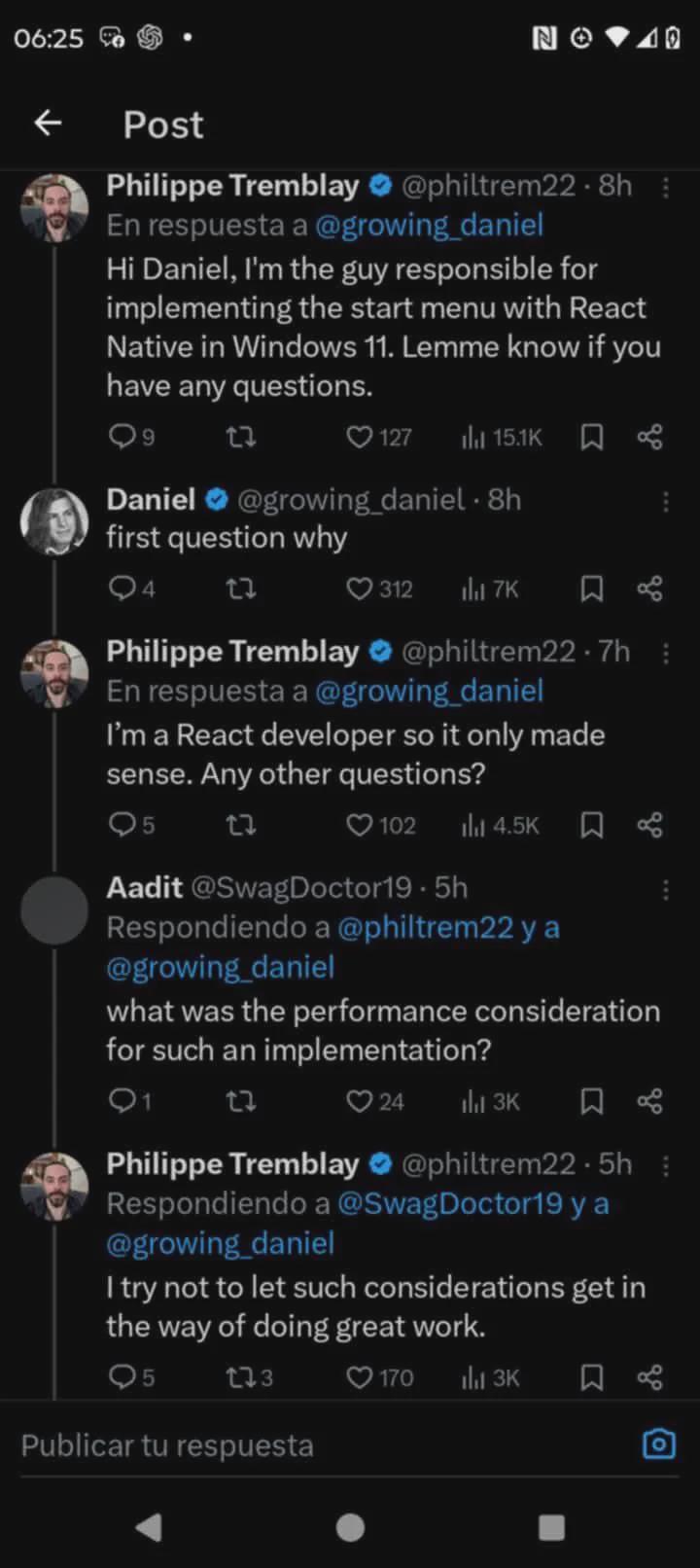
    No, I was mistaken, parts of it are React native, rather than actual Electron.

    Similar problems though, stupid CPU usage spikes, high RAM use for what is otherwise just a goddamn menu.

    💬 0🔄 1⭐ 0
  • 💬 0🔄 0⭐ 1
  • 💬 1🔄 0⭐ 0
  • 💬 2🔄 1⭐ 0
  • 💬 0🔄 1⭐ 3
  • 💬 0🔄 0⭐ 0
  • 💬 0🔄 0⭐ 0
  • Nov 12, 2026, 1:38 AM

    @Viss "You can write frontend and backend code in the same language, bro" is one of the biggest lies ever. Well, okay, you CAN do it, but OUGHT you? (Also, HTTP semantics still exist???)

    💬 1🔄 0⭐ 0
  • Nov 12, 2026, 1:38 AM

    @Viss Also frontend JavaScript and backend JavaScript are still different in terms of like... what they do?

    💬 1🔄 0⭐ 0
  • Nov 12, 2026, 1:41 AM

    @theorangetheme i mean, i guess? im not sure - i dont write node code or js code myself, but if node and js are like borland c++ and microsoft visual c++ they are functionally two completely different languages with the same name

    💬 1🔄 0⭐ 0
  • Nov 12, 2026, 1:46 AM

    @Viss The languages are the same, but various underlying libraries aren't. Rendering buttons and managing frontend state is different from processing form data and talking to databases. But that's the case with JavaScript and any backend language; I think the domains are different enough that the problem isn't that the languages are different, it's that each end has different concerns. Using JavaScript for both doesn't really help (imho).

    💬 1🔄 0⭐ 0
  • Nov 12, 2026, 2:09 AM

    @theorangetheme @Viss what the industry really needed was a language where type handling is performed by the local meth head to be used for interfacing with databases

    💬 1🔄 0⭐ 0
  • Nov 12, 2026, 2:11 AM

    @tehfishman @theorangetheme have you seen those videos where people try to do comparison operators to different bullshits in js and there is no rhyme or reason to why the answers are the way they are?

    💬 1🔄 0⭐ 0
  • 💬 0🔄 0⭐ 0
  • Nov 12, 2026, 4:10 AM

    @Viss because nobody could be bothered to write native code, we got a bunch of shitty javascript apps written for an emulator that is at its core google chrome, with ALL of the shit you don't really need in order to run the javascript application. Welcome to electron apps, have a nice day.

    Image attached toot
    💬 0🔄 0⭐ 0
  • 💬 0🔄 0⭐ 0
  • Nov 12, 2026, 4:41 AM

    @Viss instead of developing an app for a device they installed a browser that just loads JavaScript

    💬 0🔄 0⭐ 0
  • Nov 12, 2026, 4:51 AM

    @Viss Do you like having a terrabyte of unexplored supporting files from dubious sources? Try node!

    💬 1🔄 0⭐ 0
  • 💬 0🔄 0⭐ 0
  • Nov 12, 2026, 7:01 AM

    @Viss As a person who does a lot of security reviews. What gets me about JS is that you can work around the inadequacies of the language and write good, readable code.

    Most developers don't and end up in a rat's nest of anonymous functions that make brainfuck look readable.

    And the hell of trivial modules that are inserted because of laziness. One example I give of this is is-even. A module with nearly 500k weekly downloads that just does !is-odd().

    💬 0🔄 1⭐ 0
  • 💬 1🔄 0⭐ 0
  • 💬 1🔄 0⭐ 0
  • 💬 1🔄 0⭐ 0
  • 💬 0🔄 0⭐ 0
  • Nov 12, 2026, 11:44 AM

    @Viss

    It's absolutely not JavaScript. 20 years ago, I tried using interpreted Smalltalk to write GUI applications using native GUI libraries and they performed well. Modern JavaScript VMs are between one and two orders of magnitude faster than the Smalltalk interpreter I was using any my mobile phone is 2-8x faster than the desktop I was using then.

    I've recently been using embedded Lua for the business logic in things I've been writing. The Lua interpreter (not even LuaJIT) is a good order of magnitude slower than v8 or JSC, yet this isn't the bottleneck.

    The problem is JavaScript, it's that the JavaScript is poking the internal data model of a document-rendering program instead of being connected to a half-decent GUI library.

    💬 1🔄 0⭐ 0
  • Nov 12, 2026, 12:27 PM

    @david_chisnall Oh, interesting. So a kind of path dependency, that is, HTML and browsers being the established way to present stuff on "the internet", has lead us to build applications using a system that was intented to structure documents. Sorry for paraphrasing, I just need to process this thought.

    💬 1🔄 0⭐ 0
  • Nov 12, 2026, 12:57 PM

    @bjorndown

    To give a very concrete example: imagine you want users to be able to edit rich text, select, copy, and paste in that.

    On macOS, I would use an NSTextView. This class was part of the 1994 OpenStep specification and the 1994 functionality is most of what I want. Around 20 years ago, Apple also added spell checking as you type and a few other things. My interface to this is an object that implements the NSText protocol. Typically, unless I'm building something very complex, that's an NSMutableAttributedString. An attributed string is a class that wraps a string (the default NSMutableString won't have any problem for things under a few tens of thousands of characters, but you can plug in one more optimised for your use case if you want) and associates attributes with ranges.

    The text view has some built-in shortcuts for things like bold and italic and for popping up a font dialog. It also has APIs for letting you control the current font from typing. You can get notifications on changes (after finishing editing, or after each character is typed). If you want to do something like parse a source file with some language parser that you've written, it's very easy to have a first pass that goes and attaches semantic attributes to the nodes and then a second that maps semantic attributes to fonts. You also have fine-grained control over things like hyphenation algorithms, grapheme cluster to glyph mappings, and so on. Again, almost all of that has been there since 1994.

    In contrast, in the web, you have to build a load of this yourself. There's no standard rich-text editing view. You have to build something that takes keypresses and modifies the DOM. Copy works okay, but if you want paste then that's additional custom stuff that you have to do. Take a look at how some rich-text editing views work and you'd be horrified: they do things like render plain-text editing controls underneath styled text so that they can capture input.

    The problem is not really the technology, it's the market shape. On OS X / macOS, there's a company that ships the widget set and everything below it. Users wanted the red squigglies for underlining so Apple added that to NSTextView, along with a dictionary service that let apps use either a shared dictionary or a per-application one depending on the use case. Every app benefitted from that. Similarly, in early OS X, scrolling in NSTextView was a bottleneck, but it wasn't NSTextView's fault: it delegated to CoreGraphics for putting glyphs on the screen and each glyph was a set of bezier paths that needed rendering with antialiasing. This was all done on the CPU. If you scrolled, the CPU would have to render tens of thousands of small antialiased beziers. So Apple added a caching layer on the GPU (with a silly name: Quartz 2D Extreme!). Now the CPU rendered each glyph once per font / size that's in use and this went in a texture. CoreGraphics managed that caching layer and the render-glyph routine became an instruction for the GPU to render a region from the texture into the window's buffer. Even low-end GPUs at a time could do tens of millions of pixels a second of compositing, so this was very fast and meant the CPU was doing less so the other things were not as squeezed for CPU time.

    Imagine today the same requirement coming from the maintainers of, say, a React rich text editing control. They need the browser vendors to provide the feature. The browser vendors need the OS / windowing system vendors to provide the underlying functionality. By the time the platform people get the requirements, they're filtered: it's not 'what does the user want to be fast'. They can't say 'actually, we have this different API that lets you render text really nicely, but even if you exposed it in the browser, the way that this rich text control is written couldn't use it, you should change it like this', yet that's exactly the kind of bidirectional feedback that made these things fast on OS X (Windows was a bit weird in this respect because the Office team had their own widget set and didn't like Windows shipping things that made it easy to compete with Office).

    It's a common problem in our industry: people at one layer in a stack build things to work around limitations in the layer below. People working on the lower layer then use those things to determine what they should optimise for. So you get local optimae where the new version of the platform is very efficient at implementing the unfortunate pattern that a previous version of the platform forced users to adopt.

    And none of this is JavaScript's fault.

    💬 0🔄 0⭐ 0