Login
You're viewing the functional.cafe public feed.
  • Nov 6, 2026, 6:23 AM

    I wanna talk about the political movement of the Open Source community. If you spend enough time on fedi, you surely will have heard *plenty* of criticisms of what's going on in Open Source, and rightfully so.

    So I'm curious, what do we think the Open Source community *should be doing* in order to achieve important progressive and anti-authoritarian goals? What should the next generation of programmers be thinking of and working on in this space?

    A special rule: You're only allowed to say "don't X" if you have at least as many "do Y" recommendations. Preferably, I'd like to see more do's than don't's.

    Boosts welcome :cyber_boost_request:

    #tech #openSource #FOSS #progressive #programming #askFedi

    💬 56🔄 181⭐ 131

Replies

  • Nov 6, 2026, 6:33 AM

    Here, I'll start with something (perhaps I may share more later, too):

    Developers need to listen to their users, especially when it comes to UX.

    There was a tendency in the old school of open source in which programmers kind of had this attitude that "if you don't wanna learn how to be a terminal wizard, you deserve to be spied on by Facebook" because you don't know what PGP is. Or that if a user thinks Linux apps are hard, the response was often to scoff and tell them to "git gud", instead of actually just making the program easier to use.

    I'd like to see developers more and more accepting the idea that in order to make a real impact, we're going to need to develop things that can actually be used by a general audience.

    💬 2🔄 16⭐ 76
  • Nov 6, 2026, 7:24 AM

    Okay, another:

    Focus on community. Foster online community.

    Create easily searchable references on the web. Not just documentation, but also forums and wikis. Make it so when somebody pastes an error message, they can immediately find a page where people are working through sorting that issue. Don't make them join your stupid Discord (you can't search the web for Discord messages!!)

    Actively encourage users to ask simple, easy questions, simply as a way of getting them used to asking questions. Ban the phrase RTFM ("Read the friendly manual", except we all know the F secretly doesn't actually stand for "friendly"). Don't dismiss users who "didn't do enough research before asking" -- many of them may not have known what to look up because they're so new to all of this. It's easy to be blinded by your own competence that you forget what it's like to be a newbie. That's not to mention how dreadful online search has become nowadays.

    I also suppose it goes without saying that you need to police and moderate your communities, and be explicitly welcoming to marginalized communities by being anti-racist, anti-transphobic, etc. This needs to be the No Bigots Club.

    💬 4🔄 20⭐ 57
  • Nov 6, 2026, 7:11 AM

    special awards section for folks who can talk about projects that ought to exist but don't (or they do exist, but they aren't properly serving the need that exists because of some design failure or similar).

    💬 1🔄 2⭐ 15
  • Irisiris_meredith@mastodon.social
    Nov 6, 2026, 6:31 AM

    @riverpunk
    I'd really like them to work a hell of a lot more closely with domain experts, I think. Librarians, social workers, union activists, journalists... the people who are important in maintaining a robust civil society.

    💬 2🔄 6⭐ 43
  • Nov 6, 2026, 6:36 AM

    @iris_meredith that makes sense.

    Do you mean in particular when it comes to software *about* those domains (e.g. tools for union organizing need to be made by people who are working with real union organizers), or are you making a broader point here?

    💬 0🔄 0⭐ 5
  • Irisiris_meredith@mastodon.social
    Nov 6, 2026, 6:47 AM

    @riverpunk
    I think that I want them to both do what you suggest and to *do more of that work in the first place*. I think there's a degree to which the OSS community engages in, to phrase it in a vulgar way, a lot of jerking themselves off. The world has a sharply limited demand for Kubernetes derivatives

    💬 1🔄 0⭐ 8
  • 💬 0🔄 0⭐ 4
  • Nov 7, 2026, 7:16 AM

    @riverpunk @iris_meredith

    I should really write that blog post on SOSS at coding.social but lack the time. 😔

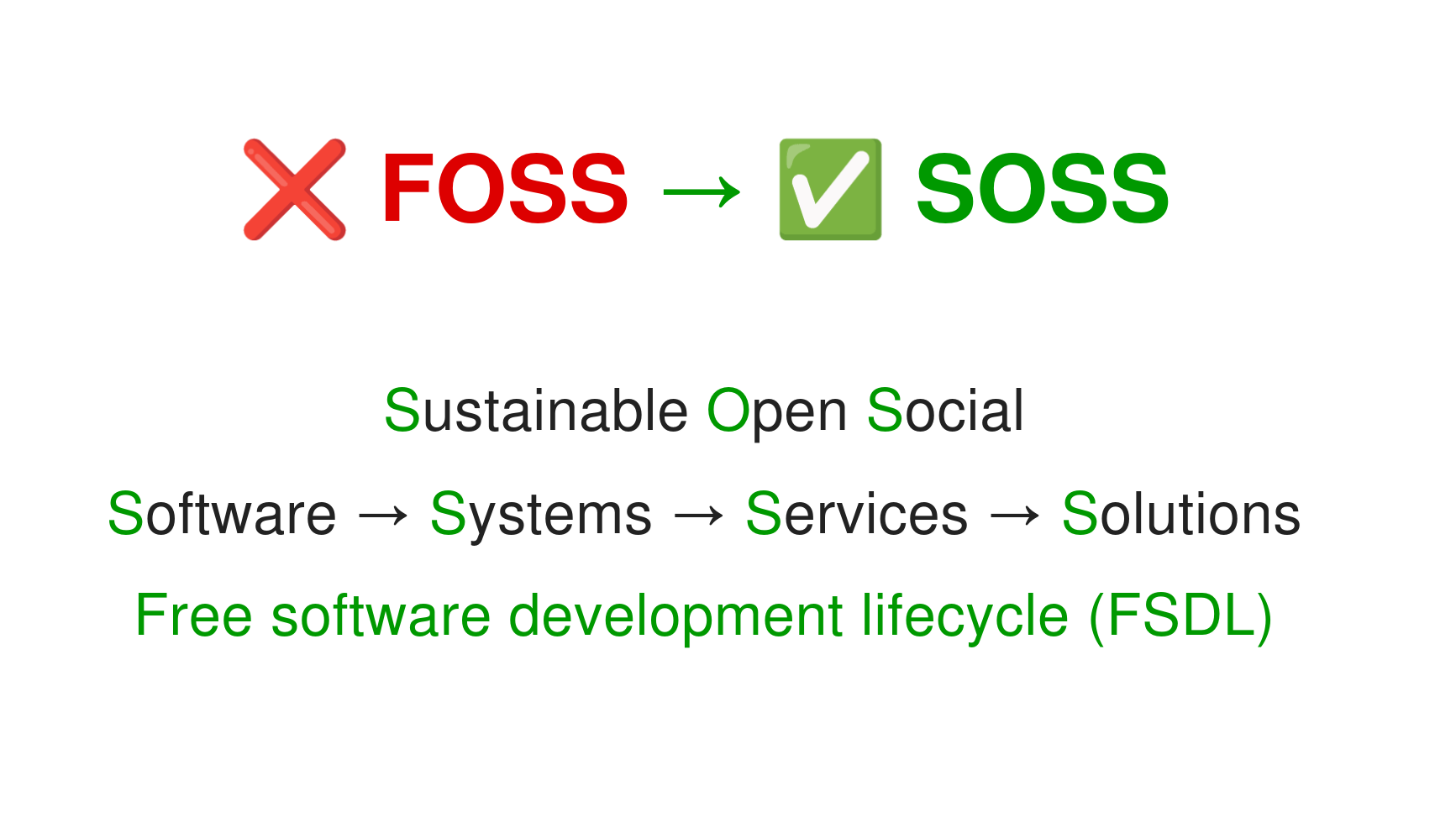
    FOSS has won, but it is only about the code with the 4 freedoms attached. Many well-meaning individuals, but in-the-large it has enabled Big Tech's success, and also LLMs. It earns trillions for the global economy. Meanwhile the movement of *FOSS creators* is inherently unsustainable.

    SOSS stands for Sustainable open social software -> systems -> services -> solutions. Overarching focus of SOSS initiatives is holistic sustainability.

    SOSS initiatives emphasize the process, where the delivery at the end of the pipeline is FOSS. Software is only a solution if it satisfies stated needs of its stakeholders, *including* the developer as stakeholder. Devs should drop the notion of "users", as it clouds this focus on needs.

    Any solution has a lifecycle from inception to end-of-life during which it evolves based on changing needs: The Free software development lifecycle.

    Transition from FOSS project to SOSS initiative. Sustainable open social software, to systems, to services, to solutions. Via the Free software development lifecycle (FSDL).
    💬 2🔄 1⭐ 2
  • Nov 7, 2026, 7:32 AM

    @riverpunk @iris_meredith

    Note that in my experience "community" is often a trap, unless you define really well what it means to be part of it. Usually the term is all too easily used, while expectations about the community vary wildly.

    Proper expectation management is a requirement to avoid all kinds of problems to software development projects, as they grow in popularity and use.

    This holds from the earliest start, where a developer might say "this is just my pet project", or "doing this as a side-quest", or "to add to my portfolio to enrich my CV while looking for work".

    This avoids entitled "users", allows people to make proper selection of the software they want to use. Avoids the friction we so often see between what the developer wants, and what people expect and subsequently demand.

    And the developer will be more aware of their own stated needs for the project. E.g. when it becomes more popular, and now they decide to go all-in and try to earn a living from it.

    💬 1🔄 2⭐ 2
  • 💬 0🔄 4⭐ 1
  • 💬 1🔄 0⭐ 0
  • 💬 0🔄 0⭐ 1
  • 💬 1🔄 1⭐ 0
  • 💬 1🔄 1⭐ 0
  • 💬 2🔄 0⭐ 0
  • 💬 1🔄 0⭐ 0
  • Nov 8, 2026, 8:09 AM

    @scips @nik @riverpunk @iris_meredith

    I've been facilitating SocialHub for a number of years, and it got me insight on another gripe I have with FOSS: it is all fragmentary, indvidualistic, everyone working on their own projects. While there is *some* (a trickle) of funding for FOSS projects, there's hardly any for community and movement formation that ties things together into healthy ecosystems.

    My reason for joining SocialHub as a facilitator was to help foster a healthy fediverse development ecosystem, where the ActivityPub protocol would come into its full power. Today, while the fediverse is a success in some regards, it fails to deliver on the promise of ActivityPub.

    The social dynamics that are at play in grassroots environments, esp. in FOSS and social impact movements, are the reason I started Social coding commons. Today there's still opportunity to realign fedi to AP's capabilities, but it requires a course correction..

    coding.social/blog/prosocial-w

    discuss.coding.social/t/major-

    💬 0🔄 0⭐ 0
  • Nov 9, 2026, 12:29 AM

    @scips @smallcircles @nik @riverpunk @iris_meredith

    Yes certainly OFFDEM will happen this year again.
    The place is secured and what is important is redundancy and participation on the forum. OFFDEM is what we make out of it, it is not only an event but we look for sustainability and longer developments. Join the existing working groups and help us shape this year's event.

    offdem.net/

    💬 0🔄 1⭐ 0
  • 💬 0🔄 0⭐ 0
  • 💬 0🔄 3⭐ 13
  • Nov 6, 2026, 8:05 AM

    @nacly I'd say there's probably a bit more nuance to be had in the Discord discussion (I'm sure the article being from 2021 contributes to that fact), but I vaguely agree with the post yeah.

    I'm not generally a proponent of what you might call "FOSS purity". If a tool is common and what people already use, I'm not super keen to abstain entirely solely because it's proprietary.

    But the issue is that even if Discord was FOSS, you can't look stuff up on Google (or whatever) from in those conversations. So it's not a good format for community support unless other options haven't really worked.

    We should be debugging in public so that many, many people can later refer to those pages to get help.

    💬 1🔄 0⭐ 7
  • Nov 6, 2026, 12:32 PM

    @riverpunk Agree that the un-"searchability" of #Discord is a major reason to avoid it.

    On the "purity" note, indeed the post I shared is 5 years old and would love to know if there's a newer version/equivalent of it for 2026. 😅

    I think we should still *aim* to use free (as in freedom) #opensource tools for our communities, which is often in tension with reaching people where they are! This can be tough to navigate and another reason to give each other empathy and understanding. ❤️

    💬 0🔄 2⭐ 2
  • Nov 7, 2026, 4:42 AM

    @riverpunk @nacly

    I’m not generally a proponent of what you might call “FOSS purity”. If a tool is common and what people already use, I’m not super keen to abstain entirely solely because it’s proprietary.

    My first reaction to your root post was “let’s start by calling it freedom-respecting software, or anti-monopolist software, instead of open source or FOSS”…and this is a good example of why that’s necessary. 🙂

    Once you realize that the movement is about user ownership and control and not any kind of purity or (as GNU calls it) “philosophy”…everything changes. Those who come to that realization avoid monopolistic (“closed source”, and centralized) software, because they become aware that it creates monopolies and gives others illegitimate power over them.

    Bugs can be fixed, features can be added, users can be onboarded, unpopular software can be made popular…but rarely does monopolistic software become anti-monopolistic.

    💬 2🔄 2⭐ 0
  • Nov 7, 2026, 9:40 AM

    @contrapunctus @nacly Might I suggest "Software for good"? Perhaps that could be a more useful phrase than Free Software or Open Source or FOSS or Libre or whatever.

    It may be harder to pervert Software For Good, at least compared to Free Software. And it would also maybe be a little more appealing (it may be more productive to say "we *are* this" instead of "we *oppose* that").

    But who knows, I only just thought of the phrase today...

    💬 1🔄 0⭐ 0
  • 💬 1🔄 0⭐ 0
  • 💬 1🔄 0⭐ 0
  • Nov 7, 2026, 10:01 AM

    @riverpunk
    It could, unless it's FOSS and not Big Tech that we "unionize", and make it possible to assign prices according to use-cases which we assess by our own values

    Use "it's bad for humanity" as a justification to charge more. Incentives that are less worse.

    @contrapunctus @nacly

    💬 0🔄 0⭐ 0
  • 💬 1🔄 0⭐ 0
  • 💬 2🔄 0⭐ 0
  • Nov 7, 2026, 6:43 PM

    @contrapunctus
    OTOH "community" risks sounding like a homogeneous group, sort or like a nation, which risks making us just guess or make up what the "community's best interests" are

    Something to hint that "communities" consist, among other parts, of "individual autonomies"? That's why I'm emphasizing "individuals, UGs, hackspaces, workshops, SMEs" and that we need them to have the capacity to walk away from any particular source of funding and survive mild shocks.

    @riverpunk @nacly

    💬 0🔄 0⭐ 0
  • 💬 0🔄 1⭐ 0
  • 💬 0🔄 0⭐ 0
  • Nov 6, 2026, 8:08 AM

    @riverpunk adding on to "create searchable references": make a page where you list all (intended) errors your application can throw, their cause, and potentially a fix

    im greatful for every documentation on how to configure or install a certain software, but if i get an error and nowhere's to be found what an error means im lost

    💬 1🔄 0⭐ 8
  • 💬 1🔄 0⭐ 5
  • Nov 6, 2026, 11:12 PM

    @riverpunk@defcon.social @kruemmelspalter@chaos.social

    fwiw Discord has made it so that you can search discord messages on a search engine if the server has opted into it. I still think this is a band-aid fix for a complicated problem, and that discord is currently speeding off a cliff wrt enshittification. What we need are some guides to hosting community infrastructure, like how to set up a simple to use and low cost forum. Ideally something low maintenance and not PHPBB.

    I see lots of orgs use Discourse, but they're kinda expensive. The free plan is pretty good, except they only let you have 2 admins, and the least expensive plan from there is $100/mo for 5 admins and a bunch of other features. I think that's kinda whatever bc maintaining your domain and email for you is nontrivial, but the fact that you need the $500/mo plan for SSO is highway robbery.

    💬 0🔄 0⭐ 0
  • Nov 6, 2026, 10:48 AM

    @riverpunk Here's a biggie: Open source projects run by democratic member-owned not-for-profits, with unionised staff who are paid a living wage.

    So you pay your $10 a month for, say, KDE or Mastodon or whatever, and you're a co-owner with voting rights.

    These open source non-profits, in turn, are institutional members of other non-profits, particularly those responsible for the frameworks and dependencies their software relies on.

    💬 1🔄 2⭐ 11
  • Nov 6, 2026, 11:09 AM

    @riverpunk Federated structures to these non-profits.

    You join the local, say, Mastodon branch in your city. They hold meetups at least once a month. All the local branches are members of a state branch, and then a national branch, and ultimately the international nonprofit.

    For online services, your local or state branch might offer members that service. In turn, the servers for those local and state branches are maintained by the national branch.

    💬 1🔄 2⭐ 5
  • Nov 6, 2026, 12:26 PM

    @riverpunk I know my answer is counterintuitive, but building face-to-face local community, democratic governance, and institutional structures around open source is important, IMHO.

    It creates an alternative economic and power structure to big corporate tech.

    The early days of home computing (at least in Australia) were driven by users' groups, swap meets, and home BBSes.

    If we want to take computing back, we need to rebuild and strengthen those grassroots structures.

    💬 0🔄 5⭐ 7
  • Nov 6, 2026, 1:16 PM

    @riverpunk I think this is important in many ways. Teaching each other and helping each other was a big part of the early tech community. It not only intellectually enriched us, it also built real human connections. It fostered a sense of belonging. It raised future contributors. When I first started doing development, such platforms were in decline and what was available to me was the ruthless StackOverflow. It gave me the exact opposite feeling.

    But it's even worse today, we are overwhelmed with slop. Search results were hijacked by SEO spam much before LLMs, and now it's spam on steroids with the help of the slop machines. Hand written blogs and teaching content are hard to find.

    On top of that, there is this looming feeling that the craft of programming is not valueable anymore, when people show me things I could have never built in a reasonable time, that they built with Claude in an evening, it makes me question if what I'm doing is worth it anymore.

    I think that communities will be the perfect antidote to everything that AI is doing to our craft. It can give learners slop-free resources. It can be a place to showcase things that AI could have never built. It can be a place where we forget all the madness that is happening outside, and just write programs, and find joy in it, with people who also find joy in it.

    💬 0🔄 0⭐ 0
  • Nov 8, 2026, 3:43 AM

    @riverpunk I know this is attached to a comment on community but since it mentioned wiki's. Make it easier to download and access wiki's and documentation offline. There are some such as arch I've gotten from kiwix but it would be nice if it was easier to have offline access of more knowledge resources without needing to scrape the internet (and contribute to making it worse)

    💬 0🔄 0⭐ 0
  • Nov 7, 2026, 4:33 AM

    @riverpunk It’s a good sentiment, but what keeps it consistent across different developers and projects? That’s why I believe we need cooperative governance in the free software world, so users always have formal power in the project’s decision-making, and “developers listening to users” becomes a certainty, not merely a nice-to-have. (An example of this is https://prav.app, which I’m associated with)

    💬 0🔄 0⭐ 0
  • Nov 9, 2026, 10:00 AM

    @riverpunk I really liked your post about re-thinking FLOSS, but I think (humbly) you're walking in the wrong direction here. A community is not a McDonalds. It can feel rude because the etiquette is different. If your grandma makes cookies for you and your friends, you can't then say "these are shit cookies" as though you can compare them to fast food. There's no "customer is always right" because there's no customer. There's an expectation that you'll take your plate to the sink, or the kids will help with the setup or cleanup, or a thousand different rules which change depending on where you are, exactly.

    Instead, it works a lot more like "this is your house, you have to do your chores, you have to follow the rules, you have to communicate" (this respect is part of what RTFM is about. Sadly it's applied very disrespectfully by children, but that is / was the goal). As an example here, early on in the Linux Gaming scene, a bunch of gamedevs said (some irately, some thankfully) that most of their bug requests came from Linux users. The idiots thought that all the bugs were in Linux. The smarter ones realised that this was a community pitching in, taking the plates to the sink.

    I think when it comes to community, this kind of soft habit forming is how we keep the community going. The thing we need is more LUGs, more beer, more chats. People bringing their partners, more actual food, potlucks, and on and on.

    And to be clear, my first instinct was to make the same mistake, to suggest better funding models, but this is the same problem, it turns things into the same "capitalism" model. Maybe co-operatives, etc. but not really a true distribution of power and responsibility. In the end it has to come down to each of us.

    So actually my first suggestion is going to be...

    💬 1🔄 0⭐ 0
  • Nov 9, 2026, 10:13 AM

    @riverpunk GUNS! Not real guns, metaphorical ones.

    See, the thing you'll notice about all the anarchist groups is that they are / were armed. Why do the Zapatistas have guns? Because capitalism is always colonising. You leave a commons and a capitalist will turn up with a fence. So, you need guns. Capitalists turn up? You shoot them. They turn up with an army? You shoot them. Eventually they won't bother, the costs are too high. You also kind of need a moat, something no one would cross. The GPL3 acted like such a moat, a lot of companies wouldn't touch GPL3 code.

    Aside: being able to push capitalists aside also kills the idea of AI in FLOSS software dead. It becomes a strange "why would you do that? Who are we racing? I'm just having fun"

    We need ways to be toxic to capitalists (that includes AI bros). We need the code itself to toxify AI, we want the very names of software projects to be toxic to software companies. Project names which are rude words, or trademarks (no one is going to like importing the "Sony C*nt" library). It needs to conflict badly with commercial entities (DNS entries which aren't using DNS, everything is a torrent, whatever it takes for a regular computer to say "this will destroy your PC")

    💬 0🔄 0⭐ 0
  • Nov 9, 2026, 10:18 AM

    @riverpunk Second suggestion: we need to take politics seriously. We need to aggressively pursue our agenda through politics. We need to be annoying AF like the NRA. How will FLOSS devs get paid? UBI. How will communities form? Laws making co-operatives a lot more like non-profits. Free administration, and on and on. Every step should be about empowering the community and stopping proprietary software. We should make a proprietary format straight up illegal, and force governments to use FLOSS formats.

    💬 0🔄 0⭐ 1
  • Nov 9, 2026, 11:33 AM

    @bakuninboys hmm. A few notes. I've included some numbers to break up my disparate thoughts. Feel free to use them as a reference if you decide to respond. Hopefully none of this comes off as too antagonistic.

    1)

    Firstly, I think the point of the whole FOSS thing is to *give regular, non-technical users access to software that lets them liberate themselves*. Really, "liberate" is perhaps a too strong word. Software that lets them choose what they want to do with their computer. Too often, Big Tech offers tech solutions that dictate from the get-go what kind of options you're allowed to pursue with your PC.

    2)

    With that in mind, I don't think it's insane to want to build a model that truly does serve the users in a meaningful way. Grandmas cookies are great because they're just a treat. When you're trying to get tools in the hands of people who can't write their own (specialization is a thing), I think it's fair to say those users ought to be able to look at your offers and tell you what's lacking.

    If you don't want your software to work like that, that's fine, but don't call yourself part of a movement -- clearly you're only doing this as a hobby project.

    3)

    On that note, lets not look at hobby projects in open source as being necessarily the same thing as politically useful software. If your janky little messaging app isn't taking feedback from users on all the ways the UX is confusing and could use improvement, then it's clearly not serving an important function in a movement meant to empower users. You're allowed to release it, but as stated in (2), please do not mistake your project as being part of our movement.

    4)

    Maybe the funding model isn't gonna be the solution to shipping a bunch of features that users provide feedback on, but I don't really know what else would be. I'm all ears, but the current situation seems to be that we are lacking in resources, and my guess is that the best way to increase resources is with funding.

    I don't think money is necessarily an evil thing. The economy is simply the sum total of all human effort. The big question is where we want to be putting that effort. Is it going towards meaningful things or stupid things? If we put money towards open source, that is the best way to direct human effort into open source. Without it, you will only ever get contributions from off-hours in developers' free time.

    If the fear around money and co-ops/non-profits is that the power structure will lead to corruption, then I would suggest we begin with unions and spend much of our time on designing structures that prevent hostile takeovers or Benevolent Dictators For Life. In other words, Democratic, worker-controlled power structures.

    ---

    Is any of this going to be easy, or cheap? No. Is there going to be an obvious path forward for how to actually even ship all of the features users are providing feedback on? Again, no.

    But it seems currently that a lot of voices aren't necessarily interested in even trying to find solutions to those resource problems, and instead think FOSS should just be a hobbyist movement for nerds.


    💬 1🔄 0⭐ 0
  • Nov 9, 2026, 12:17 PM

    @riverpunk So first, not at all, I think we fundamentally want some pretty similar things, and I thank you for taking the time to listen. So for (1), we're notionally in agreement. I think I'm a lot more fundamentalist about what we need to shed, I think tinkering around the edges is how we got into this mess.

    So like, the word "user" functions in the same bucket as "customer", like "a guy walks into a shop", so now, whatever community thing you build, it's already mapped to some transactional thing. Walking into a KFC and walking into a church, same thing. The priest takes your order, gives you a ticket, you pay and eat your body of Christ. It comes in a little paper box along with a plastic toy. The volunteers map to employees, there's a hierarchy. I'm saying maybe the whole shape should be different. (I actually think borrowing liberally from religion or sporting teams is wiser than capitalism)

    So we get to (2) and now we have "professional software" with "business needs", and that can work (eg Blender) but the fact is that people aren't just non-technical, they're also non-political, so asking for community driven software is just not going to work. That's why there's no alternative to the Adobe stack. Really, the professional artist community could have paid software engineers to create FLOSS software. Where is it?

    I also think you're underselling "hobby" projects. It's pretty well known that FLOSS software is way more efficiently written, often less buggy, and just plain better, than proprietary software, to the extent that companies have tried to replicate an "internal OSS model" to try and gain those efficiencies. The trouble has always been: how do we get this "hobby" to scale? How do we get all of us to read each others' code?

    btw an example of "hobby" is libxz. Easy to write off when it works.

    So with that in mind, let's look at (4) without necessarily solving the problem. The issue here is funding as an idea itself. We're not trying to "fund projects" like executives, our actual goal is closer to mutual aid. The trouble there is, *something* isn't working online like it does physically. I say LUGs because I think this is where we lost our way. We need a physical space like a library or a computer shop and there needs to be free food. This is the connective tissue we need.

    And to be clear, I'm speaking in favour of non-profits and co-ops. My point wasn't that money is unnecessary, but that the focus should be on the co-operatives & organisations themselves, the models, what works, how to share that, how to scale it.

    💬 0🔄 0⭐ 0
  • Nov 6, 2026, 6:45 AM

    @riverpunk Well I suppose that I should start by directing you to an opinion piece I wrote about how we should define open source, as it'll give context to the rest of this: peoplesrepublicofglasgow.uk/1d

    Some do's:
    - Use licenses like Hippocratic some more to show the world that we'll set boundaries and that we're done taking shit from the OSI and corpos
    - Experiment more, a lot more, we should be trying out novel concepts and trying to help our fellow developers by giving them more examples of how they can develop
    - Write! More! Languages! Firstly, compiler development is fun. Secondly, someone might make the next rust or C# and make programming easier for a lot of people
    - Start writing some more standards so that we can remove single points of failure(e.g. standardize the linux api so we don't need to rely on linux being secure)
    - Make more communities, like when I was on reddit I made r/Developer_NOAI so that we could have a space without ai to talk about programming
    - Make friends, collaborate, all collectively agree that email is dogshit and not needed, etc.
    - Write opinion pieces, or as I prefer to call it, open source theory
    - Decentralize Decentralize Decentralize

    And some don't's:
    - Don't use ai, it rots your brain, destroys the environment, and just like isn't good for programming especially
    - Don't be assholes to normies, I see that far too much
    - Don't claim that one tool is superior to another tool, it's all subjective and everything(except javascript/typescript) has it's place.
    - Don't let what an epstein apologist and his buddies 40 years ago decided you have to do to be a [morally] good programmer define what you do

    💬 1🔄 4⭐ 12
  • 💬 0🔄 0⭐ 2
  • Nov 6, 2026, 6:49 AM

    @riverpunk My stance may be a bit more philosophical. This next generation already knows it better than us greabeards but, first and foremost, be inclusive. Because welcoming communities are key to keeping any project alive, and because it's the right thing to do as a human being. That being said, I think the hacker ethic is still a viable guideline e.g. in terms of openness, being critical about authorities and using public data. When I discovered free software decades ago I sensed a spirit of sharing and making the world a better place together that I would like to live on, too. And finally, don't enable big tech, if at all possible.

    💬 0🔄 1⭐ 8
  • Nov 6, 2026, 6:54 AM

    @riverpunk ⁃ Develop and adopt a code of conduct for your project that enshrines tolerance and mutual respect. (See contributor-covenant.org)
    ⁃ Prioritize interoperability and data import/export
    ⁃ Emphasize accessibility
    ⁃ Emphasize ease of use, not just features
    ⁃ Welcome beauty, artistry, fun, and whimsy
    ⁃ Go out of your way to welcome beginner contributors

    All of this is praxis, IMO.

    💬 2🔄 1⭐ 13
  • 💬 0🔄 6⭐ 7
  • Nov 7, 2026, 4:28 AM

    @drahardja@sfba.social @riverpunk@defcon.social copy and pasting the contributor covenant is not enough though!!

    the contributor covenant is a template, not a document that should be used as is for every project. imo copying it verbatim is worse than not having a code of conduct at all, as it shows very little thought has been put into it. (ive seen lots of projects even copy the note that says to change it!!)

    projects should at the very least change the title to "<project name> code of conduct" and tailor the "addressing and repairing harm" section to what the project will actually do if the CoC is breached.

    the contributor covenant is a great starting point, but tailoring it to the values of a project shows that effort has actually been put into it and it probably isn't just there for show.


    i definitely agree with all your other points though!!

    💬 0🔄 0⭐ 0
  • Nov 6, 2026, 7:01 AM

    @riverpunk Create cooperatives with a strong political message and strong governance. Don't believe that a license is somehow going to fix things. At that point it does not need to be open source anymore, but rather owned by the cooperative instead.

    💬 0🔄 1⭐ 8
  • 💬 0🔄 0⭐ 0
  • Nov 6, 2026, 7:14 AM

    @riverpunk Some cooperatives use open source software, but generally I don't think there is a lot of overlap. What I do know is, that cooperatives afford you better governance, where you could even kick members out if you agreed to that. Licenses do nothing for governance, which in my opinion is the main reason for our current problems. So what would you do in a (even proprietary) coop model? If that software became part of your infrastructure you would join the coop.

    💬 0🔄 0⭐ 2
  • Nov 6, 2026, 10:04 AM

    @brillenfux @riverpunk

    >So what would you do in a (even proprietary) coop model? If that software became part of your infrastructure you would join the coop.

    So if I need a word processor, spreadsheet or a whole OS I am supposed to join a cooperative that develops those? Multiple if needed? Even though I am not actually a software developer or actually in the software business at all?

    💬 1🔄 0⭐ 1
  • Nov 6, 2026, 10:30 AM

    @cava @riverpunk Typically you don't HAVE to, but I wouldn't stop your enthusiasm. After all, governance is most important to regulate the affairs between the contributors. With that said, though, several coops sell products to the public. And again, with THAT said, yes there are typically very good reasons to join a coop that organizes a critical part of your infrastructure. If that is for example a suite of office software, I could see how that made a lot of sense.

    💬 1🔄 0⭐ 1
  • Nov 6, 2026, 10:26 PM

    @brillenfux So, let me see if I understand you right.

    In our current world, the developers -- as well as some of the most enthusiastic of users -- tend to show up to conferences and engage in email threads or community forums. But there tends to be a lack of actual, I guess, enforcement.

    If users want X to happen (say, a new feature, or specific language changed in the interface to be more inclusive, or an endorsement from a toxic community dropped from the project website), they can engage online and try to get it to happen. Heck, even the smaller contributors could want it. But if the people in charge of the project don't want to, then it doesn't happen.

    Under your recommendation of using co-ops, an enthusiastic user who wants to actually be part of the decision-making process could actually be somehow empowered to engage beyond just asking. And the same for the dozens of smaller contributors who don't own the project.

    Am I interpreting you correctly, here?

    If so, there would be no need for a user to really join a coop to use an OS or a word processor, unless they want to have power over the direction of that software.

    CC: @cava

    💬 1🔄 0⭐ 0
  • Nov 7, 2026, 8:41 AM

    @riverpunk @cava Yes, very often exactly that. And for software this is probably the best model. Some coops, for example those that organize agricultural equipment, may choose to execlusively provide their services to members though. So there are consumer- and producer coops. But for software the most important model is probably the producer coop.

    💬 0🔄 0⭐ 0