A point I frequently make when talking about chatbots is that their output only seems to make sense because we are making sense of it. And worse, we can only do that sense-making by projecting a mind behind the text, something we do reflexively.
>>
A point I frequently make when talking about chatbots is that their output only seems to make sense because we are making sense of it. And worse, we can only do that sense-making by projecting a mind behind the text, something we do reflexively.
>>
While you might think that understanding something someone wrote is simply a matter of unpacking the meaning (or message) they packed into the words, in fact what we do is much cooler and more involved:
>>
We keep in mind everything we know or believe about the authors knowledge and beliefs, about our common ground with the author, and about what the author believes about their intended audience, which might not be us.
(For more details and with citations, see the "... is a parlor trick" section of my recent encyclopedia entry on "AI"
https://faculty.washington.edu/ebender/papers/Bender-AI-2026.pdf )
>>
The first author is a person or group of people speaking for the institution, giving instructions to people who wish to enter Guggenheim Hall but don't have a Husky card that is registered for the building.
It's the second author I'm particularly interested in here. The one behind the hand-written note.
>>
I am a bystander to both of these conversations. (My Husky card works here.) But the hand-written note immediately evokes for me someone who works in the building, likely has responsibility for reacting to the doorbell rings, and has an office not immediately next to this door.
>>
Meanwhile, I also see them modeling the state of mind of the impatient delivery person, who has pushed the button, but hasn't heard the ring (since the bell is close to the person's office, not this door), and then is doubting whether they pushed hard enough.
>>
The sign caught my attention because of the juxtaposition of the institutional language (fairly static information, stated by people who don't expect to actually interact with most readers directly) and the much more conversational hand-written note.
>>
The author of the note was a little flashy with their ability to model the state of mind of doorbell-pushers: The note was likely written in the wake of several noisy experiences on their end, with the solid expectation that similar circumstances would arise again, but it's addressed to someone(s) they haven't interacted with (yet).
>>
And I think it's exactly this flaunting of the ability to perform intersubjectivity across space and time that makes this such a lovely example for helping to understand the illusion of chatbots.
>>
Because it only works because the readers can do the same thing, and construct what's going on for the writer by imagining their point of view.
When we do this with other people, it is lovely. Literally the stuff of relationships, communities, societies.
But it is also fundamental to how we interpret language and we can't just turn it off. And that is what chatbot purveyors are preying on with their product design.
/fin
@emilymbender is this why the llm vendors dress their llm's actions in human terms, such as hallucination, lying, etc?
@esoteric_programmer @emilymbender Well, yes, but don't see it as cynical or a hack on their part.
It is because they got got themselves by the trick!
It write like a human with a context and an internal model enough that they believe it is one!
They are projecting meaning and making meaning for it to the point that they cannot accept that it does not have a meaning making ability in itself. So they use language made for meaning making entities.
@emilymbender
Great example! Thank you so much for sharing it. 🙏🏻 I learnt a lot, can’t say better than that. 👍
@emilymbender This reminds me of the labor theory of value. If we're just rearranging energy and matter, then how can we be ending up with more than we had to start with? It's because labor is a social act, where a person anticipates the needs and desires of other people; it's where energy and matter are bound into human social structures.
That's exactly why "generative AI" is a dead end.
"Similar" experience by me:
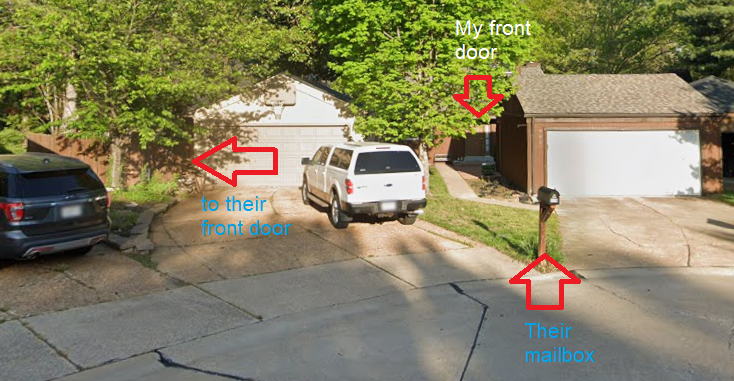
Living at the "crowded end" of this cul-de-sac, I regularly received delivery attempts and packages for my next door neighbor:
The mailbox to the right of the white vehicle in the driveway is his. showing his address, which is "978". But the front door you see at the end of the sidewalk behind it (under the tree) is mine, at "982".
…
It seems that people would see his mailbox with the correct address (978) and assume that the front door clearly visible behind it was his. But his front door is behind the fenced and gated ares to the left of that garage on the left.
So I put a note on my door saying "978 if over there <---" with an arrow pointing left.
My neighbor objected to that. We didn't discuss why. But he objected.
So I removed that note and replaced it with a note that said "This is 982."
…
Both notes were successful at redirecting my neighbor's deliveries to their house. This avoided my annoyance. And it also avoided the risk that they'd stay home for a delivery, but could miss it when the delivery was attempted at my house.
So adding the note for delivery people *worked*, and everyone was "happy."
[To be clear, for those who have legitimate concerns:
>> I do not live in that house any more. <<
I moved out some years ago. Please don't bother the current residents. Those are "starter" homes with a fair amount of turnover.]
@emilymbender Nice explanation. Thanks.
@emilymbender So, like, for LLMs... there's a ghost in the machine, but not in the sense of a spirit or something with agency, but rather in the sense that we are imagining it as an explanation?
A door closes suddenly, and we're so used to thinking someone must be there to slam a door, so we imagine a spirit rather than realizing that wind can also slam a door… but for text?
Idk i might have gotten lost in the metaphor here... am I kinda maybe getting your point correctly?
I don't speak for Emily, but for me, I think your metaphor works well.
The only difference is that the ghost in the cottage is completely your own construction, but the ghost in the LLM is what someone has worked hard to inject into your understanding.
@nielsa
@emilymbender I navigate this kind of inferred knowledge, audience issues all the time as an engineer. In a public safety, inspection heavy industry.
For whatever reason, people get scared to state reality in a simple way, defaulting to language so clinical it assumes shared knowledge. It's so reflexive, I think it is a human thing.
There is a world of difference in "inspect to new design standard" and "inspect for this exact broken part because it killed 7 people."
One tells the reader what is important and one assumes shared knowledge.
In your case it's a annoying doorbell, but it highlights the difference between that clinical communication and what is actually necessary for smooth operations.
@emilymbender
A short glance onto your profile page reminded me, you are a linguist. As my mom were. That explains a lot. This thread is, what linguistics are for.
But I still wonder in which states of mind post-it notes are constitutional...
@emilymbender
in terms of the communication model it's interesting.
Nevertheless on a practical level, my view on this handwritten note is
"passive-aggressive venting, will not resolve the situation for the writer in most cases. Ineffective communication for probably 50% of delivery drivers. Writer did care more about being snarky than in actually resolving the issue, leaving room for future complaints about illiterate readers."
I know (from experience) that you can write purposely disconnected nonsense and people will find meaning in it.
Even after you tell them:
"No, that's, actually just some disconnected nonsense that I strung together a a goof."
They will insist that there's meaning there.
As i read your analysis, I realized that I had had the same/similar response to the handwritten note. That gave me a concrete form for my anxieties about my oldest grandchild's use of Chatbot. But, it also gives me another illustration for him of why he should use it less ( I'm shooting for total abandonment, but he has to get there himself).
@emilymbender I'm being forced to use llms at work, and lately I've been experiencing intense rage while using the chatbot at least once a day. What's the point of being angry at a machine? But like you said, I can't turn it off as much as I try.
@alter_kaker I'm so sorry you are being forced into this. The rage is a good thing though! Hold onto it.
@emilymbender I don't know that it is good, because it's not rage at the people who put me in this position. I feel the rage that I'd feel if I was repeatedly confronted with a very stupid and obtuse person who keeps trying to kiss my ass but never learns anything. I'm having a hard time not typing cruel things into the prompt, like the kind of leading questions some kind of sadistic boarding school teacher out of Dickens would ask. So that's clearly me anthropomorphizing the machine on a very deep level. It makes me feel crazy.
@emilymbender and thank you. I'm going to have to figure out how to turn back from the brink, hopefully while keeping my job 😅
@emilymbender You make me miss my time in the linguistics mines. I was always more syntax and minority language fieldwork oriented, but this thread is something I would happily show an undergrad to convince them to take a semantics and pragmatics course; it really captures the beauty of that subfield.
@emilymbender I need such a note. I keep having to tell delivery people that ringing twice won't make me any faster, just more nervous.
@emilymbender
Hmm. What about Alsatian cards? (Asking as a German)
@wauz 🙄
US universities have mascots, and usually name their various bits of infrastructure after those mascots. UW, where I work, has the husky as its mascot.
@wauz Border Collie cards work everywhere, they bring the museum to you.
Interesting thread!
@emilymbender cool points! I guess humans simply can't help anthropomorphising the world around them? We'll just keep talking to our pets, malfunctioning toasters and yeah: chatbots.
@misjavanlaatum @emilymbender this is the theory of self that means we are predisposed to religion. If we know we are a self, and others can be selves, why not the wind or the stones? It’s beautiful and infuriating.
@emilymbender And LLM creators go to great lengths to use rhetorical tricks to push that illusion, such as first-person pronouns and use of emotion terms.
@michaelgemar Yes, I am well aware.