Login
You're viewing the slime.global public feed.
  • Oct 19, 2026, 4:36 PM

    (Also, if you're wondering: The reason to not just accumulate in a list and then print it at the end is that some of the inputs to this program will result in *infinite runtime*, and in that case the best case is to write the updates to STDOUT as I go so I can introspect what is happening in the debug mode.)

    💬 2🔄 0⭐ 0

Replies

  • Oct 20, 2026, 12:22 AM

    Current status: accumulating a list using value::rest and then having to reverse it at the end. oh geez these are real Ocaml hours here

    Hey, did I see at some point Idris has a List variant in the standard library which is optimized for fast tail insertion somehow? Did I imagine that?

    💬 1🔄 0⭐ 1
  • Oct 20, 2026, 2:28 AM

    Right up until the last minute this language is giving me a cornucopia of "this thing I did before has stopped working suddenly and the error message doesn't hint why"

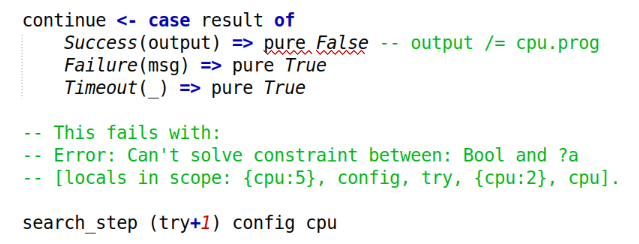
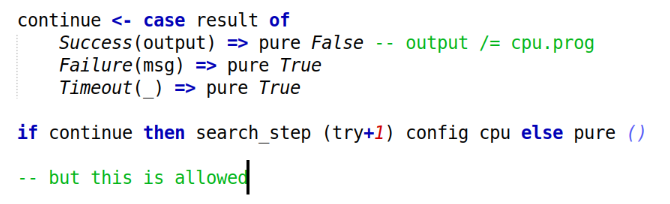
    Here, a very simple "case" statement fails, because… because the variable I assigned to wasn't used. I was sincerely not sure if I was confused about the (seemingly undocumented) whitespace rules again. No, I just needed to use the result. But I wanted to write the expression before I tried to use it. Silly me!

    continue <- case result of
    Success => pure False
    Failure => pure True
    Timeout => pure True

Fails on the word "pure False" with

Error: Can't solve constraint between: Bool and ?a
(there is a list of locals in scope)
    same code but now there is an "if continue" on a later line
    💬 1🔄 0⭐ 0
  • Oct 20, 2026, 2:49 AM

    Alright. Any Idris users awake?

    I want to compare two lists. That's easy to implement recursively, and I THINK it's implementable with zipWith tho docs remain… vague ( idris2docs.sinyax.net/data/bas what does zip do if the lists are of unequal length?)

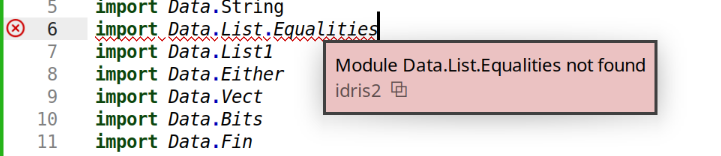
    …but! It *sounds* like something the standard library would have. And indeed I find a Interface-satisfying function exists in in Data.List.Equalities…

    idris2docs.sinyax.net/data/con

    …but I can't import that.

    I type this post, and the explanation jumps out.

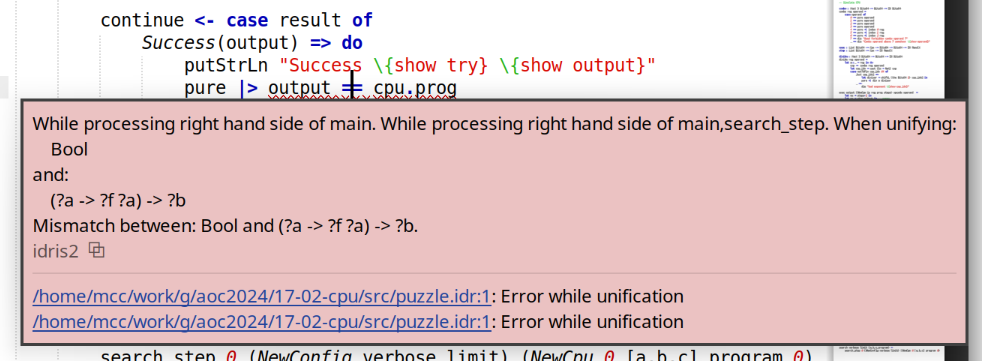
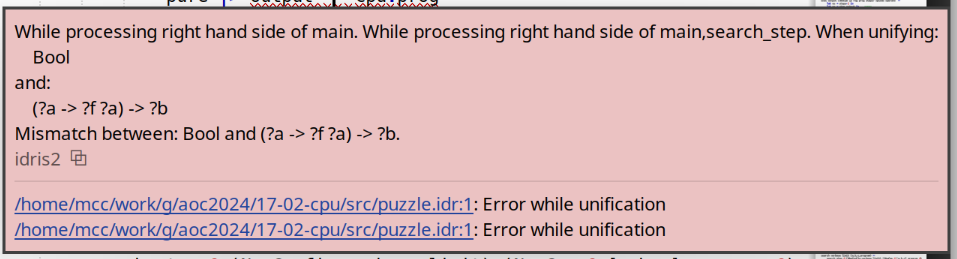
    Error on "output == cpu.prog". Cannot unify "Bool" with "?a -> ?f ?a) -> ?b. Terrible error
    Module Data.List.Equalities not found
    💬 2🔄 0⭐ 0
  • Oct 20, 2026, 2:52 AM

    …it's in contrib. List equality isn't in the "prelude" (default) or "base" (despite the name, not default; you have to specifically import base).

    The doc doesn't *say* it's in contrib. But the *url slug* says it's in contrib. I only notice this when pasting the url into this compose box.

    …Also, while writing this thread, I got Idris2 maintainers begging me not to use anything in contrib because that's all stuff that's GOING to be spun out into its own library but hasn't been yet. So, uh…

    💬 1🔄 0⭐ 0
  • Oct 20, 2026, 2:59 AM

    Oh right, I was going to ask a question. Any Idris users awake? Two part question.

    1. idris2docs.sinyax.net/data/con Do I understand write that if I can import the package containing this symbol, a == b and a /= b on `List int` will magically work?

    2. Is it surprising that I changed my ipkg to say "depends = base, contrib" and despite this, "import Data.List.Equalities" fails in the Idris executable, and succeeds in the LSP? And also list1==list2 still fails with the mystery (?a->?f?a->?b error?

    💬 2🔄 0⭐ 0
  • Oct 20, 2026, 3:01 AM

    Wait. Wait. Hold on a friggin minute

    Computer

    Enhance

    … this type is assigned female at birth ????

    zooming in on the error message...
    (?a -> ?f ?a) -> ?b
    💬 2🔄 0⭐ 0
  • Oct 20, 2026, 3:17 AM

    Okay. Whatever. Whatever!! At this point I go on tilt. I can't decode this documentation, I can't figure out why `idris2 -o` ignores my ipkg and `pack exec` fails without printing error messages. I know SML/NJ! I write my own list-equality helper. It takes seconds.

    …oh wait, it's not letting me use the Eq interface. Odd. Fine, I'll compare ints.

    …oh, there's… no such thing as… equality on ints. fine. Fine! I wanted Bits64s anyway. I—

    OH COME ON HOW IS THAT NOT A COVERING FUNCTION??

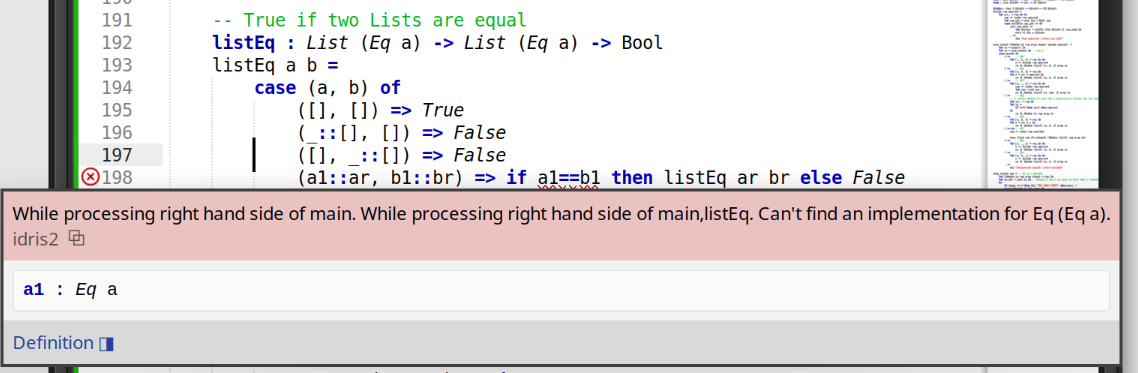
    -- True if two Lists are equal
listEq : List (Eq a) -> List (Eq a) -> Bool
listEq a b =
	case (a, b) of
		([], []) => True
		(_::[], []) => False
		([], _::[]) => False
		(a1::ar, b1::br) =>
			if a1==b1 then
			listEq ar br
			else False

It fails with: Can't find an implementation for Eq (Eq a)
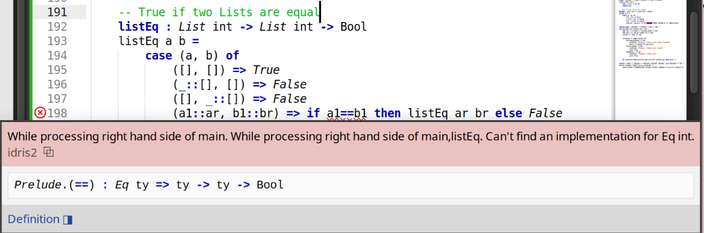
    Same function but "Eq a" is replaced with "int". Error: "Can't find an implementation for Eq int".
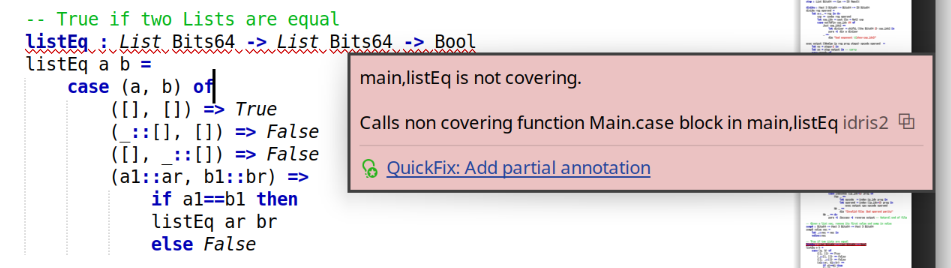
    Same again but "int" is replaced with "Bits64". It says "main,listEq is not covering"
    💬 2🔄 0⭐ 0
  • Oct 20, 2026, 3:20 AM

    At about this point a very nice types.pl user replies to point out that the reason my original == code, with Data.List.Equalities, did not work was because I mixed up |> and <|. Again.

    …I…

    I'm frustrated. At this point. I'm not concentrating well. I'm trying not to mention "COVID-19 post-viral syndrome" in this thread, or how much Benadryl I'm on.

    Okay. Okay. It works now. As long as I run "pack exec". Which means I am now banned from getting error messages in the command line. Okay. Fine.

    💬 2🔄 0⭐ 0
  • Oct 20, 2026, 3:22 AM

    Please excuse me for my unprofessional outburst. With regard to whether my "listEq" implementation was a covering function. Although I'm still right.

    EDIT: Im wrong. I was given a counterexample. I think what I should have matched in cases two and three was (_, []) and ([], _); since the case ([], []) was already excluded, those patterns can only match "lists of 1 or more items" in the _ positions, and it will work. I did not test it.

    💬 2🔄 0⭐ 2
  • Oct 20, 2026, 3:26 AM

    Also this… this is correct. This is absolutely correct. The problem was my |> / <| mixup, not which modules I had imported, and I don't have any need whatsoever for contrib, so I'm out of `pack` jail now. Okay. Alright. That's good. Okay. types.pl/@ionchy/1174710916268

    [QRT inset not provided because of the Mastodon 5 GUI reset dropping tomorrow. I've switched to masto-fe and can no longer quote boost.]

    💬 1🔄 0⭐ 0
  • Oct 20, 2026, 3:28 AM

    Hey question if in Idris you feed the |> function into the <| function, like you execute <| |>

    Does it unlock a quantum computing library

    💬 2🔄 0⭐ 0
  • Oct 20, 2026, 3:41 AM

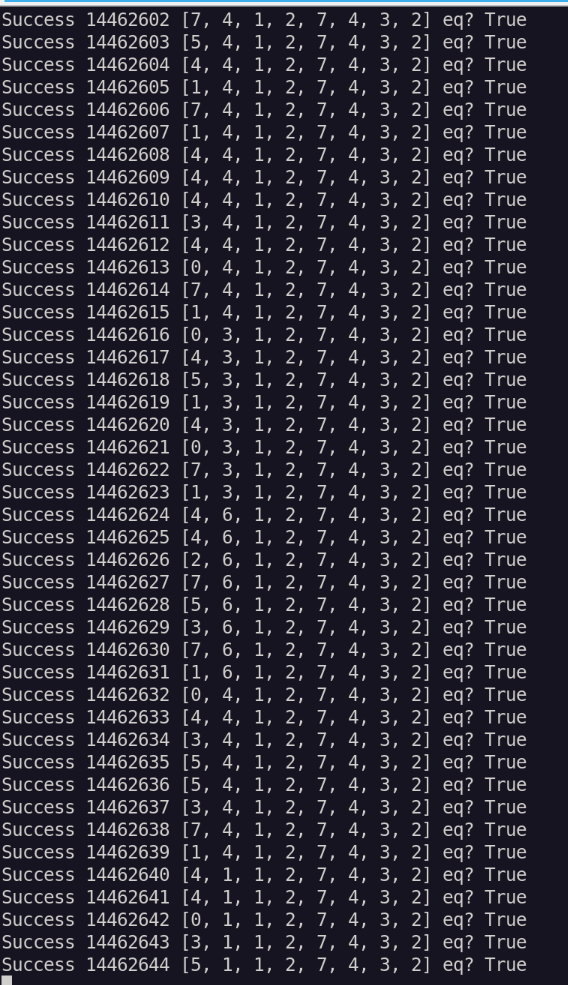
    So. The story so far: In part 1, I made an emulator for a gross ass mini CPU. I'm given a program for it. In part 2, AOC guy informs me this program is SUPPOSED to be a quine, but it has a bug; the initial "register A" value is wrong. I need to find the A that reproduces the program. So I run the program in a loop, incrementing A each time until the program output equals its own code. I know this works; it works on the sample.

    But on my *assigned*program… well…

    lots of lines like "Success 15943678 [5, 0, 7, 7, 1, 1, 1, 3] eq? True"
    💬 1🔄 0⭐ 0
  • Oct 20, 2026, 3:44 AM

    (Ignore the "eq? True" there, I forgot a "not", it's repeating until it prints False).

    I didn't finish my program, as of this second. I didn't get around to implementing the code to recover after invalid-program or infinite-loop failures (but that's ok, because it appears those failures never never happen on the program input). I have it printing output on every line, and STDOUT is *definitely* slowing me down.

    Looking at the output, it's clear I don't need any of that.

    💬 1🔄 0⭐ 0
  • Oct 20, 2026, 3:47 AM

    Although there are many programs this "cpu" COULD execute, the AOC guy clearly designed it to run this one program, or variants on this one program. The program is clearly expressing some function. You can like… *see*, the relationship between input (A value) and output (printed list). It's not linear, or smooth, but it's close. It's hard to express from a screenshot. I can see the output string herky-jerky growing as A linearly increases.

    💬 1🔄 0⭐ 0
  • Oct 20, 2026, 3:51 AM

    The instruction set consists of a function that divides A by two, and a bunch of XOR ops. There's a jump function that jumps if A is nonzero. Implication: A is like a sort of logarithmic counter; the program whittles away dividing repeatedly by two until A hits zero. It's very clear the number of output digits scales linearly with the number of digits in A.

    This means a linear scan is out. After running a pretty long time, my output has 8 digits. My target string has 16.

    💬 1🔄 0⭐ 0
  • Oct 20, 2026, 3:56 AM

    So even if I'm more efficient and am not waiting on STDOUT, I can't (shouldn't?) count up to 16 digits by hand.

    However, I'm *mostly* sure I can do something like a binary search. The XORs mean the output isn't smoothly increasing, but it's increasing on average, so a binary search will get me into the neighborhood, and maybe that'll identify a block of, I dunno, a thousand or a hundred "A" values that I can linearly scan and find my result.

    …tomorrow.

    💬 1🔄 0⭐ 0
  • Oct 20, 2026, 6:21 AM

    …okay. I am *completely certain* the correct answer is somewhere between 35,184,372,088,831 and 281,474,976,710,656, noninclusive.

    💬 2🔄 0⭐ 0
  • Oct 20, 2026, 6:27 AM

    I'm laying in bed. I think about how the values in the input/output lists are all in the range 0-7, and wonder if the AOC taskmaster wants us to be thinking of them as an octal number.

    I think about "comparing" lists. I realize I don't know which end to compare from. I make a decision. I get up and start doing a *manual* binary search. Why not?

    I quickly find the numbers don't behave the way I hoped. Most numbers I pick turn into long strings of 4s, for some reason.

    But.

    Page full of numbers and comma-separated strings of numbers.
    💬 1🔄 0⭐ 0
  • Oct 20, 2026, 6:30 AM

    Treating my "goal" string as an octal number and looking at it in different bases revealed nothing interesting.

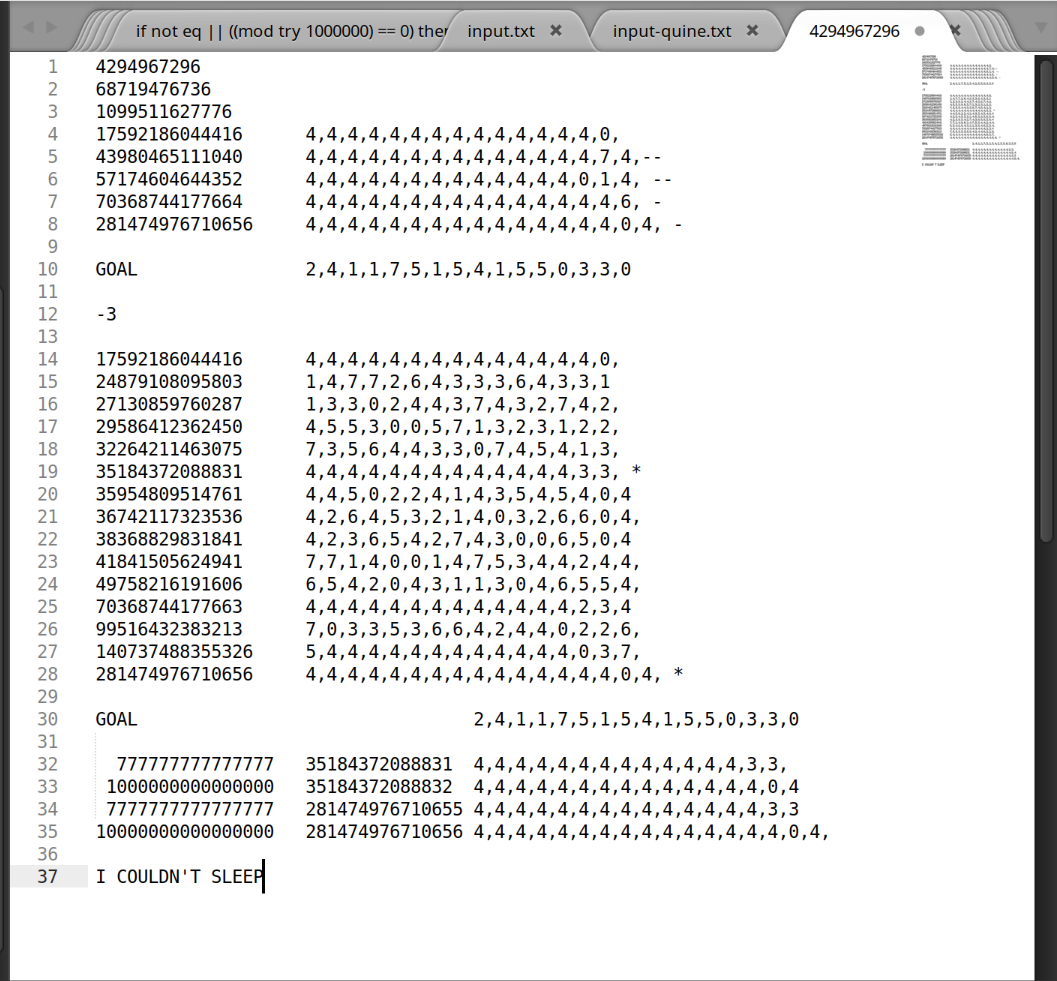
    A regular binary search really gets me nowhere. I think: Wait, isn't this math bitwise/logarithmic? I try doing a "binary" search picking midpoints with 10^((log10(a)+log10(b))/2). [block 1 in image above]

    That goes better, but not good enough. I quickly get two *broad* endpoints of my range, but can't reduce it further. [block 2 in image above]

    But then—

    💬 1🔄 0⭐ 0
  • Oct 20, 2026, 6:34 AM

    [block 3 in image above] I try looking at my input numbers in octal. I *immediately* realize that the number of printed "digits" in the output is exactly equal to the number of digits in my "A register" number represented as base 8. Hence: My answer will be n where
    octal 1000000000000000 <= n < octal 7777777777777777. 15 digits.

    This is the first concretely useful thing I've worked out so far.

    💬 1🔄 0⭐ 0
  • Oct 19, 2026, 6:38 PM

    @mcc
    The length of the expected output list is known. So the program might die if this length is exceeded by the output list.

    Yes, this feels hacky, but somehow you need to solve the halting problem.

    And if you're at it, you could of course break an evaluation as soon as the output is not a prefix of the expected output.

    So the CPU might keep the list of "expected remaining output" and "consume" it upon fitting output.

    💬 1🔄 0⭐ 0
  • Oct 19, 2026, 6:40 PM

    @hcschuetz Hey, that's a good optimization. And it did occur to me another potential optimization is to cache previously seen states (only 4 registers; not so hard) and abort if i detect a loop. However I think I could still run in a *very* long loop using only loops and slowly modifying one of the registers in a non-repeating or increasing fashion. It would be hard, given the operators, but not out of the question.

    💬 0🔄 0⭐ 0
  • 💬 0🔄 0⭐ 0
  • 💬 1🔄 0⭐ 0
  • 💬 1🔄 0⭐ 0
  • 💬 1🔄 0⭐ 0
  • Oct 20, 2026, 3:44 AM

    @mcc perl has the "spaceship" operator, it only makes sense that somebody else would have the Cosmic Ark operator

    Image attached toot
    💬 1🔄 1⭐ 0
  • Oct 20, 2026, 12:26 PM

    @mcc

    Hah, I dropped into the thread with @rotopenguin's post, expecting some light-hearted programming-language humor, not some "Epic trials of MCC" thread with 1.414×10⁴ posts 😆

    You have a great deal more fortitude for this adventure than I would ever have, but it sounds like you're having fun and learning stuff which is the important bit 😁

    💬 0🔄 0⭐ 0
  • Oct 20, 2026, 12:56 PM

    @gumnos the other "weeks" in this project have not gone off the rails in quite this way

    💬 0🔄 0⭐ 0
  • Oct 20, 2026, 3:34 AM

    @mcc what about listEq [] [1,2] or listEq [1,2] []. these are not handled in the case blocks above. (the left hand side of the two False cases is not general enough).

    also it couldn't find Eq int because int is not Int (need to capitalize type names, lowercase types are type variables)

    💬 1🔄 0⭐ 0
  • 💬 0🔄 0⭐ 0
  • 💬 1🔄 0⭐ 0
  • Oct 20, 2026, 5:57 AM

    @mcc Disregarding my previous promise to know what I am talking about:
    For your code that starts with

    listEq : List (Eq a) -> List (Eq a) -> Bool

    I think the interface restriction needs to be written like this:

    listEq : Eq a => List a -> List a -> Bool

    For your specialized integer code, I think you need to capitalize your int as Int or maybe Integer (so List int should be List Int)

    Both these suggestions based on what I skimmed at idris2.readthedocs.io/en/lates

    As for the covering, I don't know.

    I really like following you Idris 2 adventure, I wish to learn it myself some day.

    I remember my intense struggles and frustration when learning Haskell a long while ago.

    💬 1🔄 0⭐ 0
  • 💬 0🔄 0⭐ 0
  • Oct 20, 2026, 3:16 AM

    @mcc well the list equality comparison seems to have worked since it says the thing with the red squiggle has type Bool
    it's expecting something of type (?a -> ?f ?a) -> ?b so that's just what (|>) takes as the second argument, but why do you have that there anyway? pure (list1 == list2) should be enough

    💬 2🔄 0⭐ 0
  • 💬 0🔄 0⭐ 0
  • 💬 1🔄 0⭐ 0
  • 💬 0🔄 0⭐ 0
  • Oct 20, 2026, 3:19 AM

    @mcc Based on what I can see of your program, I think the issue is with `|>`, since that's reverse function application: that is to say, `5 |> show` is effectively sugar for `show 5`. That means you're trying to take the result of `output == cpu.prog`, which is `Bool`, and apply it as a function to the value `pure`, as though you wrote `(output == cpu.prog) pure`.

    Again, I can only see what's not obscured, but with those assumptions, I think you might just want `pure (output == cpu.prog)`?

    💬 1🔄 0⭐ 0
  • 💬 0🔄 0⭐ 0