Login
You're viewing the sfba.social public feed.
  • Aug 5, 2026, 2:33 PM

    New paper thread! "Rings in the Sky: Orbital Data Centres and Potential Impacts to Astronomy and the Sky" by A. Boley, me, and @hannorein. Submitted, and posted to the arxiv preprint server.

    What would the sky look like if companies actually launch the tens of thousands up to one million "AI data center" satellites that they have asked for? Well, the short answer is, horrifying. The long answer is... this paper! arxiv.org/pdf/2608.02757

    💬 4🔄 113⭐ 52

Replies

  • Aug 5, 2026, 2:39 PM

    These companies all want sun-synchronous terminator orbits, so that they can be sunlit all the time*. Sun-synchronous orbits have a nodal precession rate that matches Earth's orbit period around the sun. Meaning, they keep the same configuration relative to local daytime. If the satellite passes over the equator where it is 6pm directly under the satellite, it will always do that.

    *important problem with this assumption coming later in the thread

    💬 1🔄 9⭐ 18
  • Aug 5, 2026, 2:42 PM

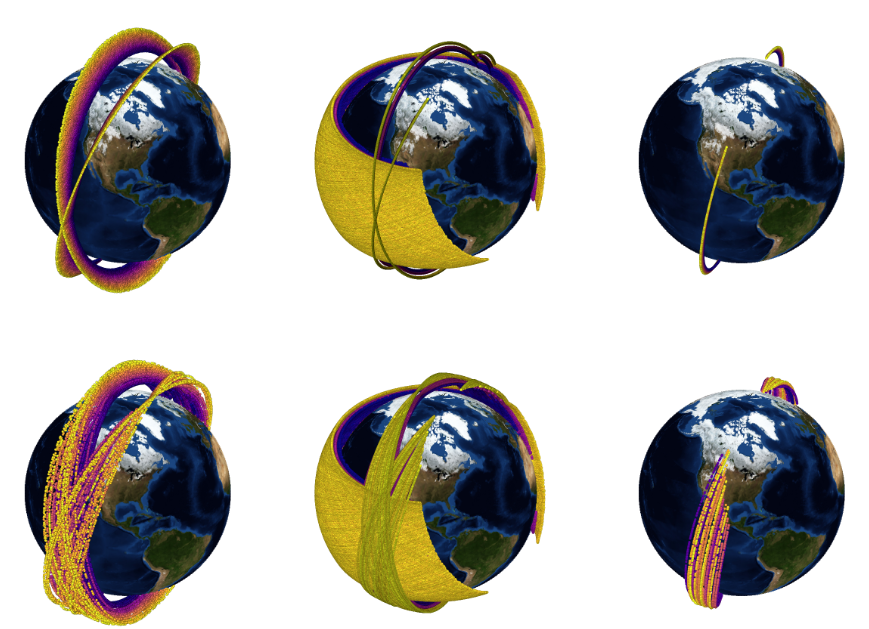
    We model 3 different configurations that 5 different companies have asked for variations on. An "X-ring", where both possible nodes are used, so you get one orbit tilted at ~98 degrees (depending on inclination) and the other tiled at ~82 degrees. They make an X over the equator. There's also "X-ring plus orbital shell" which is whatever the fuck SpaceX asked for with their million satellite filing. And a single ring, which is self-explanatory.

    💬 2🔄 6⭐ 5
  • Aug 5, 2026, 2:44 PM

    Next we have to make wild assumptions about the size of the satellites, because all of these companies have no idea what the fuck they are doing (and orbital data centers might not even be physically possible), so they haven't actually provided any solid info on how big they are. We are guessing from sketches posted on twitter, basically. SpaceX is ~800m^2 of reflective solar panel, so we use that for every company.

    💬 1🔄 10⭐ 11
  • Aug 5, 2026, 2:48 PM

    A completely fucking ridiculous drawing in an FCC filing from Cowboy space (I did a thread about that last week, mastodon.social/@sundogplanets) indicates they might have a reflecting area of 4800 m^2. WAY BIGGER than the ISS, the biggest thing ever placed in orbit, in pieces, not as one monolith. These companies are just making shit up. For comparison's sake, we just use 800m^2 for every simulation.

    💬 4🔄 9⭐ 14
  • Aug 5, 2026, 2:51 PM

    And then we make a silly but useful assumption. We are very honest about this, the section is titled "All models are wrong, some are useful"

    We say that all satellites are spheres. Obviously, this is not true. But it provides a good comparison point. And without completely detailed, perfect info about the shape and materials of every satellite in orbit, we can't actually do a better job of this, and this actually does a good job of reproducing Starlink brightnesses. So, spherical cow it is.

    💬 1🔄 8⭐ 14
  • Aug 5, 2026, 2:54 PM

    And then, we confirm something that Hugh Lewis posted previously (sorry for Linkedin, that's where it is linkedin.com/pulse/sun-always-)

    These orbits don't actually stay sunlit all the time! Unless you're above something like 1400km altitude, these sun-synchronous terminator orbits will pass through Earth's shadow at some times of year. That means your data center will have to turn off every 90 min, or have huge batteries. You can't have 24hour sunlight AND low altitude, low-latency orbits.

    💬 3🔄 8⭐ 17
  • Aug 5, 2026, 2:59 PM

    Here's the future that the techbros want. Earth as a ringed planet.

    What does that actually look like in the sky? Well, it depends on your latitude and the time of year. The worst time of year for sunlit Starlink satellites is summer, but due to these orbits, the worst time for sunlit sun-synchronous terminator orbits is actually the wintertime.

    6 diagrams of the Earth surrounded by rings of satellites in different configurations.  The first has 2 highly tilted rings that cross over the equator.  The second has that plus a shell of satellites around Earth's middle.  The third has a single highly tilted ring.  There are 3 more diagrams showing the same 3 configurations described, but with more variation in where the satellites cross Earth's equator, so they are messier rings.
    💬 5🔄 35⭐ 9
  • Aug 5, 2026, 3:03 PM

    And then there are a bunch of horrifying sky diagrams. Please take a look at the paper if you want to see those! I will share the extra movies here.

    First, Cowboy "Stampede" (my goodness I hate these names), a single ring. This is the view from 30N on the winter solstice. You can even see in the movie how part of the ring is not sunlit. There is also a histogram showing the brightness of satellites and stars: for a lot of the time the ring is up, there are more bright sats than stars.

    A movie of a clock going through the nighttime hours, an all-sky diagram showing a line of satellites, rough north-to-south that swing across the late evening and early morning sky, and a histogram showing how many satellites are different brightnesses, compared with real stars.  There are more bright satellites than bright stars for a lot of the time the ring is above the horizon.
    💬 1🔄 15⭐ 14
  • Aug 5, 2026, 3:08 PM

    Now Blue Origin's "Sunrise" which has the X-ring configurations. Here's from 30N on the winter solstice.

    A movie of a clock going through the nighttime hours, an all-sky diagram showing 2 lines of satellites, rough north-to-south that swing across the late evening and early morning sky, and a histogram showing how many satellites are different brightnesses, compared with real stars.  There are more bright satellites than bright stars for a lot of the time the ring is above the horizon.
    💬 2🔄 11⭐ 12
  • 💬 2🔄 11⭐ 11
  • Aug 5, 2026, 3:14 PM

    From the far north (or far south), you'd see one of the rings continuously, all through the long winter night (which could be 24 hours of darkness and near-darkness). But the satellites will keep you company! Ugh. Gross. There would be more bright satellites than bright stars, all night long.

    A movie of a clock going through the nighttime hours, an all-sky diagram showing a line of satellites, rough north-to-south that swings to east-west and then back to north-south throughout the night, and a histogram showing how many satellites are different brightnesses, compared with real stars.  There are more bright satellites than bright stars for the whole night.
    💬 2🔄 6⭐ 15
  • Aug 5, 2026, 3:18 PM

    And then there's SpaceX's freaking ridiculous million satellite filing. I had to reduce the frame rate for this animation because it made my computer (and me) sad. We called this the "overalls" configuration. Giant overalls, in the sky. Anytime the megaconstellation is sunlit, there are more satellites than stars visible in the sky.

    A movie of a clock going through the nighttime hours, an all-sky diagram showing 2 lines of satellites, roughly north-to-south that swing across the late evening and early morning sky that connect up with the entire southern part of the sky full of satellites in the morning and evening, and a histogram showing how many satellites are different brightnesses, compared with real stars.  There are more visible satellites than stars anytime this megaconstellation is sunlit.
    💬 4🔄 21⭐ 20
  • Aug 5, 2026, 3:22 PM

    Relatedly, Hugh Lewis just recently posted a paper showing that even by making the most conservative assumptions possible about size and orbits, and ignoring everything else that's already in orbit, all 3 of these proposed megaconstellations have so many satellites that they could cause Kessler Syndrome BY THEMSELVES arxiv.org/pdf/2607.29644

    So, the good news is that we'll never have a ring like this. The bad news is, HELLOOOO Kessler Syndrome!

    💬 3🔄 28⭐ 29
  • Aug 5, 2026, 3:23 PM

    I'll end with my favourite sentence from our paper: "This new, anthropogenic sky feature would even be easily visible in a light-polluted city: the natural patterns of the star-filled night sky that have been a source of wonder and knowledge for all of human history will have been erased by urban light pollution and then replaced by human-made artificial patterns."

    This is stupid. Stop launching satellites just because you can, techbros.

    💬 4🔄 41⭐ 72
  • 💬 0🔄 1⭐ 0
  • 💬 0🔄 0⭐ 0
  • Aug 5, 2026, 3:14 PM

    @sundogplanets and that is not even taking into consideration the damage such satellite constellations do to the atmosphere. Just the few tons of aluminum starlink is dumping into the atmosphere are already a big source of concern, 800m*m armatures raining from the sky sounds like what disaster movies are made of

    💬 1🔄 2⭐ 0
  • 💬 0🔄 0⭐ 2
  • Aug 5, 2026, 3:35 PM

    @sundogplanets

    That was my thought… the glorious band of the Milky Way that most urbanites don’t even know they are missing anymore will be replaced by a bright, gaudy tech band that will shine through even the worst light pollution.😞

    💬 1🔄 0⭐ 6
  • 💬 0🔄 0⭐ 0
  • 💬 0🔄 0⭐ 0
  • C. Jacobscjacobs73_perpetual_chrysalis@thistlenfern.org
    Aug 5, 2026, 4:43 PM

    @sundogplanets Their floating data center idea sounded bad to me from the start. These renders of their proposed operations make me physically ill. We could have tech that improves people's lives, but instead we have money vampires scattering crap everywhere that makes life worse.

    💬 0🔄 0⭐ 0
  • 💬 0🔄 0⭐ 0
  • Aug 5, 2026, 3:25 PM

    @sundogplanets I expect the disgusting megaconstellation CEOs will reply that of course it's all possible, and just trust them to know how and stop complaining.

    💬 0🔄 0⭐ 0
  • Aug 5, 2026, 3:33 PM

    @sundogplanets

    Did Huey Lewis share the News?

    The good news is, I've read various science fiction stories and settings affected by Kessler Syndrome, and they seem fun. Let me go review them. Wait... no... oh, no...

    💬 0🔄 0⭐ 2
  • 💬 0🔄 0⭐ 1
  • 💬 0🔄 0⭐ 0
  • Aug 5, 2026, 5:01 PM

    @sundogplanets Countries need to ban satellites in their near space and jam or destroy those that aren't moved. Just keep USA satellites over USA.

    💬 0🔄 0⭐ 0
  • Aug 5, 2026, 3:53 PM

    @sundogplanets Really interesting renders. Have you calculated the total brightness? Like is it "oh there's a ridiculous quantity of star-like points" or "now the ground is lit like half moonlight all the time"?

    💬 1🔄 0⭐ 0
  • Aug 5, 2026, 3:55 PM

    @wikkit I thought about this as I've laid awake in the middle of the night. Would the rings cast shadows??? UGH. I should actually calculate that at some point...

    💬 0🔄 0⭐ 0
  • 💬 0🔄 1⭐ 0
  • Aug 5, 2026, 3:10 PM

    @sundogplanets

    Each one of these things is a twirling little bomb over our head just waiting to fail and reenter the Earths atmosphere. What could possibly go wrong if they all fail at the same time.

    💬 0🔄 1⭐ 0
  • 💬 0🔄 0⭐ 0
  • 💬 0🔄 0⭐ 0
  • 💬 1🔄 1⭐ 0
  • 💬 1🔄 1⭐ 0
  • 💬 1🔄 1⭐ 0
  • 💬 1🔄 1⭐ 0
  • 💬 0🔄 1⭐ 0
  • Aug 5, 2026, 4:54 PM

    @sundogplanets
    (Starting with, the whole idea is mad and insane)

    I wonder if they intend to treat these satelites as network nodes, and pass data around (on top of what's needed for the raw workloads) such that at these times of year, those nodes drop out as they enter blackout, and come back as they emerge.

    It would be insane bandwidth, but I think the principle might be sound. Anyone?

    And I still think the whole idea is nuts.

    💬 0🔄 0⭐ 0
  • 💬 1🔄 0⭐ 0
  • 💬 0🔄 0⭐ 0
  • Aug 5, 2026, 2:51 PM

    @sundogplanets and the ISS is already so bright! It's somewhat magical to watch it « swoosh » silently in the sky. :blobfoxwhoaa: Still have fond memories of it happening while I was on schoolbus back from high school :blobfoxaww:

    💬 0🔄 0⭐ 0
  • 💬 0🔄 0⭐ 0
  • Aug 5, 2026, 2:42 PM

    @sundogplanets @hannorein

    Just thinking about this - does filling the sky with these satellites make locating/tracking large asteroids on possible collision course with earth more difficult?

    💬 1🔄 3⭐ 3
  • 💬 0🔄 1⭐ 0
  • Aug 5, 2026, 3:42 PM

    @sundogplanets
    Great and important work. But I'm not sure I would have used the same title. When reading about rings in the abstract, I noticed that I had immediately beautiful images of planets with rings in my mind. Even though I know that it will be horrible.
    @hannorein

    💬 0🔄 0⭐ 0
  • 💬 0🔄 0⭐ 0