Login
You're viewing the scl.zmb.cm public feed.
  • Oct 5, 2026, 9:08 AM

    #mathober day 5: Inellipse

    Any convex pentagon has a uniquely determined ellipse that touches all of its sides from the inside!

    For a quadrilateral, is seems that there's basically one "degree of freedom" – you can squish and stretch it!

    For a triangle, there's two degrees of freedom: Rotation and squishyness (aka eccentricity).

    One way to construct a pentagon's inellipse involves a pentagram, so here's a witchy diagram for the three types of shapes.

    #mathober2026 #math #geometry

    A drawing involving a pentagon, a quadrilateral, and a triangle, all with ellipses inside of them. Around that, some random symbols.
    💬 6🔄 0⭐ 0

Replies

  • Oct 6, 2026, 10:13 AM

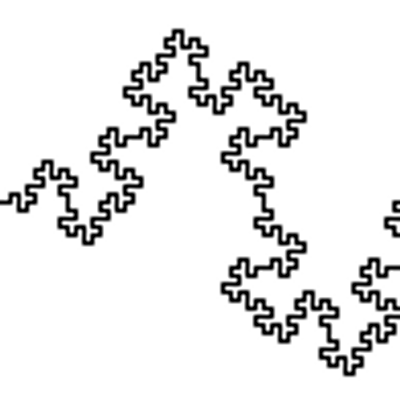
    #mathober day 6: Connected Topology

    Learned about the "Topologist's Sine Curve", sin(1/x), defined on (0,1], together with the origin. The question: Is it "connected"?

    Turns out that it's neither path-connected (the duck can't reach the horizon) nor locally connected (no matter how small you make the "sun disk", the river that overlaps it will never be one piece) , but still "connected" (there's no gap between river + sun you could cut along). Weird!

    #mathober2026 #math #topology

    Digital painting: A river snaking towards the horizon in increasingly dense curves. Behind that, a pretty sunset. A duck is swimming on the river.
    💬 3🔄 0⭐ 0
  • Oct 7, 2026, 11:15 AM

    #mathober day 7: Five Circles Theorem

    Arrange five circles so that their intersections are distributed around a sixth circle. Draw a pentagram through their second intersections. Then its tips will always also lie on the circles!

    First time experimenting with #krita's watercolor brushes, happy with how that turned out. 🎨🖌️

    #mathober2026 #math #geometry

    Digital drawing: Six disks drawn in watercolor style on rough paper, overlapping in the described manner. Plus a golden pentagon on top of them.
    💬 3🔄 0⭐ 0
  • 💬 2🔄 0⭐ 0
  • Oct 9, 2026, 9:20 AM

    #mathober day 9: K-Cyclic Graph

    These are the twelve 7-cyclic graphs! Start on any node, and then follow 7 edges (you can re-use edges), visiting all nodes, and start back at the beginning. These are all graphs that allow that.

    #mathober2026 #math #graphtheory

    Digital ink drawing of twelve different green graphs. They all have cute names like "diamond graph" or "fish graph". In black ink, I drew what they represent.
    💬 2🔄 0⭐ 0
  • Oct 10, 2026, 3:47 PM

    #mathober day 10: Simple Pole

    I learned a lot about complex analysis today! Here's one way to visualize the function f(z) = 1/z, where z is a complex number. The height represents the real part of the result, while the hue represents the "angle" of the complex number.

    This particular function has a "pole" at the origin, where it blows up to infinity. It's "simple" (has order 1), because it's "only" a 1/z blow-up. I think a 1/z^2 blow-up would have order 2?

    #mathober2026 #math #complexanalysis

    A colorful digital oil painting. A 3D function plot where the value blows up towards positive infinity (from the right) and negative infinity (from the left). It's labelled with "1/z".
    💬 3🔄 0⭐ 0
  • Oct 11, 2026, 2:16 PM

    #mathober day 11: Problem of Points

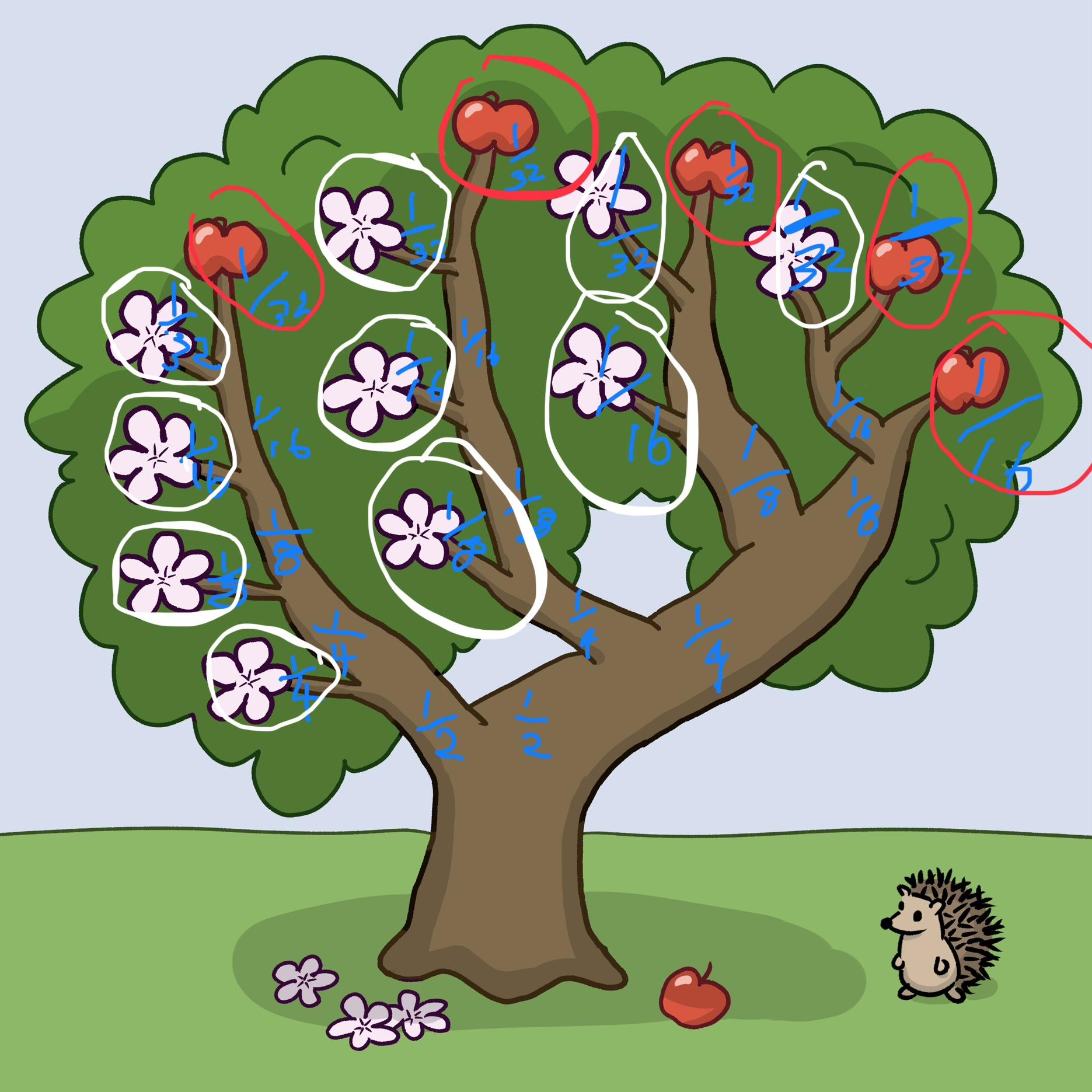
    Two players toss coins, and whoever wins 5 rounds first wins the entire pot. But: Someone interrupts the game as one player has won 3 rounds, and the other one 1. How should they split the pot now?

    This problem motivated our modern probability theory and the concept of the "expected value".

    Here's a "tree" diagram depicting the situation I described. Can you read from it how the players should split the pot?

    #mathober2026 #math #probabilitytheory

    A cartoon tree. Whenever it branches to the left, the "flower" player wins a round. When it branches to the right, the "apple" player wins a round. The tree shows flowers and apples at the places where the player has won five rounds.

At the base of the tree, the won rounds are symbolized through 3 flowers and 1 apple. Also, there's a hedgehog!
    💬 3🔄 0⭐ 0
  • Oct 12, 2026, 9:39 AM

    #mathober day 12: Reciprocal Prime Constant

    Add up the reciprocals of all primes up to n. How far is this away from ln(ln(n)), as n gets large?

    The plot of these two functions reminded me of a bridge. Can you find the constant being visualized here?

    #mathober2026 #math #numbertheory

    Digital pencil drawing of a Venetian bridge. The round curve below the bridge represents ln(ln(n)), a stair-shaped line represents the reciprocal prime sum. A gondolier sings the formula for the described constant!
    💬 3🔄 0⭐ 0
  • Oct 13, 2026, 1:05 PM

    #mathober day 13: Standard Map

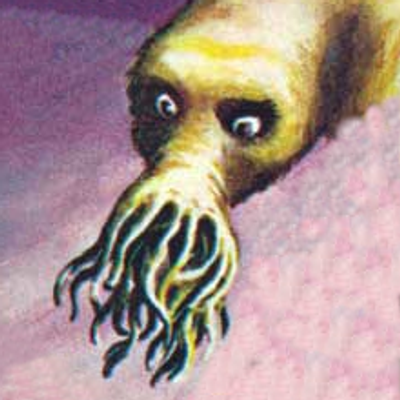
    Imagine a 2D pendulum in zero gravity. Pick an initial angle and momentum. Then, at regular intervals, "kick" the end of the pendulum forward with strength sin(angle). This is a very simple system that exhibits chaotic behavior!

    If you place a dot on a diagram after each kick according to the current angle (x-axis) and momentum (y-axis), you get the "standard map". Here is an artist's impression for kick-strength 0.971635!

    #mathober2026 #math #chaostheory

    Warped eyes with purple iris on green skin.
    💬 2🔄 0⭐ 0
  • 💬 2🔄 0⭐ 0
  • Oct 15, 2026, 4:18 PM

    #mathober day 15: Irredundant

    Here's a game for you: Select some nodes from this graph, so that:

    1. All nodes of the graph are either in your set or neighbors of your set (your set is "dominating"), and
    2. You can't remove nodes from your set without losing that property (your set is "irredundant").

    How small can you make your set? How big? Can you tell why?

    #mathober2026 #math #graphtheory

    A connected graph of 15 nodes.
    💬 5🔄 0⭐ 0
  • Oct 16, 2026, 1:16 PM

    #mathober day 16: Isochronous Curve

    There was a YouTuber called Murph
    who let marbles race, and observe:
    All of them, how sublime,
    arrived at the same time
    for the track was an isochrone curve.

    #mathober2026 #math

    💬 0🔄 0⭐ 0
  • 💬 1🔄 0⭐ 0
  • 💬 1🔄 0⭐ 0
  • 💬 1🔄 0⭐ 0
  • 💬 0🔄 0⭐ 0
  • 💬 0🔄 0⭐ 0
  • 💬 0🔄 0⭐ 0
  • Oct 5, 2026, 3:51 PM

    @blinry

    This looks like one of Kepler's early drawings including the recently discovered constellation Kneifzange... 😉

    I'll never forget the term 'squishyness'.

    💬 0🔄 0⭐ 0
  • Oct 5, 2026, 4:23 PM

    @blinry That's interesting: how closely related is it to the fact that five points uniquely determine a conic?

    💬 0🔄 0⭐ 0
  • 💬 0🔄 0⭐ 0
  • 💬 0🔄 0⭐ 0
  • 💬 0🔄 0⭐ 0
  • 💬 0🔄 0⭐ 0
  • 💬 0🔄 0⭐ 0
  • 💬 0🔄 0⭐ 0
  • 💬 0🔄 0⭐ 0
  • 💬 0🔄 0⭐ 0
  • 💬 0🔄 0⭐ 0
  • Oct 12, 2026, 5:44 AM

    @blinry My naive expectation was 3:1 but your very cute diagram shows clearly that 2:1 is correct.

    💬 1🔄 0⭐ 0
  • Oct 14, 2026, 10:45 AM

    @whybird @blinry
    I think each result has to be weighted with
    (1/2)^(number of branchings on the way to it).
    Summing then gives 13/16 for flowers and 3/16 for apples, so the proportion to share should be 13:3.

    💬 0🔄 0⭐ 0
  • Oct 14, 2026, 11:03 AM

    @tian @blinry Its winner takes all though, regardless of how many steps it took to get there. From our starting position, there are 10 outcomes where flower wins and 5 where apple wins.

    I think you are suggesting those outcomes are not all equally probable though? So now you have me doubting myself!

    💬 0🔄 0⭐ 0
  • Oct 14, 2026, 11:36 AM

    @whybird @blinry Yes, for example:
    the leftmost outcome, flower wins the next two rounds, has probability 1/4, whereas the rightmost, apple wins the next four rounds, only has prob. 1/16.

    💬 0🔄 0⭐ 0
  • Oct 14, 2026, 12:11 PM

    @tian @blinry Wow, I was clearly wrong - thank you!

    The probabilities come out like this, as you described.

    🌼:🍎 = (1/4+1/8+1/16+1/32 + 1/8+1/16+1/32 + 1/16+1/32 + 1/32) : (1/32 + 1/32 + 1/32 + 1/16) = (26/32):(5/32) = 26:5

    (You got 26:6=13:3… I *think* you were off by 1? Unless I made another mistake.)

    The same tree diagram as before, but with probability fractions marked at each branching. They start at 1/2:1/2, then 1/4:1/4 etc out to the previously noted winning positions, which are circled and have the probabilities listed in the body of the post.
    💬 0🔄 0⭐ 0
  • Oct 14, 2026, 12:19 PM

    @tian @blinry It occurs to me that the diagram could be modified so that the branch thickness corresponds to probability :)

    💬 0🔄 0⭐ 0
  • Oct 14, 2026, 1:02 PM

    @whybird @tian Ohh, I also didn't consider this correctly when I made the drawing! Thanks for catching this! :)

    💬 1🔄 0⭐ 0
  • Oct 14, 2026, 10:05 PM

    @tian I actually have in my brain now a little animation of two players (in your drawing style @blinry, and one is a hedgehog… but that’s not really the point) dividing the pot, which in this case is conveniently exactly 32 $1 notes, by splitting it in half per turn and keeping scores on each possible outcome and awarding the portion of the pot to the winner at each of the possible win states… never mind that for this scenario to be reasonable, the actual game they were playing would have had to have been harder than this dividing activity, so not a coin toss I suppose :)

    💬 0🔄 0⭐ 0
  • Oct 12, 2026, 10:19 AM

    @blinry hmmm. The sum term as well as the log terms both diverge. I think we can use the prime density function somehow, as primes are distributed logarithmically as well…?
    (coffee is broken, no brain left for the rest)

    💬 0🔄 0⭐ 0
  • Oct 13, 2026, 8:23 AM

    @blinry

    The setting in an Italian Renaissance city is (imo) well-chosen for mathart. And there's a hyper-para-superbolic rotational body in the background that goes well with the other day's prompt.

    💬 0🔄 0⭐ 0
  • 💬 0🔄 0⭐ 0
  • 💬 0🔄 0⭐ 0
  • Oct 15, 2026, 5:41 PM

    @blinry This combination of properties seems to be what is usually just called "minimal dominating", the smallest ones are "minimum dominating".
    Can you find a graph with a maximal irredundant set that is not dominating?

    💬 1🔄 0⭐ 0
  • Oct 16, 2026, 8:26 AM

    @tian I don't think so! Proof attempt: If S is irredundant, but not dominating, there is a node that's neither in S nor neighboring S. So we can add that node to S without making S redundant. So S was not maximal irredundant.

    💬 1🔄 0⭐ 0
  • Oct 16, 2026, 10:19 AM

    @blinry Certainly the new node is needed for domination, but are all nodes in S needed?

    💬 0🔄 0⭐ 0
  • Oct 15, 2026, 6:54 PM

    @blinry I choose {5, 7, 14}. That should satisfy it, and I don't think 2 nodes are possible. Since 8 is only connected to 7 either 8 or 7 needs to be in the set. Taking 8 instead of 7 "feels" wrong, 7 "gains more ground".

    💬 1🔄 0⭐ 0
  • Oct 15, 2026, 7:46 PM

    @envy Neat, yeah, I think 3 ist the "minimum" size. Not quite sure about the largest set yet!

    💬 1🔄 0⭐ 0
  • 💬 1🔄 0⭐ 0
  • 💬 0🔄 0⭐ 0
  • 💬 0🔄 0⭐ 0
  • 💬 0🔄 0⭐ 0
  • Oct 16, 2026, 5:59 AM

    @blinry The first part seems simple enough, since a minimal dominating set is irredundant. To cover 8, we must pick either 7 or 8, and 7 is a better choice. Of the remaining uncovered graph, no one is sufficient, but 5 and 14 are. So, it can be made as small as three, and no smaller.

    💬 0🔄 0⭐ 0