#mathober day 9: K-Cyclic Graph
These are the twelve 7-cyclic graphs! Start on any node, and then follow 7 edges (you can re-use edges), visiting all nodes, and start back at the beginning. These are all graphs that allow that.
#mathober day 9: K-Cyclic Graph
These are the twelve 7-cyclic graphs! Start on any node, and then follow 7 edges (you can re-use edges), visiting all nodes, and start back at the beginning. These are all graphs that allow that.
#mathober day 10: Simple Pole
I learned a lot about complex analysis today! Here's one way to visualize the function f(z) = 1/z, where z is a complex number. The height represents the real part of the result, while the hue represents the "angle" of the complex number.
This particular function has a "pole" at the origin, where it blows up to infinity. It's "simple" (has order 1), because it's "only" a 1/z blow-up. I think a 1/z^2 blow-up would have order 2?
#mathober day 11: Problem of Points
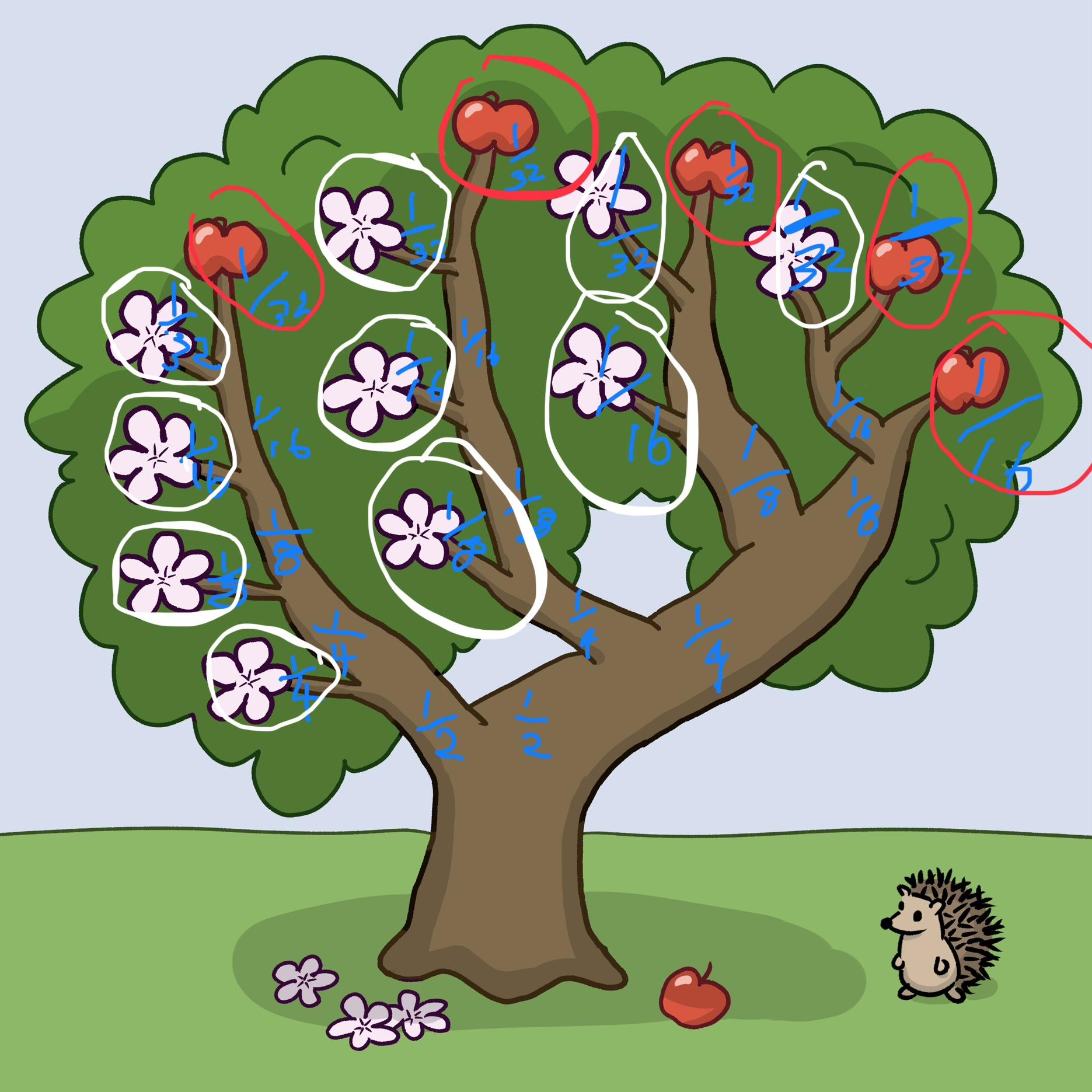
Two players toss coins, and whoever wins 5 rounds first wins the entire pot. But: Someone interrupts the game as one player has won 3 rounds, and the other one 1. How should they split the pot now?
This problem motivated our modern probability theory and the concept of the "expected value".
Here's a "tree" diagram depicting the situation I described. Can you read from it how the players should split the pot?
#mathober day 12: Reciprocal Prime Constant
Add up the reciprocals of all primes up to n. How far is this away from ln(ln(n)), as n gets large?
The plot of these two functions reminded me of a bridge. Can you find the constant being visualized here?
#mathober day 13: Standard Map
Imagine a 2D pendulum in zero gravity. Pick an initial angle and momentum. Then, at regular intervals, "kick" the end of the pendulum forward with strength sin(angle). This is a very simple system that exhibits chaotic behavior!
If you place a dot on a diagram after each kick according to the current angle (x-axis) and momentum (y-axis), you get the "standard map". Here is an artist's impression for kick-strength 0.971635!
#mathober day 14: Icositetragon
A 24-sided regular polygon, divided into 66 rhombs! Pop art style!
#mathober day 15: Irredundant
Here's a game for you: Select some nodes from this graph, so that:
1. All nodes of the graph are either in your set or neighbors of your set (your set is "dominating"), and
2. You can't remove nodes from your set without losing that property (your set is "irredundant").
How small can you make your set? How big? Can you tell why?
#mathober day 16: Isochronous Curve
There was a YouTuber called Murph
who let marbles race, and observe:
All of them, how sublime,
arrived at the same time
for the track was an isochrone curve.
@blinry ah the 👑 graph :3
@blinry I really like the whirlpool-iness! Yes, a 1/z^2 blow up would have order 2 and it would have 4 lobes rather than two.
@blinry wow! love the contrast and twist
@blinry The hedgehog!!!
@blinry My naive expectation was 3:1 but your very cute diagram shows clearly that 2:1 is correct.
@tian @blinry Its winner takes all though, regardless of how many steps it took to get there. From our starting position, there are 10 outcomes where flower wins and 5 where apple wins.
I think you are suggesting those outcomes are not all equally probable though? So now you have me doubting myself!
@tian @blinry Wow, I was clearly wrong - thank you!
The probabilities come out like this, as you described.
🌼:🍎 = (1/4+1/8+1/16+1/32 + 1/8+1/16+1/32 + 1/16+1/32 + 1/32) : (1/32 + 1/32 + 1/32 + 1/16) = (26/32):(5/32) = 26:5
(You got 26:6=13:3… I *think* you were off by 1? Unless I made another mistake.)
@tian I actually have in my brain now a little animation of two players (in your drawing style @blinry, and one is a hedgehog… but that’s not really the point) dividing the pot, which in this case is conveniently exactly 32 $1 notes, by splitting it in half per turn and keeping scores on each possible outcome and awarding the portion of the pot to the winner at each of the possible win states… never mind that for this scenario to be reasonable, the actual game they were playing would have had to have been harder than this dividing activity, so not a coin toss I suppose :)
@blinry hmmm. The sum term as well as the log terms both diverge. I think we can use the prime density function somehow, as primes are distributed logarithmically as well…?
(coffee is broken, no brain left for the rest)
The setting in an Italian Renaissance city is (imo) well-chosen for mathart. And there's a hyper-para-superbolic rotational body in the background that goes well with the other day's prompt.
@blinry I can't unsee this! love it
@blinry This makes me want to read the comic book
@blinry This combination of properties seems to be what is usually just called "minimal dominating", the smallest ones are "minimum dominating".
Can you find a graph with a maximal irredundant set that is not dominating?
@tian I don't think so! Proof attempt: If S is irredundant, but not dominating, there is a node that's neither in S nor neighboring S. So we can add that node to S without making S redundant. So S was not maximal irredundant.
@blinry Certainly the new node is needed for domination, but are all nodes in S needed?
@blinry I choose {5, 7, 14}. That should satisfy it, and I don't think 2 nodes are possible. Since 8 is only connected to 7 either 8 or 7 needs to be in the set. Taking 8 instead of 7 "feels" wrong, 7 "gains more ground".
@envy Neat, yeah, I think 3 ist the "minimum" size. Not quite sure about the largest set yet!
@blinry I can get up to 5 I think: {1, 6, 8, 12, 14}
@LaurinMurer @envy Seems irredundant to me! Neat!
@blinry I love this
@blinry The first part seems simple enough, since a minimal dominating set is irredundant. To cover 8, we must pick either 7 or 8, and 7 is a better choice. Of the remaining uncovered graph, no one is sufficient, but 5 and 14 are. So, it can be made as small as three, and no smaller.
@blinry nice!