Login
You're viewing the mastodonapp.uk public feed.

Replies

  • Oct 31, 2026, 12:16 AM

    @ascentale @ml @bikenite A7: a vestibule with a wall to lean bikes on. Seriously.

    My MTB is about 2cm longer than the vestibule in a Marayong (Sydney longer distance train) is high, so can't fit their vertical bike racks. My cargo bike and touring bike are much longer so no chance. But the cargo bike has a stand so just needs floor space.

    But with a bit of work we fitted ~6 bikes into the 3-bike stand area the other day.

    #BikeNite

    💬 2🔄 3⭐ 0
  • 💬 0🔄 1⭐ 0
  • Siegfried.realSiegfried@troet.cafe
    Oct 31, 2026, 10:04 AM

    @moz @ascentale @ml @bikenite I got similar issues with some bike racks in long distance trains. Either my bike is to long (or heavy) to fit the vertical rack, or the handlebars on my bike are too high because I'm a tall man, so the bike doesn't fit under the bar above the bike rack.

    💬 0🔄 2⭐ 0
  • Oct 31, 2026, 12:17 AM

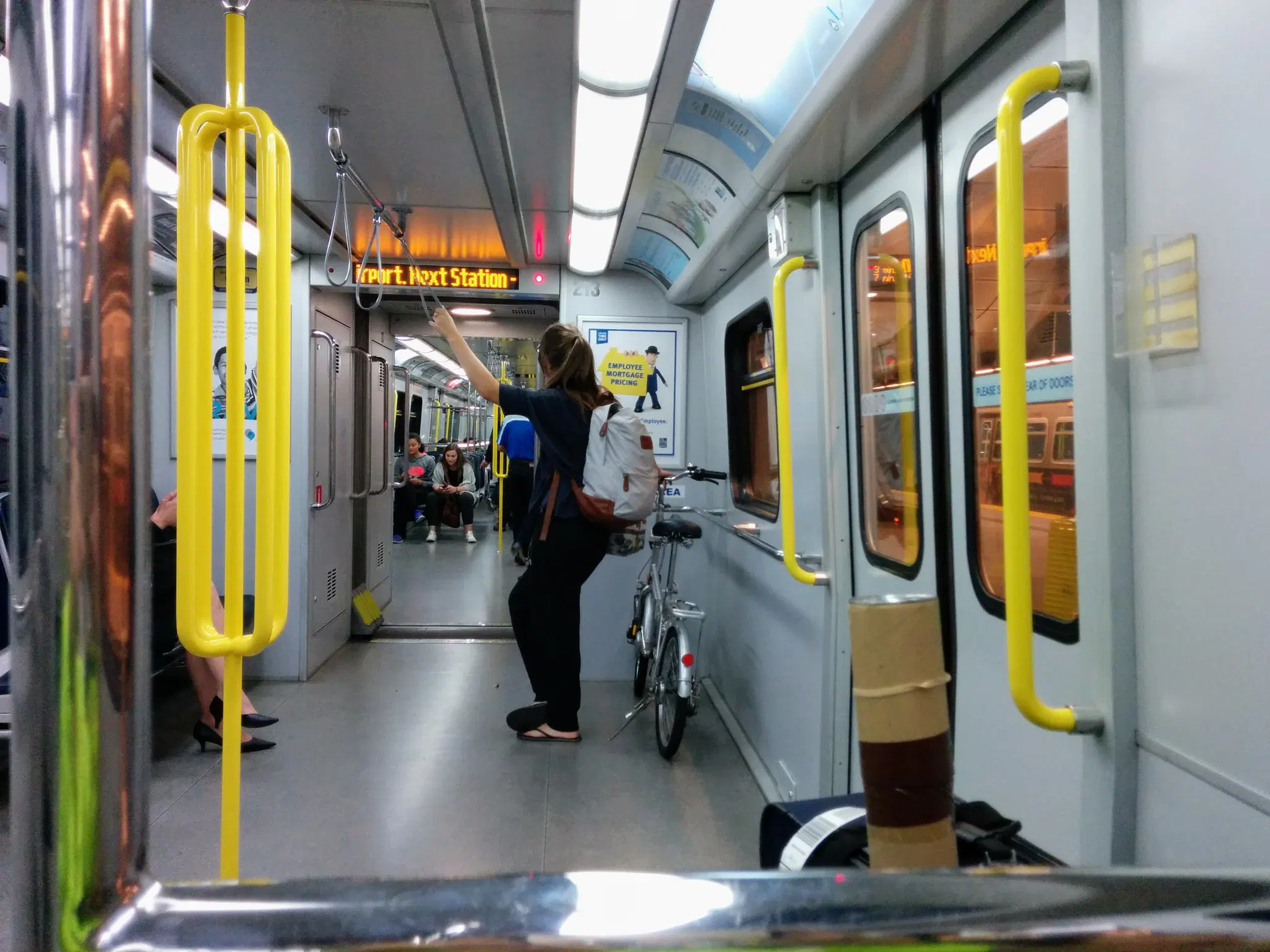
    @ascentale @ml @bikenite A7: The best I have seen was just a bunch of foldable seats mounted on the side under the windows. Seatbelts mounted on the bottom between every three seats. You place the bike next to them, pull the seatbelt from the floor up to a handle under the window and the bike is secure. You fold down the seat in front/behind the bike and sit down.

    Works perfectly for wheelchairs, kids wagons and two to three bikes next to each other. Bad picture and this is on the type that has seatbelts built in but same orientation.

    #bikenite

    A bike strapped to the side of a train car. The side of the wagon has foldable chairs under the windows and the bike is strapped to a bar above those, leaning towards the window. Behind the bike is normal train chairs facing forward in the travel direction. Colours are light gray and dark blue with orange handles on the upper part of the chairs to hold on to when walking.
    💬 3🔄 5⭐ 9
  • 💬 0🔄 1⭐ 0
  • 💬 1🔄 2⭐ 0
  • Oct 31, 2026, 9:02 AM

    @ml I saw long cargo bikes able to get in with not so much problems, those pockets are usually just next to the entrance so reasonably easy to get on and off as long as you can walk and push/pull it yourself. Most of the time other passengers help you too. The door openings are often wide enough that bikes can get on and off at the same time if you are careful.

    In Germany however there might be a 30-40 cm jump up to the train since they haven't really figured out this accessibility thing yet. Oh, and I saw stations with 47 steps down from the platform where only option is to carry your bike... (Yes, I counted)

    💬 1🔄 1⭐ 0
  • Oct 31, 2026, 9:19 AM

    @eq The difficulty there is that I assume those pockets are probably the only place a wheelchair user can fit. Even though I'm disabled, I have more options than wheelchair users so I don't like to take up those spaces.

    Thanks for sharing your experience.

    #BikeNite

    💬 1🔄 1⭐ 0
  • Oct 31, 2026, 9:37 AM

    @ml There are more than one wagon and the train (and the station) is clearly marked for which ones are for wheelchairs and which ones are primarily for bikes. It's in general very nicely thought out, already before the train arrives there is a display showing roughly where the bike entrance and wheelchair entrance will be so you can place yourself accordingly. In practice it doesn't always work out, the train might stop 50 meters further away than was intended.

    The trains might be nicely prepared for the wheelchairs but the stations don't always have elevators and that limits the amount of wheelchairs quite a bit I'm afraid. Not everyone can carry their wheelchair up 47 steep steps... The accessibility still needs a lot of work in certain parts of Germany.

    My favourite train changes wagons over the summer for the tourists, the whole train is 50/50 bike/passenger split in the middle. Every wagon can take 10 bikes but you can squeeze in the double. However, 30 cm step to the platform.

    💬 1🔄 1⭐ 0
  • Oct 31, 2026, 9:45 AM

    @eq Yes, there's definitely a whole picture to deal with.

    Even when train platforms have elevators, they are often at the very ends of the platform, which means the abled folks who want to use them run to go to them and those who are disabled but walking or using manual wheelchairs get there later...making tight connections harder.

    And if abled people want to take the elevator, it's just a sign they need more elevators on that platform because there are people who absolutely cannot get down without the elevator and they will often be "outcompeted" by those for whom the elevator is a desired convenience.

    Ramps would be nice (elevated bridge over the tracks, then a series of switchback ramps) as a failsafe in case power goes out or a crowd of abled people will not yield to people with mobility disabilities.

    #BikeNite

    💬 0🔄 1⭐ 0
  • Siegfried.realSiegfried@troet.cafe
    Oct 31, 2026, 10:26 AM

    @eq @ascentale @ml @bikenite A7. We had a similar question some month ago about train compartments for bicycles. Loved to read the answers how it is managed worldwide. But yes, it's still worth to repeat it several times!

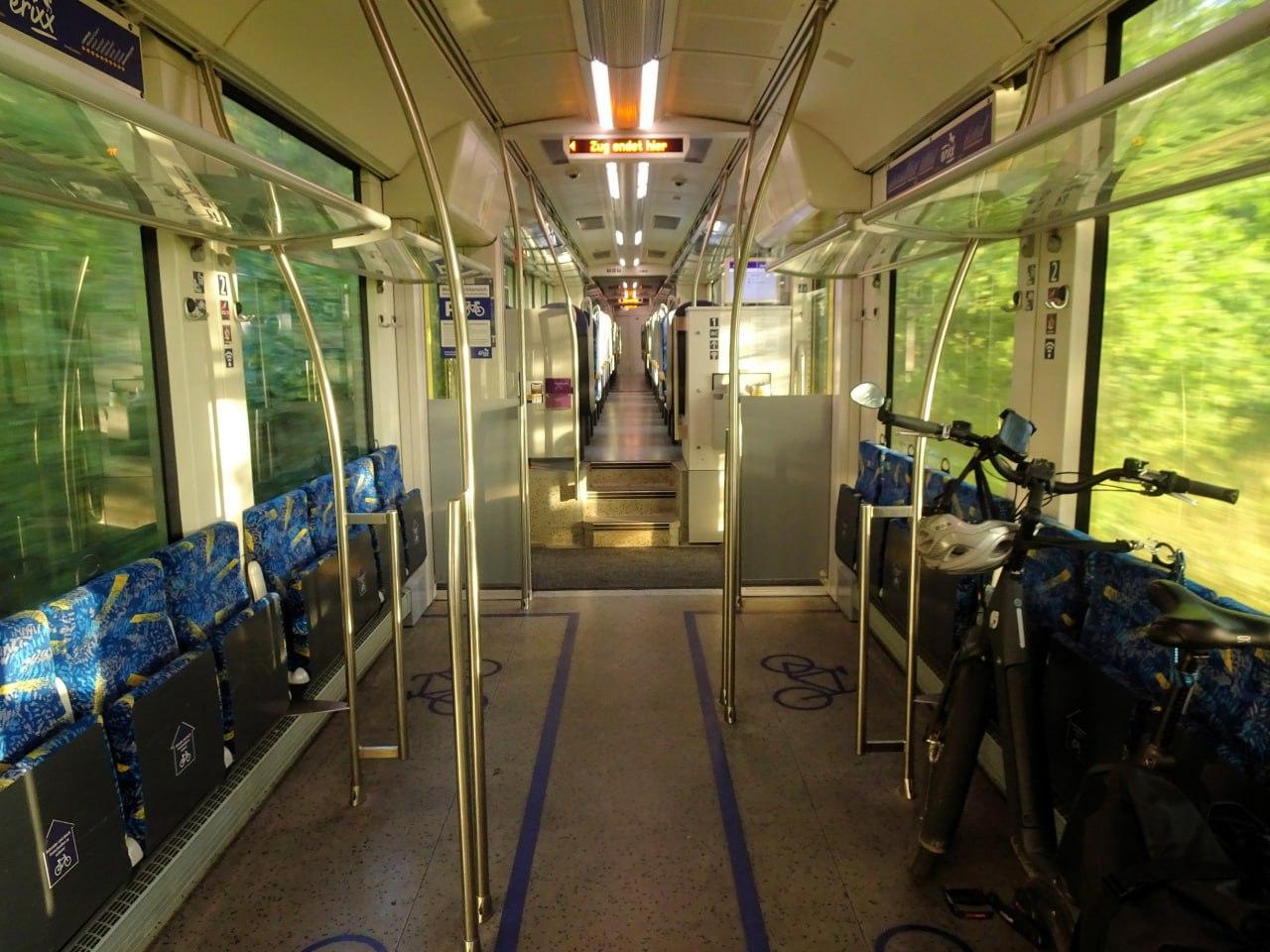
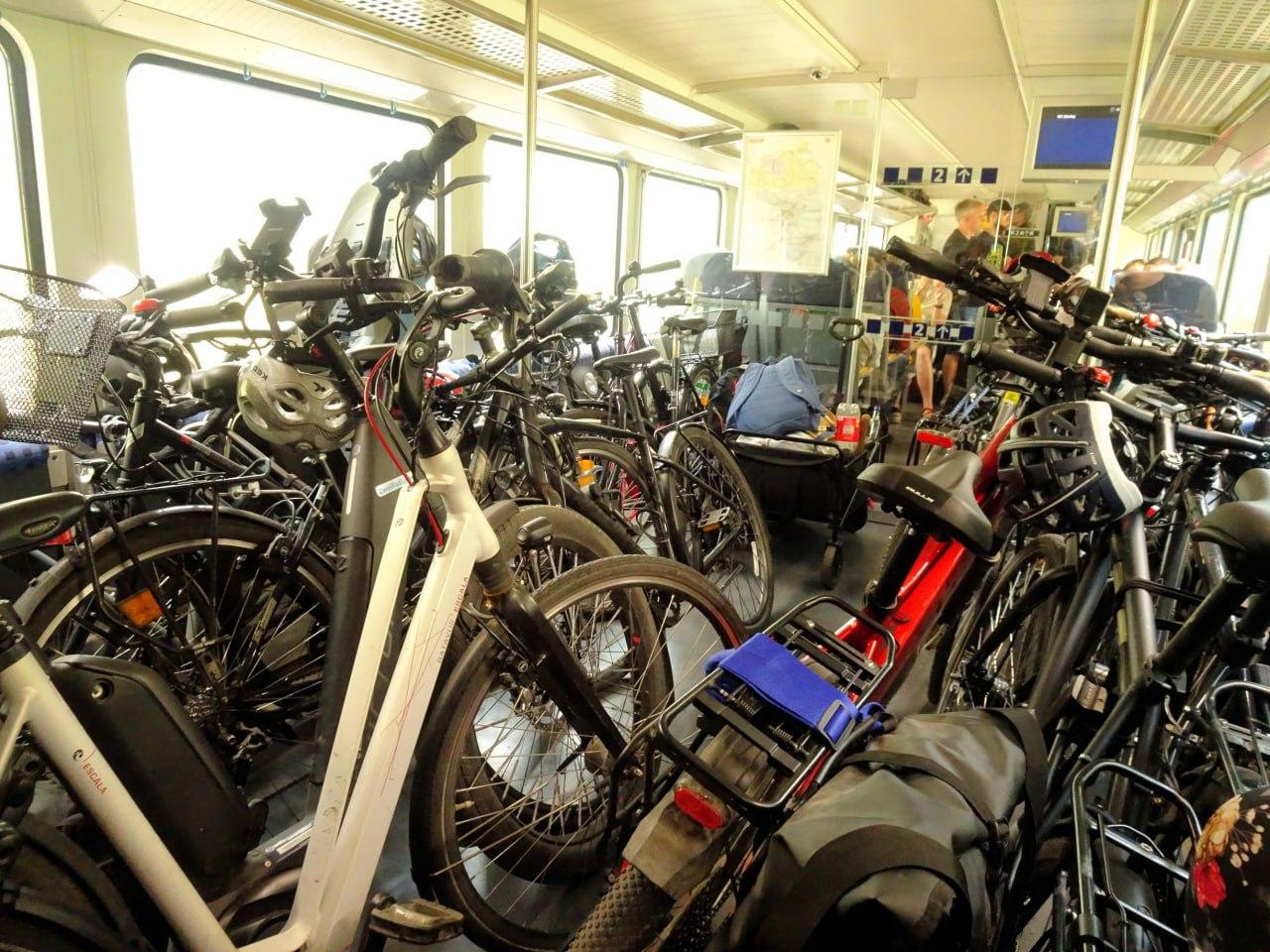
    Local trains in Germany like your example often do it pretty well: Easy access through wide doors, enough space, straps to secure the bike. (Challenge: Tell the people sitting in that compartment that the train offers so many empty seats for them, but it is mandatory that I have to use this space for my bike.).

    Most bike racks in German long distance trains are a mess. E.g. ICE 3: Bike rack for 3 (yes, only three!) bicycles per train with a bar above so my handlebars don't fit under the bar. (No, I don't have pictures, as I was arguing with the train conductor how to fit my bike in a rack I payed a lot of money for.) ICE 4 is doing way better, but still challenging. Check train material before you book!
    #bikenite

    An almost empty train compartment for bicycles in a local German train. (Own picture)
    A train compartment for bicycles in a local German train, crowded by many bikes. (Own picture)
    💬 0🔄 2⭐ 0
  • Oct 31, 2026, 12:17 AM

    @ascentale @ml @bikenite

    A7. Honestly, to me, the train cars and whatnot that have a horizontal bar and space where a bike can be leaned against the side are the easiest and most accessible ones. That wouldn't translate over to buses, however. I think for buses we're stuck with the front racks.

    #BikeNite

    💬 1🔄 2⭐ 2
  • Oct 31, 2026, 5:56 AM

    @theantlady @ascentale @ml @bikenite a7 #bikenite
    Busses are hard. I think that mostly around a city bikes on buses should be rare. Mostly that bus routes shouldn't need a personal mobility option for the stop to destination, it should be walkable (and buses should accommodate walking aids) but it does need the pt to be done well.

    Long distance bikes go under the floor with other luggage, but need some barriers to protect them.

    💬 1🔄 0⭐ 0
  • 💬 0🔄 3⭐ 0
  • Oct 31, 2026, 2:49 AM

    @ascentale @ml @bikenite
    #BikeNite A7. Not sure. It's a good question. I feel like bike racks on the front of buses are stressful and only accessible to the most able bodied riders. But getting bikes into a bus would be hard and remove a lot of space for passengers. Maybe buses could have a storage compartment that people could walk their bike on and store it with wheels on the ground.

    Otherwise, motorized lifts ...

    💬 0🔄 3⭐ 1
  • Oct 31, 2026, 9:17 AM

    @ascentale @bikenite A7. The lack of accessible cycle space on transit and trains is a real problem for me as a disabled cyclist who has a disability that affects her ability to lift as well. I currently ride a folding recumbent trike, but it's not a commuter fold like a Brompton. A strong abled person could probably fold it fast enough, but not me. And even if they did, the luggage area is not big enough for it...it would need to go into the cycle space but those are never built for anything but upright bicycles.

    I have given presentations about accessibility in cycling, but I'm not much of an engineer so I haven't been specific about exact rack solutions to this particular aspect of ableism in cycling/transportation/urbanism.

    Part of it involves wheelchair accessibility - that is, some of the trains, trams, and light rail systems I've taken have level boarding that immediately gets up to a second level inside with no ramp. We need things to be on a level with the platform and to stay on that level. Some rail I took in Austria managed this.

    On land, Sheffield racks or a single long bar are the best for their adaptability to locking up a number of different cycle designs. But on transit the difficulty with the bar is that abled upright riders can easily max out the space and there's nothing left for a trike/recumbent rider who's disabled. As much as possible, I'd want a design that works regardless if people are only thinking of themselves. If the design does most of the work, they you don't have to have rationing & policing.

    Some train cars I've seen were almost entirely dedicated to bikes (not cycles). So they had more room and the racks were meant for the bikes to go head or tail in. I think a system like this *might* work if the ones nearest the doors were reserved for wider/longer cycles like trikes/recumbents since they cannot go along the aisle and turn as easily to get to a center spot. And if the arms between the spaces were adjustable, then you could adjust the width of the spaces according to upright bike, cargo bike, trike, recumbent, etc. But it would still rely on (self-) policing more than I'd like.

    Ultimately, what works best for accessibility is cultural change. What I mean by this is that if abled people actually feel deep shame if they make things harder for disabled people, they will think about accessibility from the beginning, design well, and even any compromises will be maintained better due to the culture valuing accessibility over the personal convenience to abled people. But we're a long way from that in most cultures I know of.

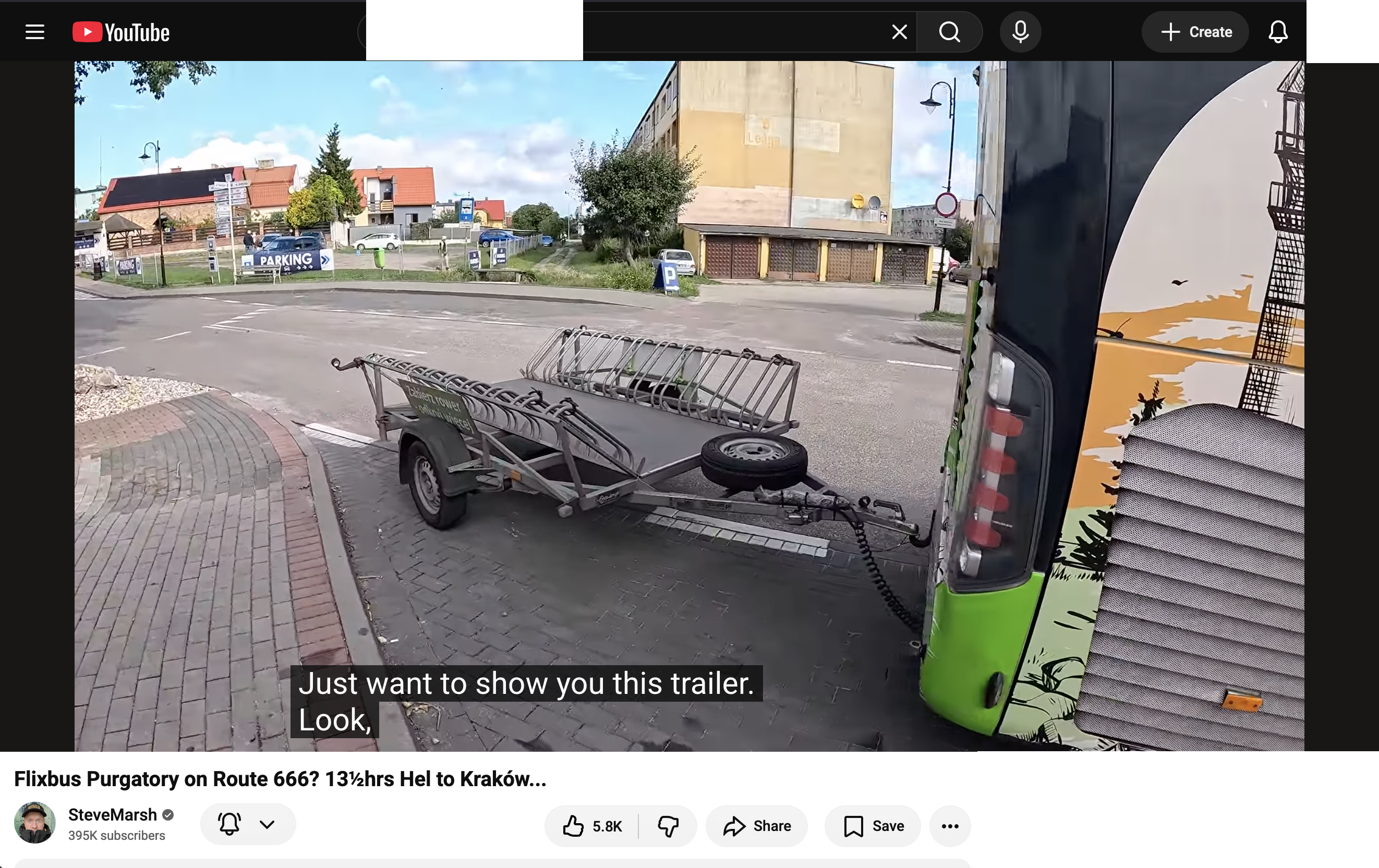
    In a Steve Marsh video, I saw a Flixbus that came with a bike trailer. Which was very cool! Except it was a wheelbender rack designed for upright bikes only. Perhaps articulated buses with one side being reserved for cycles, using better designed racks?

    Regardless, I think that making things accessible, and allowing people to travel with the sorts of things people end up having to buy or rent a car to have the freedom to take with them would do a LOT to shift folks out of personal cars.

    #BikeNite #Accessibility

    Screenshot of YouTube video titled "Flixbus Purgatory on Route 666? 13½hrs Hel to Kraków..." by Steve Marsh. Shown is the back of a typical bright green Flixbus with a plain metal trailer attached to it. The trailer is low and has no sides. It has a wheelbender rack on either side of the trailer and a spare trailer wheel stored on its tongue. A wheelbender rack is a type of rack which "holds" the front or rear wheel and that's the only support for it. Which, unlike something that holds the cycle frame, means that it is easy for the metal wheel rims to get bent if someone or something knocks against the cycle while the wheel is being held.

The captions are on so it says "just want to show you this trailer. Look,"
    💬 0🔄 5⭐ 0
  • 💬 0🔄 4⭐ 0