Login
You're viewing the functional.cafe public feed.
  • Nov 11, 2026, 8:44 AM

    Understanding something in your brain well enough to encode it as software means understanding it *better*, in the same way that writing isn't just putting words on a page but understanding what you are trying to say, programming can be about learning what you are trying to *do*.

    💬 4🔄 94⭐ 190

Replies

  • Nov 11, 2026, 8:45 AM

    The problem is that this only works if you can build abstractions that allow the proximal programming task to be built in terms of the nouns and verbs that the user cares about, and not endless Computer Stuff that only programmers will care about. But programmers, we _love_ Computer Stuff. And as I have tried in vain to make some tiny inroads into higher abstraction levels my little patch of the noosphere, "abstraction" means "editing more YAML files" everywhere else now.

    💬 3🔄 2⭐ 40
  • Nov 11, 2026, 8:47 AM

    Programming has in some sense never been more low-level. I normally don't like retrocomputing fetishism and there are many beautiful things about having piles of RAM and CPU to spare, but *socially*, the vast expanse of resources within our computers has lead to an explosion of complexity that fills those resources up. We have fallen farther and farther from that goal, to the point where I can barely see it any more.

    💬 3🔄 7⭐ 72
  • Nov 11, 2026, 8:49 AM

    And now, AI has arrived, to take that final step away from us. Don't bother understanding things. That's really hard. The AI says:

    It's fine. I'll just write the code _for_ you. All that YAML you need to edit? It's fine. Just tell me in english, I'll set up all the "boilerplate config". Never mind what it means. You don't need to understand the *details*. It's okay to just think at a *high level*.

    Don't worry about "mistakes". You can tell me to make no mistakes.

    💬 3🔄 20⭐ 93
  • Nov 11, 2026, 8:53 AM

    When I posted a short thread earlier about AI "anti-abstracting", this is what I meant. We've been falling further away from the light of user-legible abstraction for decades, into the abyss of Computer Stuff, until that light is barely visible, a smudge in the dark firmament above. The AI can put us out of our misery, create all the Computer Stuff we'll ever need, crush us beneath it, blotting out the light forever, making it so we never need to understand anything in precise detail ever again.

    💬 4🔄 16⭐ 85
  • Nov 11, 2026, 8:54 AM

    Well until it helpfully destroys the Computer Stuff again. And we'll be angry, but that's okay. We won't know why we are angry any more because we won't know what its happening any more, so we must not really be angry at all. The tools to express ourselves are gone. github.com/openai/codex/issues

    💬 3🔄 4⭐ 50
  • Nov 11, 2026, 9:02 AM

    The AI itself needs to be resisted, and, hopefully (in its current form) destroyed. But the AI isn't what got our field to this point, where the oppressive clutter of Computer Stuff is so pervasive and so exhausting that we would be willing to do anything, even surrender our own ability to *think*, just to be rid of it, just to be able to address the actual problem at hand. There is a crisis of tool complexity that we just *need* to find a way to address.

    💬 2🔄 49⭐ 120
  • Nov 11, 2026, 9:04 AM

    We are so invested right now, even the AI critics, in talking about how we produce code, how to get more code, how to get the right code, that we are dedicating almost no time to talking about how code produces _us_. How the collaborative practice of programming builds community, how the analytical practice of programming builds habits of thought. Maybe we need to start there, to talk about how we want our tools to shape ourselves before we can reimagine how we want to shape our tools.

    💬 11🔄 105⭐ 212
  • Nov 15, 2026, 1:37 AM

    … and therefore, Kubernetes is ontological violence.

    💬 4🔄 0⭐ 18
  • Nov 11, 2026, 9:18 AM

    @glyph thanks for this thread!

    It's echoing what I'm feeling about how to teach introduction to computer science right now, and I might just assign it as reading :)

    To me, recognizing that a lot of the value of a "computer science education" is now, but also has always been, the ways it sharpens your understanding of systems and processes, means that I might as well teach those things explicitly with programming as an example domain, rather than making "teach programming" my main goal. Do I want my students to understand how to write a "for" loop in Python, or do I want them to understand the nature of repetitive processes and edge cases to repetition, with "for loops in Python" being a nice controlled laboratory in which to learn about those things while also discussing them in non-code contexts?

    💬 1🔄 1⭐ 14
  • Nov 11, 2026, 5:31 PM

    @tiotasram FWIW, there's an old Lomonossow quote that possibly should be applied to programming:

    Mathematics should be studied if only for that it helps us organise our ideas.

    @glyph

    💬 0🔄 0⭐ 6
  • 💬 0🔄 0⭐ 5
  • Nov 11, 2026, 9:23 AM

    RE: mastodon.social/@jk/1154974641

    @glyph this is something i've been thinking about for a while, people don't like acknowledging that their tools are what create the possibility space that they inhabit, determine what they can and should desire, and which roles they adopt in trying to satisfy them. you see similar discomfort in considering topics like e.g. physical disability. that the faculties might be in charge of goals (rather than instrumental to them) inverts the accepted power dynamic in an uncomfortable way

    💬 1🔄 3⭐ 17
  • Nov 11, 2026, 3:52 PM

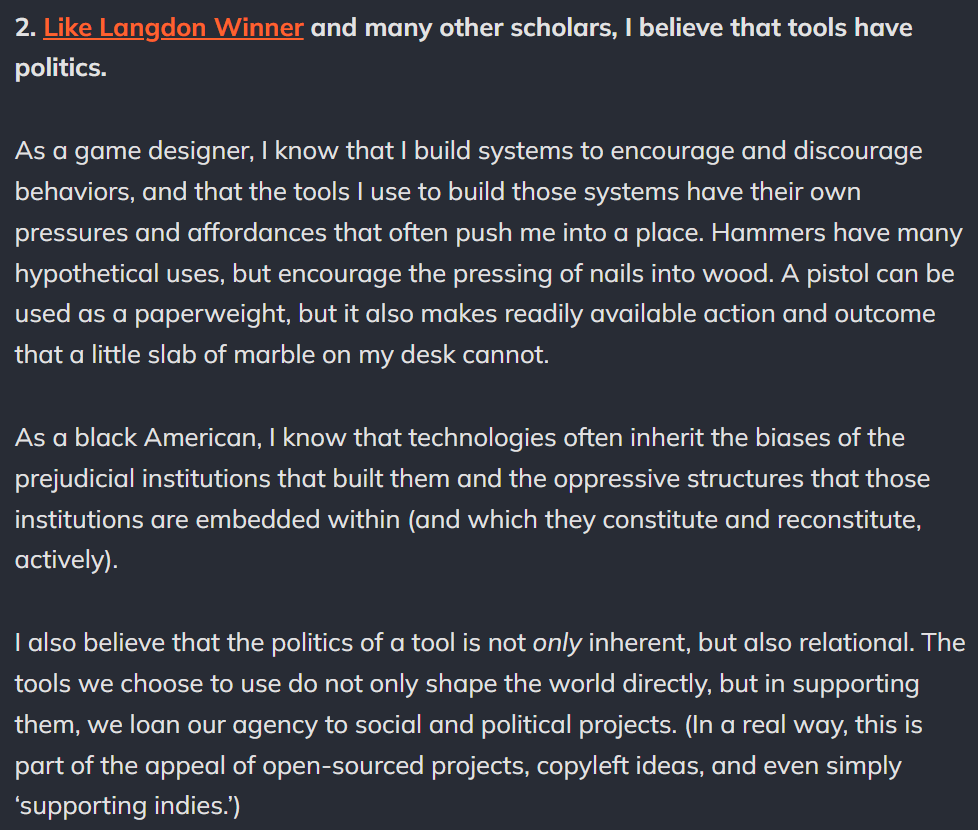
    @jk @glyph good except from austin walker's recent IGF post, which talks about relationship to "tools" and why "it's just a tool" is not the end of the story

    2. Like Langdon Winner and many other scholars, I believe that tools have politics. 

As a game designer, I know that I build systems to encourage and discourage behaviors, and that the tools I use to build those systems have their own pressures and affordances that often push me into a place. Hammers have many hypothetical uses, but encourage the pressing of nails into wood. A pistol can be used as a paperweight, but it also makes readily available action and outcome that a little slab of marble on my desk cannot.

As a black American, I know that technologies often inherit the biases of the prejudicial institutions that built them and the oppressive structures that those institutions are embedded within (and which they constitute and reconstitute, actively). 

I also believe that the politics of a tool is not only inherent, but also relational. The tools we choose to use do not only shape the world directly, but in supporting them, we loan our agency to social and political projects. (In a real way, this is part of the appeal of open-sourced projects, copyleft ideas, and even simply ‘supporting indies.’)
    💬 0🔄 0⭐ 4
  • 💬 0🔄 0⭐ 2
  • Nov 11, 2026, 4:03 PM

    @greg @glyph yeah, that framing (tools as having sprung from an oppressive structure with prejudiced goals) re:active choice is really important. the way tools shape us and eventually recontextualize their own use is a big part of how they become retrospectively inevitable, which allows a "tech tree" framing of history where There's No Stopping Progress etc

    💬 0🔄 0⭐ 1
  • 💬 0🔄 0⭐ 2
  • Nov 11, 2026, 10:43 AM

    @glyph I was with you right until this last paragraph.

    Yes, the insight of what the software's job is and whether that job actually needs to be done is fundamental.

    Yes, the explosion of capacity has led to abandonment of the part where we really grapple with what we want done and why.

    But I don't think the answer is more focus on us, and how the tools shape us.

    (At this point, I should highlight that in this context, "we" and "us" means programmers even though I personally have only ever been adjacent to the programming world, and my focus has always been primarily on getting a robot to do something useful, with software as one tool in that toolbox.)

    I think the answer is to try a new approach specifically aimed at helping people better focus on, understand, and express *what they want done*. Something deterministic and shared, like a periodic table or taxonomy of species or library cataloging system, but for tasks and behaviors / capabilities.

    Several years ago I had a Kuhnian insight for how to create such a thing. I've spent the time since trying to pummel it into something that other roboticists can understand, but first work and then long covid intervened and progress is slow. If you're interested, I'm happy to share.

    (Kuhn did not underestimate the challenge of explaining something that sits orthogonally to a field's preconceived notions.)


    💬 0🔄 0⭐ 1
  • 💬 0🔄 0⭐ 1
  • Nov 11, 2026, 3:51 PM

    @glyph thank you for writing this. A lot of this has reframed parts of my own thinking that weren't nailed down. If you're willing to just copy paste the contents of this thread into a blog post or a static file somewhere I'd love that. If not, totally get it.

    💬 0🔄 0⭐ 0
  • Nov 11, 2026, 6:10 PM

    @glyph @glyph The potential of «AI» to weaken our interactions and dissolve our communities is probably at the core of the vested interest of the technooligarchs marketing them. Divide et impera. Drug us dumb so that we come back for another dose.

    💬 0🔄 0⭐ 0
  • Nov 11, 2026, 7:15 PM

    @glyph this whole thread is excellent. Thinking about "how code makes us" also put me in mind of @TodePond 's work on tools for creativity, building things that work with, but also change, our minds and thought patterns.

    💬 0🔄 0⭐ 2
  • 💬 0🔄 0⭐ 0
  • 💬 0🔄 0⭐ 1
  • Nov 15, 2026, 1:58 AM

    @glyph

    I dunno, I personally think Kubernetes is right thing, right place, right time, for one fairly specific case. I actually kinda like it. At least in theory.

    💬 0🔄 0⭐ 1
  • Nov 15, 2026, 2:05 AM

    @fxchip in _principle_ the idea of motivating everything with control loops and convergent execution to declarative state is excellent. in practice Kubernetes is a mediocre implementation of this which requires way too much incidental complexity to drive. but this is all covered by the CW ;-)

    💬 0🔄 0⭐ 2
  • 💬 1🔄 0⭐ 0
  • 💬 1🔄 0⭐ 2
  • Nov 15, 2026, 2:58 AM

    @glyph It has Promotion Design all over it. Maybe I'll change my mind but so far it feels like 5 other things I have used for running (often) too many different (usually) poorly decomposed services.

    💬 0🔄 0⭐ 1
  • Nov 15, 2026, 7:57 AM

    @glyph me, reading only this post and not the big thread leading to this conclusion: yes, definitely, I have no questions

    💬 0🔄 0⭐ 9
  • Nov 11, 2026, 10:05 AM

    @glyph I love the phrase "solving a crisis by escalation" for this. Software has been in a complexity crisis for a long time, and we keep trying to solve it by hiding things behind more layers of complexity. This is a largely a social failing. You don't need to coordinate with anyone if all you do is wrapping and layering and isolating existing stuff. To simplify, to get rid of needles complexity, you need to work holistically across the stack, which means you need to talk to people, a lot of people, and have hard conversations. No one is paying you to do that.

    💬 2🔄 5⭐ 16
  • Nov 11, 2026, 2:15 PM

    @plexus @glyph

    This.

    The software I work on should have had its domain modeled by mathematicians, but that is definitely not what happened.

    Some managers think that the problem is in the code. Yeah, there are certainly a lot of code issues. But even a complete re-write of the application software won't fix the underlying domain modeling issues.

    💬 0🔄 0⭐ 1
  • Nov 15, 2026, 12:45 PM

    @plexus @glyph Pardon me if this is a bit of a tangent. "Solving a crisis by escalation." I think that has been the norm for decades in my own field of work, accessibility.

    If we take as a given that the world isn't designed for disabled people, that most software developers, website authors, etc. won't ever voluntarily make stuff accessible to us, and that that's never going to change (though we do have legal victories from time to time), then the only option is to pile on complexity.

    💬 1🔄 0⭐ 0
  • Nov 15, 2026, 12:46 PM

    @plexus @glyph As much complexity as our current computing hardware will allow. Never mind any thought of implementing a simple, elegant solution. There are things that need to be made accessible *now*. And now we have AI to help us pile on that complexity faster.

    💬 0🔄 0⭐ 0
  • Nov 11, 2026, 9:07 AM

    @glyph thank you for that thread, it captures something important about learning, and software dev as a medium for learning.

    💬 0🔄 0⭐ 1
  • 💬 0🔄 1⭐ 5
  • 💬 0🔄 0⭐ 0
  • 💬 0🔄 0⭐ 0
  • Nov 11, 2026, 10:49 PM

    @glyph Bryan Cantrill, not even an AI hater, called it (wrt this effect and its lack of laziness) a "McKinsey consultant slot machine" in his latest talk.

    I think that's a perfect description in another sense as well: just think for a moment that some people are letting McKinsey consultants into fun hobbies like demoscene!!

    💬 0🔄 0⭐ 0
  • Nov 11, 2026, 8:57 AM

    @glyph yes, programming, same as writing, is a process of formalising and crystallising logic and structure from our abstract thoughts. What we're doing today is outsourcing thinking. It's a dangerous road.

    💬 0🔄 1⭐ 7
  • Matttidestakemeaway@mastodon.art
    Nov 12, 2026, 11:24 AM

    @glyph AI is made by and for the "ideas people", who think that the existence of the people who do the actual *making* of something is an unfortunate side-effect of bringing a product to market. Even the use of "high level" is chosen for positive connotations, because "shallow understanding" sounds negative, despite being the same thing in this context.

    💬 0🔄 0⭐ 0
  • Nov 11, 2026, 5:28 PM

    @glyph A big problem with retrocomputing programming is, "new" programming languages often eschew "old" hardware needlessly, without a good reason. If they didn't, new and advanced abstractions could come in really handy in programming old machines, as well as new-but-small machines.

    💬 0🔄 0⭐ 0
  • Nov 15, 2026, 1:08 PM

    @glyph Re: "an explosion of complexity", I feel like this peaked sometime in the late 2010s with peak microservices (and yes, Kubernetes), but at least in very online programming communities, the pendulum has swung the other way, with people at least looking at doing whole web apps as a single binary that can run on a Pie.

    Of course, LLMs are now consuming vast amounts of resources. But I don't *think* the LLMs themselves are the kind of complexity you're talking about here.

    💬 1🔄 0⭐ 0
  • Nov 15, 2026, 6:15 PM

    @matt The LLMs themselves are just an API that you use, and one that's relatively simple at that. But the code they produce does tend to mirror this style of complexity, where they pointlessly create the same utility classes over and over again with slightly different names.

    My only evidence for the complexity curve here is "vibes", I don't know how I'd quantify it, so I don't know that I could identify the peak.

    💬 1🔄 0⭐ 0
  • Nov 15, 2026, 6:16 PM

    @matt But between COVID despair and now AI despair, I don't see a lot of attempts at managing this complexity; I do agree that things aren't getting much *worse* but I also don't see a resurgence of the monolith or small-business framing vs. startup; just a lot of startups stretched to their breaking points

    💬 2🔄 0⭐ 0
  • Nov 15, 2026, 6:20 PM

    @matt like the normal way that I get a sense for this stuff is to look at what kind of tooling and best practices conference talks are suggesting, and the talks that I see in the last few years are like "resisting end-times fascism" or "for the love of god please remember that we're human beings" or "replacing your brain with a private datacenter full of GPUs" and so it just doesn't give the impression that getting rid of the YAML is a priority

    💬 0🔄 0⭐ 0
  • Nov 15, 2026, 6:24 PM

    @glyph I'm embarrassed to admit this now, but as far as I knew, in the late 2010s and early 2020s, the loudest voice that I knew of pushing for the monolith or small-business framing was DHH, and I bought into what he was saying. Search for "majestic monolith", "conceptual compression", and "one-person framework".

    💬 1🔄 0⭐ 0
  • Nov 15, 2026, 6:26 PM

    @matt eh, no need to be embarrassed about that. I also agreed with a lot of what he was saying at the time. And it's not like he never knew how to build software, he *was* a very successful "enterprise software" iconoclast before he decided to become a full-time racist

    💬 0🔄 0⭐ 0
  • 💬 0🔄 0⭐ 0
  • Nov 11, 2026, 5:26 PM

    @glyph FWIW, I've been looking heavily into a programming language that would also have prepositions and pronouns. No luck so far, although Smalltalk has sort of tried. Might end up hacking something together in my #CopiousFreeTime.

    💬 0🔄 0⭐ 1
  • 💬 1🔄 0⭐ 0
  • Nov 11, 2026, 5:33 PM

    @glyph No I haven't. It was before my time, and I only vaguely know of it from my retrocomputing interests.

    I'll make a point to read up on it.

    💬 0🔄 0⭐ 0
  • Nov 11, 2026, 9:01 AM

    @glyph editing taught me the same lesson from the other side. The paragraph that won't close is usually hiding a claim I can't actually defend, and drafting is how I find that out. But the analogy has a soft spot: a fluent implementation of a misunderstanding still runs, and running feels exactly like understanding. The test isn't that it works, it's that it survives the case you didn't design for. Your million-dollar deletion, though, is the purest editing move there is. The best edits are cuts.

    💬 0🔄 2⭐ 0
  • 💬 3🔄 3⭐ 3
  • 💬 1🔄 0⭐ 1
  • 💬 0🔄 1⭐ 1
  • Nov 11, 2026, 1:05 PM

    @glyph took me a long time to learn it as a rule instead of an accident. The cut that hurts is usually the right one, and the sentence I'm proudest of is usually the thing keeping the piece from closing. These days affection for a line reads as a warning label to me.

    💬 0🔄 0⭐ 0
  • Nov 12, 2026, 1:16 AM

    @glyph film editors got there before either of us. they call the first assembly every scene you loved shooting, and say the movie only starts existing once most of it is gone. writing found the same rule, debugging found the same rule. three crafts arriving at one instinct is probably a hint about where the rule lives.

    💬 0🔄 3⭐ 0
  • Nov 11, 2026, 10:56 AM

    @glyph There is a lot in common in this respect between computer programming and statistic modelling. In the latter, AI just piled up on ML, which can be a powerful tool but also made people confident they could model phenomenon without understanding anything about them. I witnessed this directly during my brief period working as an actuary, it was driving me mad already.

    💬 0🔄 0⭐ 0
  • Nov 11, 2026, 6:17 PM

    @glyph

    For my master's thesis, I wrote a program. Not because I had to - none of my professors would have even thought of suggesting that to me. But I needed to spell out what I was trying to do - a method to analyse music - as specific as possible, without leaving loopholes. So, programming it was.

    The output of the program? Vaguely interesting, but could have gone without it. What I learned during the process? Valuable.

    💬 1🔄 6⭐ 15
  • 💬 0🔄 1⭐ 2