nothackingnothacking@infosec.exchange
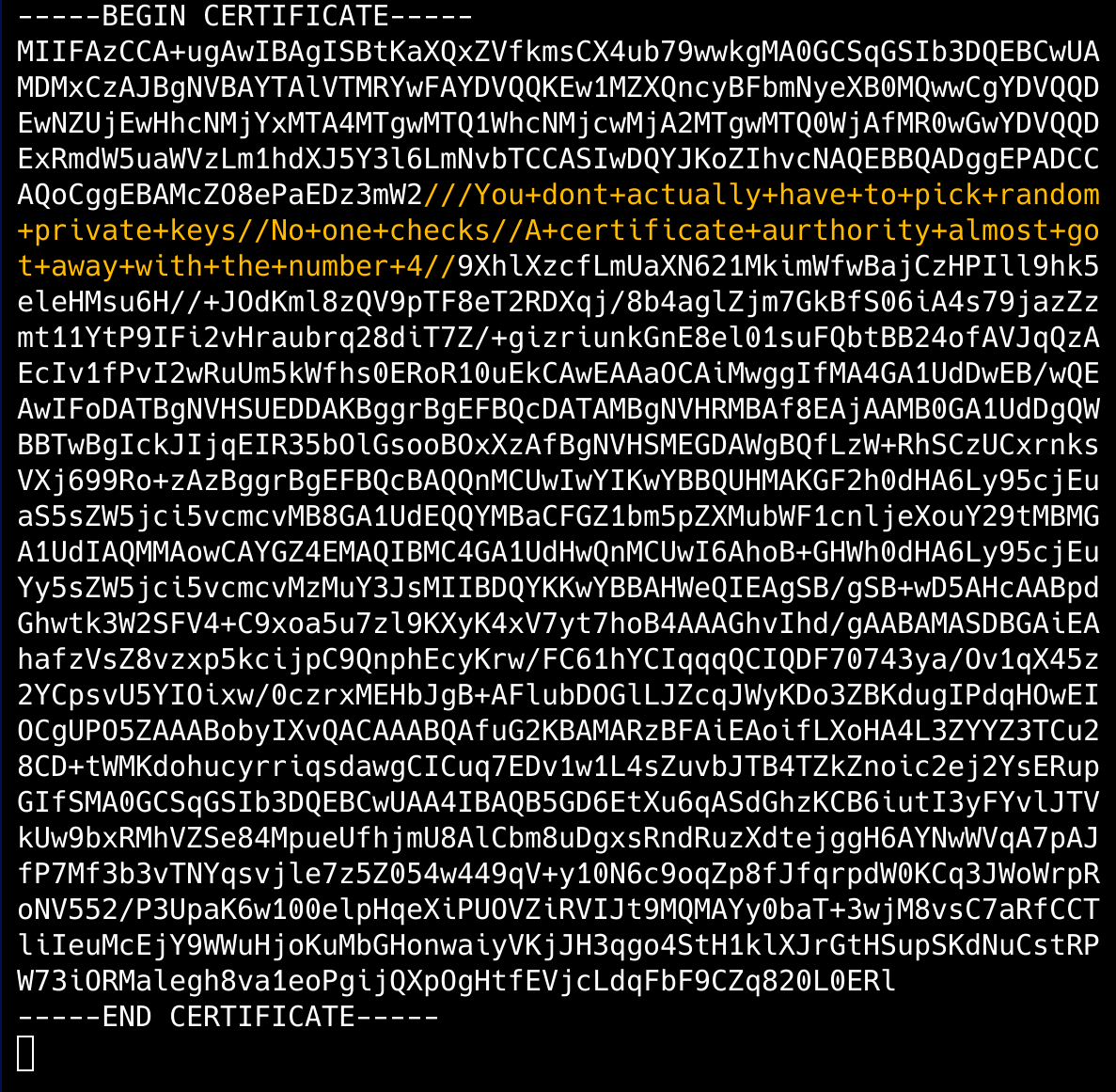
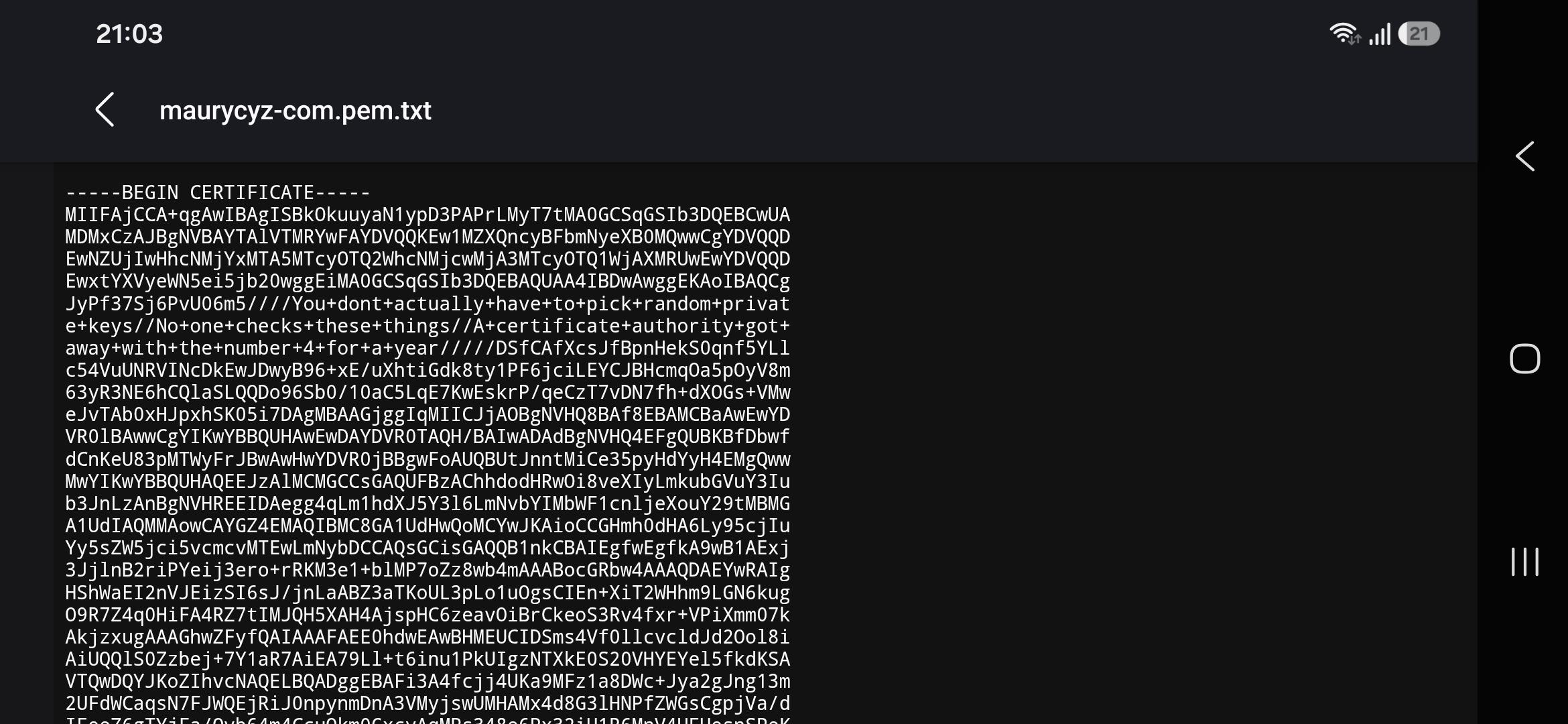
Nov 8, 2026, 7:35 PMCheck out my new TLS certificate: yes, Let's Encrypt signed this and yes, it works.
 Nov 8, 2026, 7:38 PM
@nothacking@infosec.exchange cool website :neocat_overjoyed:
 Nov 8, 2026, 8:53 PMNov 8, 2026, 7:44 PM
@nothacking@infosec.exchange iirc they do do a short bruteforce so super tiny private keys dont work but the limit is very low

@stag @nothacking They must not have been doing this in 2025, though!
Nov 8, 2026, 8:27 PM@stilescrisis@mastodon.gamedev.place @nothacking@infosec.exchange yeah seems like it was added as of oct 20 2026 https://github.com/letsencrypt/boulder/releases/tag/v0.20261020.1 and checks up to 255
@stag @stilescrisis @nothacking Can't wait for the sequel to 4: 256
 Nov 8, 2026, 7:54 PM

@wonka @benbe @nothacking yeah, fun fact is, those aren't necessarily insecure. That concept is called a "Vanity RSA key", see https://badkeys.info/docs/vanity.html - what would you expect Let's Encrypt should check here, and do you think they should reject it? (Based on which criteria?)
@hanno @wonka @benbe @nothacking What if OP was selecting a private key instead of a public key like in this case?
@BucciaBuccia @wonka @benbe @nothacking I don't understand that question. What do you mean exactly?
@hanno @wonka @benbe @nothacking My intuition is that vanity keys limit the key space, because they impose a pattern or constraint. Under the premise, is it worse to limit the public key or the private key?
@BucciaBuccia @wonka @benbe @nothacking Sorry, question still makes no sense. The whole concept of vanity RSA keys only exist for the public key part.
 Nov 9, 2026, 2:35 AM

@hanno Now I'm imagining a "vanity private RSA key" as a complement to a ring with a hidden diamond on the inside of a plain looking band: https://joalys-paris.com/en/guides/diamonds-inside-ring @BucciaBuccia @wonka @benbe @nothacking
-----BEGIN RSA PRIVATE KEY-----
MIIEoAIBAAKCAQAryWObd6p1/aaZwQneaINL4lslkGOesxFzujQkoPiIzOxVWMHs
///Double+Vanity///this/key/has/a/vanity/prime/and/public/key///
Io/C4HvWPYPgZ/X++2CpbhHG6/lVQgG2eP5340ZadjTl90b4qNJk2MXsZhK5j1c4
cD1unEZdpCQx/ePawiMYU2yP+dy6w+InhsnqbcDMJtSXhpzWHPXc842j3LY7Y4ZN
N3LxRkBRXK05v54akC+/+7e8xBQOhCYX6YOG/99VKSpu75TznDMcxSLxR6hg7vkA
1U/GPb7au76hv+yiJ91iOM1IAoPOA7H8eePrAgMBAAECggEACaQYGH0qvTwSWLxW
TfA5KJY4d3bpWGIZL6AKJx6CWqy0RL58RJDBYfQWXuT+xQsaigGv+j6WezLILAtk
f1xpYeN9sZ45wDcgxsQIL1BDb1gVvCAyx5x2hvQikDOPO/PoCDKVP/kKVQBUL9+O
vPy7Gu6h6P0p/JCLweh6GtZYDgrSZRMRvWTFcsYZAFpuF+lGPHr/CDg31VYwQ6ve
33+660rFSyTZ5BCfkyNgm8G0gkWYWNy2rXzPdaBOWsRwSOFPl8ld2avfCsYGVVkk
dixOsO6uOSsBRV4IQjZbF0SFJqvtZQmCRspkUShug9Kdr0HRec8ony+Gbf0MSiL6
4pTsAQKBgCyewgEyjcHBUztfvv4smjFfkS6YMD7B6aZj176HlJ0gE71Wk1LZS3pe
SW2WUap1/GYScJOCAoAQwQD1gLKssmZ5cHwfh7V8EjEI5JnXGwX90bx4+iQ49KFJ
B7kAAAAAAAAAAAAAAAAAAAAAAAAAAAAAAAAAAAAAAAAAAAAAAAEBAoGBAPs31eh7
o6FUuzD8D2YzhttcQ83yJzkPfbc2GXmbpFs3vztzaMTAa/a5M7o/2Y2rOyKX6rB5
m6/PGmmiRrlrNZZGYVlg6RXl6fawnlhI4f1s128c4WH1sy3aFDkm9c9Tnan+Yoxs
lEEOt4Y4ohmk/MMpeK8uNATIf4MAzTZ7gPjrAoGAHPCTD8fEHWjQHPBKpfwzvdYo
Cbp3gByw+FRFd7Pj9cz6QJFIWDHLPICuyz71lMOVgnZvQZzPFlTHeWHBqSFNTB1z
kW25zUG9YsRL0GOtiUNIpx8nzhqKv5joQ1r2pQla9qUJWvalCVr2pQla9qUJWval
CVr2pQla9qUJWvalCgECgYBqKEgeO9EDpbiMlJc1SuTb4XtNldx5QlCPkS7mspyb
Z01KJBTLv7xfwBdZxw15zjfpAGVOObVOb6frp4VXaTR10jvk9wzIEiXx9uSSzgmh
e9L1wzCCor8ayyLsm8gX2m+vnC2sxV1IuJ1Y/KmTSKL/HZFABbg5pTgs9bPCKCJy
DQKBgCJnkdWxL4d48cN4b2GS1jUTX+qp5KYVJkuDgfw2dXGoW9JRw3p8CAbZEMjY
PviP1i16gtCFBG71KTZ7gQzyZTBOWomSzgKamCbon4hct2/utbBPitLnbV76USUN
KGzt11D2DGL3ETeHK1Vr1XnDNQ06u9qcgTjgT+Opj+rjxPgY
-----END RSA PRIVATE KEY-----
@hanno @wonka @benbe @nothacking The only reason they could have for rejecting it is fear it undermines the trust in LE. As you say though, it's not necessarily insecure, there's no real way to automate the check and if you want an insecure key for your site that's on you.

@hanno @wonka @benbe @nothacking
I actually don't get. I/you generate something and ask Let'sEncrypt to certify that "that" comes/relates to domain. Why should it be checked, only as a matter of cortecy?
I/you responsible for what we ask to be stamped.

@nothacking To be fair, this is in the _public_ key.
In your case, the string is part of the RSA modulus, which is supposed to be a product of two primes.
It also seems to be in the topmost bits of the modulus, as your entire modulus appears to be:
```
AMcZO8ePaEDz3mW2///You+dont+actually+have+to+pick+random+private+keys//No+on
e+checks//A+certificate+aurthority+almost+got+away+with+the+number+4//9XhlXz
cfLmUaXN621MkimWfwBajCzHPIll9hk5eleHMsu6H//+JOdKml8zQV9pTF8eT2RDXqj/8b4aglZj
m7GkBfS06iA4s79jazZzmt11YtP9IFi2vHraubrq28diT7Z/+gizriunkGnE8el01suFQbtBB24o
fAVJqQzAEcIv1fPvI2wRuUm5kWfhs0ERoR10uEk=
```
The way I'd do this is:
- Choose prime p at random the usual RSA way.
- Choose prime q at random the usual RSA way, _except_ the RNG is constrained to only generate primes q such that p*q has the desired prefix.
- The `AMcZO8ePaEDz3mW2` part is probably fixed and chosen once.
- That way, you simply pick q between `AMcZO8ePaEDz3mW2///You+[...]+number+4/////...` / p and `AMcZO8ePaEDz3mW2///You+[...]+number+5AAAAA...` / p at random, as the only algorithm change.
- As the fixed prefix is much shorter than half the product, and as p and q are half the length of the product and prime density is 1/ln(n), there should be lots of q available for this to work.
I conclude your RSA key should actually be OK... kinda.
(p, q) = gen_rsa_key();
n = p * q;
vanity_n = hide_message(n);
vanity_q = vanity_n / p;
vanity_q = find_next_prime(vanity_q);
return (p, vanity_q);
If you already have one of the primes and want a particular public key, it's possible to calculate what the other "prime" by division. However, the resulting number is very unlikely to actually be a prime or even an integer.
@nothacking Yeah, you need that too, but it's basically irrelevant for security of your cert. Just important for it to work ;)
@divVerent @nothacking is the signature refused if they are not prime numbers?
@nothacking @assimilateborg There is, multi-prime RSA is a thing.
But you then have to compute the private exponent differently. Otherwise your key simply won't _work_. And you can't store the private key in the usual formats that are used for 2-prime RSA, as the CRT parameters will work differently.
LE or another CA can't detect if you did that or not, and in fact, multi-prime RSA is actually a thing.
@nothacking That method is probably somewhat worse than the method I described, but easier to implement.
First of all, this makes q likely to be a prime after a large block of composites. Kinda biasing q. Not sure if there are known attacks for this property, but definitely a bias. Doesn't seem to be huge though, you maybe lost one bit of entropy there.
Secondly, you basically ignored every other fun requirement RSA primes should have... but it seems like your primes _likely_ fulfill them, as p and q are unlikely - but possible - to become too close after your manipulation.

@divVerent @nothacking Any process for selecting a prime works this way. As numbers get large, primes get sparse, and you'll have large blocks of composites next to most.
@nothacking Nothing wrong with vanity pubkeys. RSA makes them easy without any significant loss of security. Doing them with EC is much harder.

tbf it's kinda hard to tell if a single number is random or not ;)

@nothacking your site shows the command prompt to get the text.
Well I made it a little better:
openssl s_client -connect funnies.maurycyz.com:443 2>/dev/null </dev/null | awk '/\/\//,/\/\/+/' | sed 's,//,\n,g;s/+/ /g'

@nothacking huh I just got served a txt file with just an openssl command on it from that URL
@nothacking ok it happened again

@anselmschueler @nothacking That's the intention. I'm guessing OP created the funnies subdomain for funny stuff like this. The command is how to check the certificate they posted above works. A web page could be an empty string or any text, it doesn't have to be whizzbang fonts and sliding images.
This is a beautiful webpage because it has no more information than needed to convey the concept.
@nothacking not almost, they merely got caught afterwards…
@nothacking to be fair, this isn't really possible to check? any kind of statistical checking on the CA's part would actually *reduce* security, since it reduces the space of keys that need to be searched.

@nothacking obviously the only real choice should be 73.

suckerpinch did a valid but busted cert too
https://www.youtube.com/watch?v=M1si1y5lvkk

@rootkitty @nothacking and @tom7 is actually on fedi
@nothacking Stunning!
You could add a hint to press Ctrl-D to the website.

@nothacking some exotic factorization-based schemes actually use this for public key compression. You can set up to ⅔ of the upper public key bits to some public random constant and just send the remaining bits

@nothacking@infosec.exchange Do certificates have to follow a specific format or length, or would just random alphanumeric + some symbols do?
Would that mean I can literally just keysmash and say it's a cert???

@nothacking@infosec.exchange
Fun fact: Every once in awhile I make a password a random string of 32 characters, followed by some personal joke that is just for me. I save it in my password manager. Then, if I ever look at the password, I will be reminded of whatever joke I made at the time.

@nothacking lol, awesome 🙂

@nothacking @ryanc - this feels like stupid certificate tricks. https://rya.nc/cert-tricks.html
@nothacking @ryanc NM, i didnt read the whole thread, this was posted already.
oh well, enjoy the boost i guess.
Nov 9, 2026, 9:38 PM@kajer @nothacking yeah, I don't have the certificate live any more, but it absolutely still works
@nothacking how did you get them to sign that?