Greg EgangregeganSF@mathstodon.xyz
5h agoretooted James Gleick
Are you getting chummy with your new AI friend? Finally, you’ve found someone who understands?
Here’s why that’s not good.
Are you getting chummy with your new AI friend? Finally, you’ve found someone who understands?
Here’s why that’s not good.
My dad has an iPhone 18 Pro Max. He's been using Apple's Braille Screen Input on it with great success. Then last night, it suddenly stopped working well for him, and he hasn't figured out what happened or how to fix it. He can type things like a full cell, dots 4-5-6, l, etc. but can't type real words on it. Anyone know what might have gone wrong? Please boost for reach. Thanks.
@gregeganSF @tsrono I hope the MRI helps the doctor help you heal. Hopefully they gave you earplugs because it’s actually very loud in there. Anyway, here’s an album made entirely from the sound of an MRI machine. https://staalplaatlabel.bandcamp.com/album/magnetostriction
Today I had my first ever diffusion-weighted MRI scan, Some people dislike the noises from MRI machines, but all the beeping and buzzing sounded quite hypnotic to me, like a kind of minimalist ambient techno music. Maybe the devices are actually silent, and the manufacturers secretly hired Brian Eno to compose a soundtrack that would make them seem more mysterious and impressive.
But MRI is impressive enough on its own. The hand-wavy explanation is that nuclear spins lined up in a magnetic field are made to precess by applying an oscillating, orthogonal magnetic field, and then as the excited spins relax they emit radio waves at a frequency that’s highly sensitive to the magnetic field at the nucleus, which includes contributions from its particular chemical environment.
The details are quite subtle; the spins do not relax by spontaneous emission, but from interactions between all the nuclei.
[See https://en.wikipedia.org/wiki/Spin–lattice_relaxation and https://en.wikipedia.org/wiki/Spin–spin_relaxation ]
Gradients in the imposed magnetic field make it possible to identify where in the body the signal originates. But if a water molecule moves through this gradient while its spin is relaxing, that modifies the signal. Diffusion-weighted MRI exploits this, to discriminate between, say, water inside a cell and in various extracellular environments.
The fanciest version, diffusion tensor imaging, can determine the *direction* water is diffusing along neurons, mapping connectivity between brain regions!
But the purpose of my scan was to measure the “cellularity” of my bone marrow, to see where, and to what degree, the intracellular vs extracellular water ratio has been elevated by a pesky clone of over-reproducing plasma cells.
It’s now possible to be overwhelmed, not by the vast quantity of claimed proofs and counterexamples recently disgorged by OpenAI (most of which would be over my head), but merely by trying to read all the reactions of expert mathematicians to the vast quantity of claimed proofs and counterexamples recently disgorged by OpenAI.
“100+ reactions to 100+ solutions”
https://proofsandprompts.com/2026/10/08/100-reactions-to-100-solutions/
They’ve just withdrawn three of the papers:
* Algebraicity of Weil classes on split abelian eightfolds
* Algebraicity of Kuga–Satake Correspondences for K3 Surfaces
* The rational Hodge conjecture for products of K3 surfaces
“It was touted as the biggest float since Telstra in the 1990s, but the share market debut of data centre operator Firmus is in trouble before it has even hit the share market.”
Is it just me, or does “Firmus” sound like an inept, narcissistic villain from Futurama or Rick and Morty?
https://www.abc.net.au/news/2026-10-08/firmus-ipo-underwhelms-before-it-hits-the-market/107241548
* Edited to add: Elsewhere, someone told me “Firmus Piett was a Star Wars middle manager.”
Which is kind of hilarious, and worst of all, possibly deliberate.
LUX–ZEPLIN dark matter detector: 7 tonnes of ultra-pure liquid xenon
IceCube Neutrino observatory: a cubic kilometre of ancient, pristine Antarctic ice
KM3NeT: a cubic kilometre of the Mediterranean. May contain plankton, fish poo and Vibrio cholerae.
@gregeganSF just by chance I found this. So, now there're doubts that neutrinos can be used for communication in the way previously proposed: https://news.mit.edu/2026/new-research-shows-neutrino-laser-impossible-0902
Head of climate action residents’ group: "We cannot dig up coal, ship it overseas, watch it drive climate change, and then pretend the consequences have nothing to do with us and won't be felt by us."
3/5 judges in Australia’s High Court just agreed.
https://www.abc.net.au/news/2026-10-07/mount-pleasant-coal-mine-high-court-ruling/107233650
Don’t you hate it when someone mixes up the Nobel Prizes and inserts ion channels in your neurons that open when exposed to neutrinos instead of light, and your brain just goes pffzzz ....
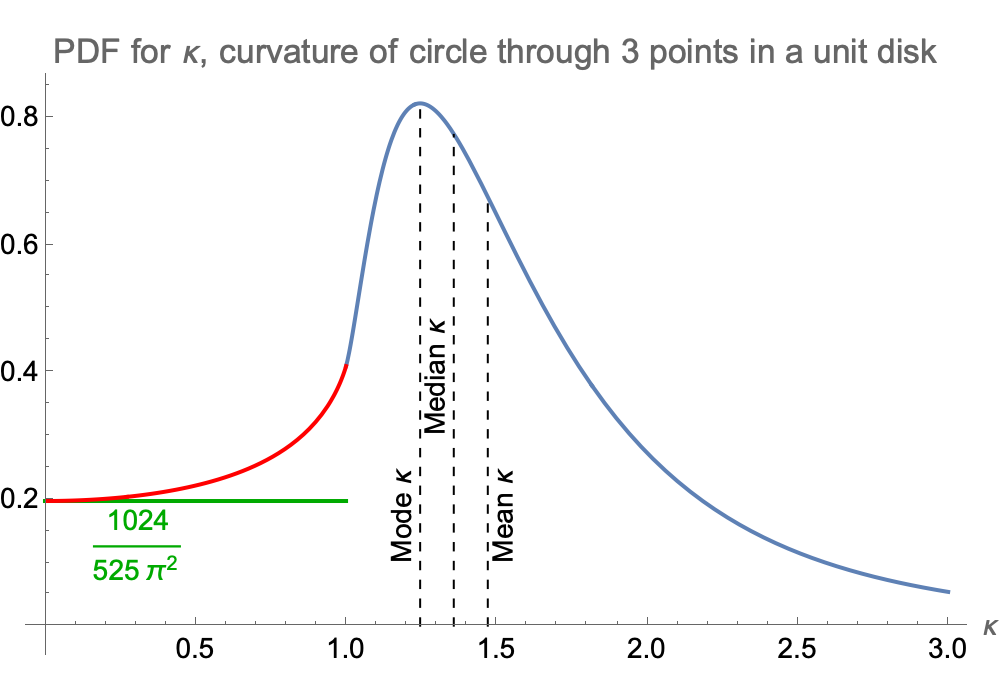
If you pick 3 points at random in the unit disk, the probability that they lie on a perfectly straight line is zero.
However, the probability that the curvature of the circle they lie on is less than ε is, in the limit of small ε, equal to:
1024 ε / (525 π²)
≈ 0.2 ε
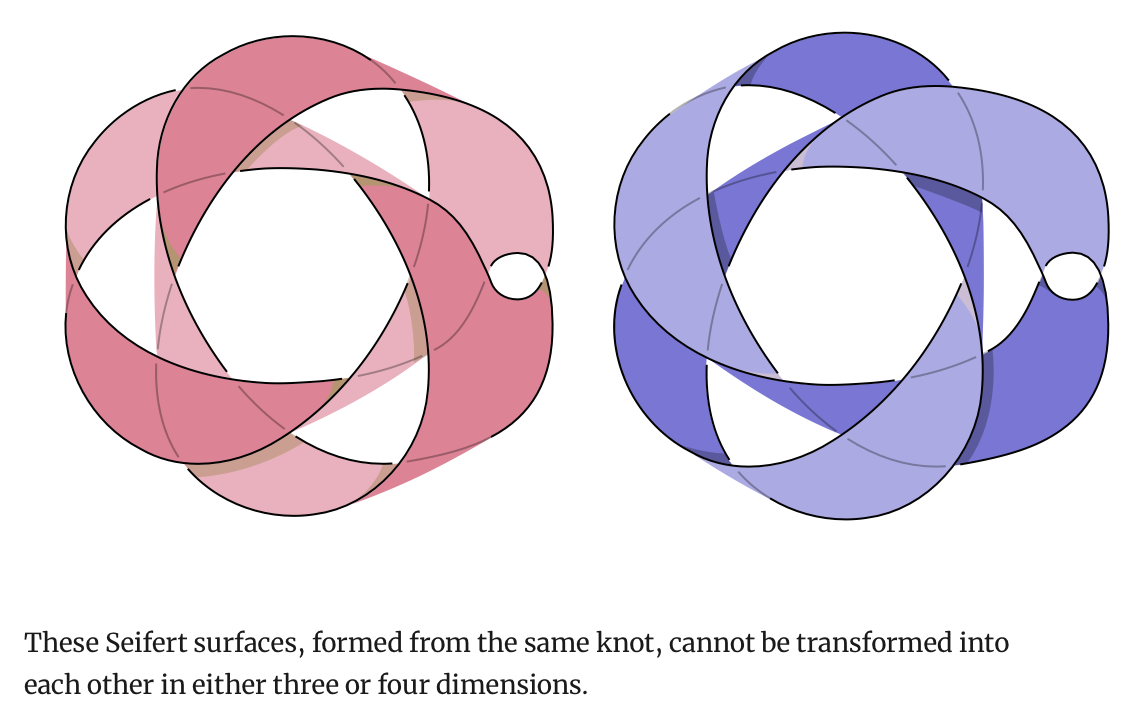
If you listen to the latest “Joy of Why” podcast, where the guest is topologist Maggie Miller, it will help a lot if you first read this @QuantaMagazine article on Miller’s work on Seifert surfaces:
https://quantamagazine.org/special-surfaces-remain-distinct-in-four-dimensions-20220616/
It includes an image of two surfaces whose boundary is the same knot, but which cannot be deformed into each other when embedded in either 3 or 4 dimensions.
I don’t know what cheesy LLM these scammers are using, but the glitches can be hilarious.
[Though I have written a novel called “Morphotrophic”, “Morphological Regency” sounds like a token midway between that and the average of all titles on Smashwords.]
Fabrice Bellard
A French engineer who lives quietly in Paris has spent 30 years writing software that the entire internet now runs on without knowing his name.
He wrote the code that streams every YouTube video, every Netflix show, every TikTok clip. He wrote the code that runs the virtual servers underneath AWS, Google Cloud, and Microsoft Azure. He calculated more digits of pi than anyone in history. He has no Twitter. He has no marketing. He just keeps shipping.
His name is Fabrice Bellard.
Here is the story, because almost nobody outside the systems programming world knows what one man has built.
Fabrice was born in 1972 in Grenoble, France. He studied at École Polytechnique, the top French engineering school. He never went to Silicon Valley. He never built a startup empire. He just wrote code.
In 2000 he started a project called FFmpeg, an open-source multimedia framework for encoding, decoding, and streaming video. He was 28. The project did one thing nobody else had done well. It handled every video and audio format that existed, in one library, on every operating system. He led it himself for years.
Today FFmpeg is the invisible engine of the internet. YouTube uses it. Netflix uses it. VLC uses it. Chrome and Firefox use parts of it. Every Android phone, every iPhone, every smart TV, every video editing tool you have ever touched runs FFmpeg somewhere underneath. If you have watched a video on a screen in the last 20 years, Fabrice's code processed it.
He was not done.
In 2003 he started QEMU, a machine emulator and virtualizer. He wrote it solo until version 0.7.1 in 2005. QEMU lets you run any operating system on any other operating system. It became the foundation of modern virtualization. KVM, the Linux kernel hypervisor, runs on top of QEMU. Every major cloud provider, AWS, Google Cloud, Microsoft Azure, IBM Cloud, runs virtual machines on infrastructure built around it. The Quick Emulator is the most cited piece of cloud infrastructure code on Earth.
He kept going.
In 2001 he won the International Obfuscated C Code Contest with a small C compiler that grew into TCC, the Tiny C Compiler. TCC can compile and boot a Linux kernel from source in under 15 seconds. In 2004 he calculated the most digits of pi ever computed at the time, using a personal desktop computer and an algorithm he derived himself called Bellard's formula. In 2011 he wrote a complete PC emulator in pure JavaScript that runs Linux in your browser, a project called JSLinux that engineers still cannot believe is real.
In 2019 he released QuickJS, a small but complete JavaScript engine that fits where V8 cannot. In 2021 he released NNCP, a neural network based lossless data compressor that immediately took the lead on the Large Text Compression Benchmark.
Then he turned his attention to large language models. He built TextSynth Server, a web server with a REST API for running LLMs locally. He released ts_zip and ts_sms, compression utilities that use language models to compress text and short messages at ratios traditional algorithms cannot reach. He released TSAC, a very low bitrate audio compression system. In December 2025 he released Micro QuickJS, a new JavaScript engine for microcontrollers, separate from QuickJS, designed for environments with almost no memory.
Fabrice co-founded a telecom company called Amarisoft in 2012, where he serves as CTO. Amarisoft builds 4G and 5G base station software used by carriers and labs around the world. He has been running it for over a decade while continuing to ship personal projects from his own home page at bellard dot org
He has no Twitter. He has no Instagram. He gives almost no interviews. His personal website is a flat list of projects with no styling, no fonts, no marketing copy. Just titles and links.
A quiet French engineer who never moved to Silicon Valley wrote the code that quietly runs the internet.
He is still shipping.
https://fr.wikipedia.org/wiki/Fabrice_Bellard
Spencer Baggins @bigaiguy
Absolutely amazing progress on short superpermutations from Jay Pantone and his AI collaborators: https://github.com/jaypantone/superperm-upper-43-80
This breaks the existing records for all n > 7.
Here is a superpermutation on 8 symbols of length 46,181 – a lot shorter than any that was previously known: https://github.com/jaypantone/superperm-upper-43-80/blob/main/words/8/superpermutation-8-46181.txt
In light of the recent news about the 3 dimensional aperiodic monotile (https://arxiv.org/pdf/2609.24779v1) Here an animation of the assembly of the rep-tile it is based on
RE: https://mstdn.social/@QuantaMagazine/117359884077976693
Graham’s conjecture (1971): Modulo some prime p, can you find a way to order any subset of {1,...,p-1} so that its successive partial sums are all distinct?
Since an initial breakthrough in 2022, three groups of young mathematicians have proved* this for different regimes: large subsets (as a fraction of p), small subsets, and finally those of intermediate size, covering all cases.
*Like many results in combinatorics, the proofs only hold for sufficiently large p.
For my friends and followers in the US: Are you registered to vote? If so, have you checked your voter registration to make sure it's still valid? (Your state government probably has a website where you can do it.)
Do you have a plan for how you're going to vote (by mail, early, or on Election Day, as your state laws and your circumstances warrant)? If you plan to vote by mail, have you applied to do so?
We're a little over a month out from a very important midterm election, and every plan helps. #uspol