Login
You're viewing the techdon.dev public feed.
  • Jul 1, 2025, 7:04 PM
    Can you program GPUs and do you want to become a HERO? #linuxphone
    community needs your help.

    We are trying record video, and have most pieces working, but one is
    missing: fast enough debayering. That means about 23MB/sec on #librem5.

    Debayering is not hard; camera images have subpixels split on two
    lines, which need to be corrected. They also use different color
    representation, but that's fixable by some table lookup and two matrix
    multiplies.

    Librem 5 has Vivante GPU, 4 in-order CPU cores and 3GB RAM. My feeling
    is that it should be fast enough for that. If task is for some reason
    impossible, that would be good to know, too.

    Image data looks like this

    RGRGRG...
    xBxBxB...
    .........
    .........

    Task is to turn that into usual rgbrgb.... format. rgb = RGB * color
    matrix, with table lookups for better quality. I can fix that once I
    get an example.

    I'm looking for example code (#pinephone would work, too), reasons it
    can not be done... and boosts if you have friends that can program
    GPUs. #gpu #opensource
    💬 1🔄 1⭐ 0

Replies

  • Jul 1, 2025, 7:20 PM

    @pavel No, it's

    RGRGRG
    GBGBGB

    You lose meaningful data if you ignore half of green pixels.

    I see no reason why it couldn't be done. Just take care not to introduce needless copies in your processing path. dmabufs are your friends.

    💬 3🔄 0⭐ 0
  • Jul 1, 2025, 7:31 PM

    @pavel Since I assume you're going to want to pass the rendered image into some kind of video encoder, you may want to make sure that you match stride and alignment requirements with your target buffer so etnaviv will be able to perform linear rendering rather than de-tile it afterwards (though IIRC it's currently gated behind ETNA_MESA_DEBUG).

    💬 1🔄 0⭐ 0
  • Jul 1, 2025, 7:46 PM

    @dos @pavel
    adding to that, what data type is the image data (float, int, ???) and what data type is expected to come out?

    instead of trying to outsource to the GPU, have you considered SIMD? (I assume librem5 and pinephone support NEON)

    if the GPU is better suited, another question is whether there's support for compute shaders on the respective GPUs (what is the supported OpenGL version, assuming there is no Vulkan support on these devices)

    💬 1🔄 0⭐ 0
  • Jul 1, 2025, 7:57 PM

    @tizilogic @pavel It's either 8-bit int, or 10-bit int stored as 16-bit.

    GC7000L supports compute shaders, but etnaviv isn't there yet.

    Naive debayering is easy, but for good picture quality you need much more than that.

    💬 0🔄 0⭐ 0
  • Jul 1, 2025, 9:37 PM
    @dos As for copies... Yes, I'm currently doing more copies than needed. I measured Librem 5 at about 2GB/sec memory bandwidth, and stream is about 30MB/sec. At 1Mpix/24fps resolution, gstreamer should be able to encode it in real time.

    Here's huge problem with v4l, which gives uncached memory buffers to userspace. That means one whole CPU core is dedicated to copying that to "normal" memory. If that is ever solved, yes, other optimalizations are possible. Currently, this means it is not even possible to copy anything bigger than 1Mpix out of the v4l.
    💬 0🔄 0⭐ 0
  • Jul 2, 2025, 9:48 AM

    @pavel I'm confused. V4L lets you stream to a CMA dmabuf which should be importable as GL_TEXTURE_EXTERNAL_OES, right? Or am I missing something?

    💬 1🔄 0⭐ 0
  • 💬 0🔄 0⭐ 0
  • 💬 1🔄 0⭐ 0
  • Jul 2, 2025, 11:43 AM
    @dos Sorry, hero, that's dark magic behind my understanding. I see the words but don't understand the sentences. :-(

    I'd need working example here. I got surprisingly far vibecoding this, but even robots have their limits.
    💬 0🔄 0⭐ 0
  • 💬 2🔄 0⭐ 0
  • Jul 2, 2025, 6:43 PM

    @pavel Not only you had copies in- and out- of GLES context there, but these copies were sequential - and your benchmark waited until things were copied before proceeding with the next frame, so it was pretty much useless in assessing GPU performance. In practice, GStreamer can happily encode the previous frame while the GPU is busy with the current one, all while CSI controller is already receiving the next one.

    💬 1🔄 0⭐ 0
  • Jul 2, 2025, 6:49 PM

    @pavel Also, it gets faster when you increase the buffer size, because rendering is so fast you're mostly measuring API overhead 😁

    With full 13MP frames: 315.1 MB in 0.62s = 511.3 MB/s

    💬 0🔄 0⭐ 0
  • Jul 3, 2025, 2:53 PM
    @dos Thanks for a patch. And yes, it makes the loop faster.. if you don't actually use the data. When used for loading/saving 720 images from the ramdisk, speed went from ~16 sec to ~21 sec.
    💬 0🔄 0⭐ 0
  • Jul 3, 2025, 3:00 PM

    @pavel I left the memcpy line commented out for a reason - with it uncommented, the result is exactly the same as with glReadPixels (which is effectively a memcpy on steroids). The point is to pass that buffer to the encoder directly, so it can read the data straight from the output buffer without waiting for memcpy to conclude.

    I've also verified that the approach is sound by having the shader output different values each frame and accessing it via hexdump_pixels inside the loop. Still fast ;)

    💬 2🔄 0⭐ 0
  • Jul 3, 2025, 3:07 PM

    @pavel That said, rendering to a linear buffer can be slower, that's expected. The question is whether gains from passing buffers around for free are higher, which for an actual "record video from a camera" use case will almost certainly be true (and which has very different performance characteristics from reading images from files - you can't directly attach a file as a texture).

    💬 0🔄 0⭐ 0
  • Jul 3, 2025, 3:09 PM
    @dos But you only hexdumped first few pixels, right?

    Is that buffer uncached or something?

    I pushed current code to https://gitlab.com/tui/debayer-gpu .

    Yes, with memcpy(), I'm getting same results as before. If I get rid of the memcpy(), and attempt to fwrite() the buffer directly, things actually slow down.

    I can't easily connect gstreamer to that, I'm going through ramdisk for now. I'm using time ./ocam.py debayer for testing -- https://gitlab.com/tui/tui/-/blob/master/ucam/ocam.py?ref_type=heads
    💬 1🔄 0⭐ 0
  • Jul 3, 2025, 7:06 PM

    @pavel > I can't easily connect gstreamer to that

    Why not? I quickly hacked up passing dma-bufs to GStreamer and even though I'm glFinishing and busy-waiting on a frame to get encoded sequentially it still manages to encode a 526x390 h264 stream in real time on L5.

    💬 2🔄 0⭐ 0
  • Jul 3, 2025, 8:15 PM

    @pavel Plugged it into V4L2 - with a caveat that for now I fed the GPU full-res 13MP frames to meet stride alignment requirement (the shader output is still 526x390). It says it does 240 frames in 10.55s. I wonder if it's really slightly too slow, or just bad timing from our camera stack :)

    Image attached toot
    💬 2🔄 0⭐ 0
  • Jul 3, 2025, 8:26 PM
    @dos Camera is 23.5 FPS, IIRC. Do you have it under version control somewhere? This is a bit of achievement :-).
    💬 0🔄 0⭐ 0
  • Jul 3, 2025, 9:04 PM

    @pavel paste.debian.net/1384224/

    It's ugly, hardcodes everything, lies on frame timing, occasionally segfaults. Most of it is copied straight from LLM, I just massaged the pieces to work together. Not the kind of code I'd like to sign off on :) But it's a working example, so have fun with it.

    💬 1🔄 0⭐ 0
  • Jul 3, 2025, 9:12 PM

    @pavel The first thing to do to improve it (after cleaning it up) would be to actually make use of the buffer pool. Dequeue the buffer, attach it as a texture, kick off rendering, get a fence and pass it with the output buffer to GStreamer without waiting on rendering to finish, then queue it back asynchronously once rendering is done. This should allow for much more complex shaders than this sequential code does.

    💬 3🔄 0⭐ 0
  • Jul 3, 2025, 9:35 PM
    @dos Fences; that must be some kind of dark magic.

    This code seems too good to be true. So, just to be sure, and in case you disappear tomorrow, can I add /* Copyright 2025 Sebastian Krzyszkowiak, GPLv2 */ and act according to that?
    💬 0🔄 0⭐ 0
  • Jul 3, 2025, 9:44 PM

    @pavel Good question. Not sure what license would be appropriate to put on something that's mostly an output of a model trained on code on all sorts of licenses anyway...

    But given that it's just a bit of glue code between three APIs put together as an example, consider it to be under MIT-0 😜

    💬 2🔄 0⭐ 0
  • 💬 0🔄 0⭐ 0
  • Jul 3, 2025, 9:58 PM
    @dos Thank you! I'll take closer look tomorrow or over the weekend. In the meantime, would you have Makefile or build command that goes with it?
    💬 0🔄 0⭐ 0
  • Jul 3, 2025, 9:58 PM

    @pavel LDLIBS = -lEGL -lGLESv2 -lm -ldrm -I/usr/include/libdrm -lgbm -lgstvideo-1.0 -lgstapp-1.0 -lgstallocators-1.0 -lgstreamer-1.0 -lgobject-2.0 -lglib-2.0 -I/usr/include/gstreamer-1.0 -I/usr/include/glib-2.0 -I/usr/lib/aarch64-linux-gnu/glib-2.0/include

    💬 0🔄 0⭐ 0
  • Jul 3, 2025, 9:36 PM

    @pavel BTW. The fact that I could stream full-res frames and bin them down in the shader at real time is an interesting news, as this may open up possibility to use phase detection autofocus.

    💬 1🔄 0⭐ 0
  • Jul 3, 2025, 9:40 PM
    @dos Exactly. That's a bit of big deal. That's why I'm trying to make sure this code does not go away. I had phase-detection auto-focus working at one point, but decided it is unusable as I did not see a way to scale down images quickly enough.

    Plus it also adds possibility of zooming.
    💬 0🔄 0⭐ 0
  • Jul 3, 2025, 9:57 PM

    @pavel There's plenty of low-hanging fruits in there. Higher frame rates and 10-bit output are also likely some debugging session or two away 😜

    💬 1🔄 0⭐ 0
  • Jul 3, 2025, 10:05 PM
    @dos :-) Hopefully. I'll believe things when I see them running locally.

    BTW there's one more important thing this can probably do: take full-resolution photos while recording video.
    💬 0🔄 0⭐ 0
  • Jul 3, 2025, 10:19 PM

    @pavel There's a question whether it will be worth elevated power consumption though. I've also stumbled upon csi erroring out with "Rx fifo overflow" requiring a reboot to recover that I haven't seen at lower resolutions, but haven't looked closer.

    💬 1🔄 0⭐ 0
  • Jul 3, 2025, 11:01 PM

    @pavel When I lie to GStreamer and tell it that its input is in YUY2, it gets faster - perhaps even fast enough to encode at 1052x780. That's another opportunity for improvement.

    (and there's nothing magic about fences, it's just a simple synchronization primitive 😛)

    💬 0🔄 0⭐ 0
  • 💬 0🔄 0⭐ 0
  • Jul 4, 2025, 8:57 AM
    @dos Yeah, I played a bit. Nice. But segfaults, occasionaly, and may segfault more when I switch to matroskamux. So I guess crash may be gstreamer-related? :-). There's also some kind of noise in bottom right corner, maybe that's related, too.
    💬 0🔄 0⭐ 0
  • Jul 4, 2025, 9:01 AM

    @pavel Pretty sure it will just work fine once it's rewritten cleanly and does such arcane magic as releasing the buffers at the right time etc. :)

    💬 1🔄 0⭐ 0
  • 💬 0🔄 0⭐ 0
  • Jul 4, 2025, 1:45 PM

    @pavel Yes, of course.

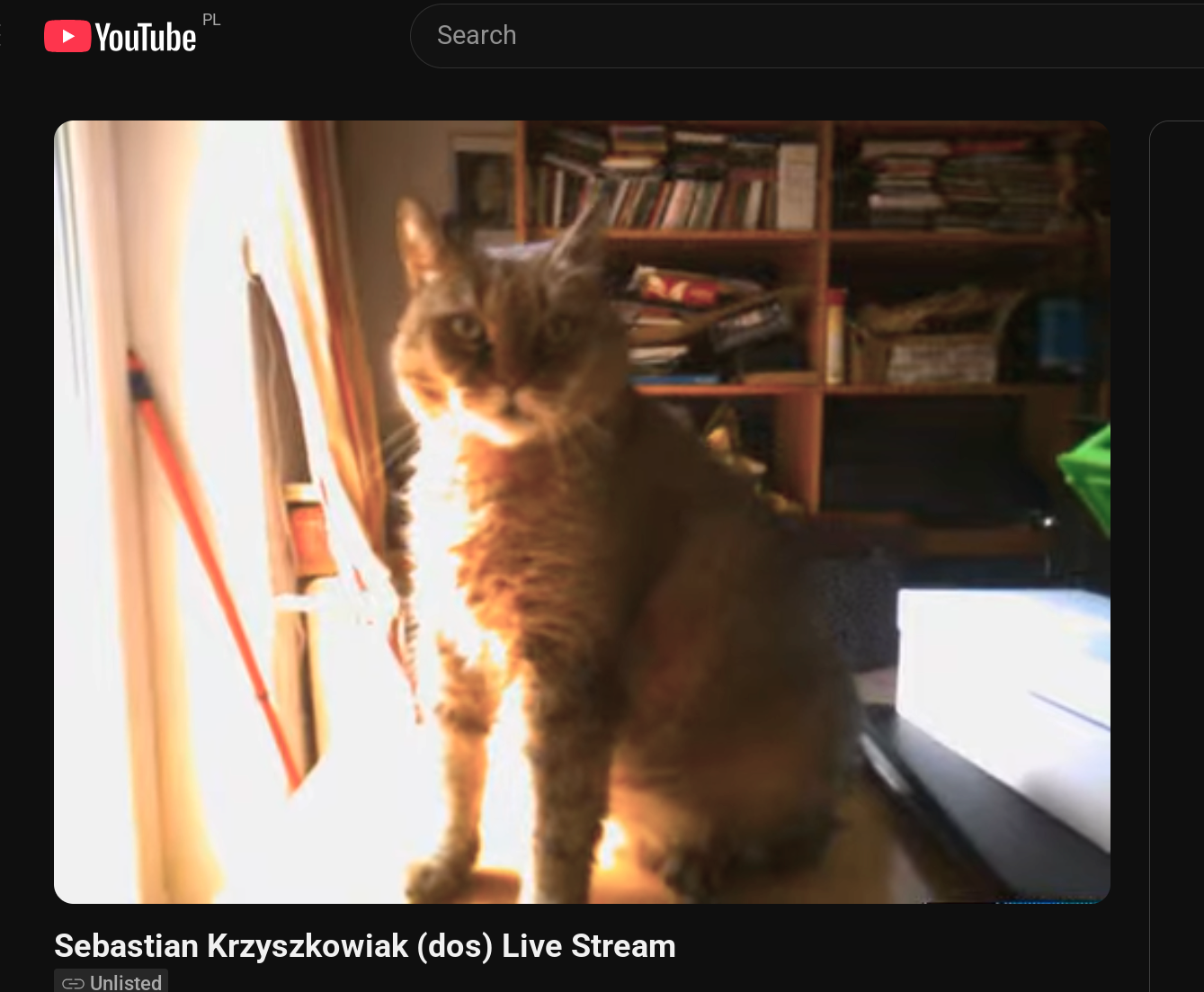
    BTW. Turns out that streaming to YouTube instead of a local file is just a matter of using rtmpsink instead of filesink 😁

    A live stream on YouTube, showing a sitting cat looking into the camera.
    💬 1🔄 0⭐ 0
  • Jul 4, 2025, 4:04 PM

    @pavel I'm playing with GStreamer now (which is new for me) and it seems like most of this code could be replaced with GStreamer elements, and the rest should neatly plug in as custom elements 😂

    💬 2🔄 0⭐ 0
  • 💬 0🔄 0⭐ 0
  • Jul 5, 2025, 12:22 PM

    @pavel You've got a dma-buf handle, already mapped buffer and even GStreamer with all its sinks available, so... however you want? Pretty much anything will be able to consume it easily.

    💬 1🔄 0⭐ 0
  • Jul 5, 2025, 1:30 PM
    @dos I don't have much experiences with GUI programming, so I was looking for suggestions. I've got dma-buf handle but would not know what to do with it in gtk, and maybe SDL is better match. Or perhaps stick to original plan and do user interface ("take picture" button etc) in another process.
    💬 0🔄 0⭐ 0
  • 💬 0🔄 0⭐ 0
  • 💬 0🔄 0⭐ 0
  • Jul 5, 2025, 12:28 PM

    @pavel Not sure what you mean. GStreamer is internally multi-threaded, but its API is thread-safe and there's only one thread in this code. Of course any kind of production-quality code will use some mainloop and enqueue buffers based on callbacks rather than while(!processed){} loop, but it's not exactly rocket science.

    💬 1🔄 0⭐ 0
  • Jul 5, 2025, 1:20 PM
    @dos There are at least two threads in this code: main one, and whatever runs "on_buffer_released". I don't yet know what causes the segfaults, but I suspect gstreamer.
    💬 0🔄 0⭐ 0
  • Jul 5, 2025, 1:33 PM

    @pavel That one line is the only thing that runs from another thread and it's neither scary nor requires any locking 😁

    But there are several other smelly things in this code and lots of missing error handling, so I'd rather start with that when looking for suspects.

    💬 1🔄 0⭐ 0
  • 💬 0🔄 0⭐ 0
  • Jul 2, 2025, 10:23 AM

    @pavel On 9f076a5, I'm getting 88MB/s with one green channel, 82MB/s with two and 105MB/s with nothing but static gl_FragColor. The three copies it does could be eliminated and I believe texelFetch could make it slightly faster on the GPU side too.

    💬 0🔄 0⭐ 0
  • Jul 1, 2025, 8:20 PM

    @pavel do you have a single frame of raw pixel data? What is the target API (OpenGL, -ES, Vulkan)?

    💬 0🔄 0⭐ 0
  • Jul 1, 2025, 9:02 PM
    @datenwolf Example of frame is here: https://gitlab.com/tui/tui/-/blob/master/ucam/bayer2rgb.rs?ref_type=heads (I also have frame generator and real frames captured from libobscura).

    Anything that works on Librem 5 is fine, bonus points if I can understand it. Robot generated code using -lEGL -lGLESv2 -lm ... and that builds and does something. Librem 5 reports:

    Vendor: etnaviv
    Renderer: Vivante GC7000 rev 6214
    OpenGL Version: OpenGL ES 2.0 Mesa 21.2.6
    GLSL Version: OpenGL ES GLSL ES 1.0.16
    💬 0🔄 0⭐ 0
  • Jul 2, 2025, 7:19 PM

    @pavel are you limited to OpenGL ES 2.0 or can you use a more modern version? ES-2.0 is very bare bones in its image format and shader capabilities and efficiently converting 10 bpp will be a PITA, due to lack of texelFetch function.
    Anyway, spent the day finding a nice polynomial to linearize the sensor values (LUTs should be avoided if possible, memory access has latency and costs energy, if you can calculate in a few instr. prefer that).

    💬 0🔄 0⭐ 0
  • Jul 2, 2025, 8:28 PM
    @datenwolf I believe I'm limited to OpenGL ES 2.0. Presumably hardware can do more but our current drivers can not, so we are stuck there.

    On the other hand... #librem5 main sensor can not do 10bpp at the moment, due to missing drivers. So maybe we can focus on 8bpp, first. Probably ineffecient conversion is "good enough" too, as GPU is a bit overpowered for this job.
    💬 0🔄 0⭐ 0
  • 💬 0🔄 0⭐ 0