@fosdem Now for some numbers.
Women are about 9.8% of OSS contributors; only 5% of projects have women as core developers.
https://arxiv.org/pdf/2105.08777
The Covid 19 pandemic had a huge impact on female public code contributions.
https://arxiv.org/pdf/2202.07278
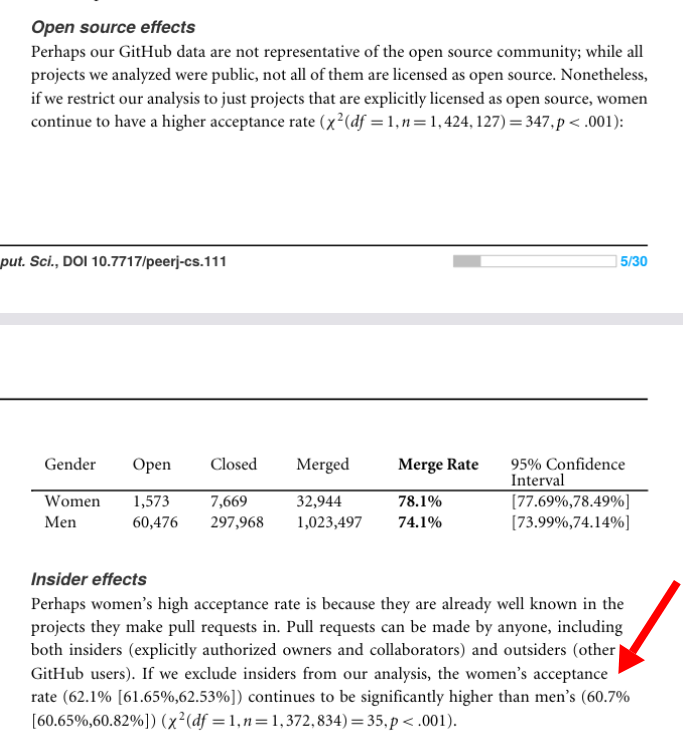
For women who aren’t project insiders, acceptance of PR's falls from 71.8% to 62.5% when their Github profile made their gender identifiable. Aka documented bias.
https://www.scrippsnews.com/science-and-tech/gender-bias-in-open-source-coding-may-be-tech-s-latest-setback

![Open source effects
Perhaps our GitHub data are not representative of the open source community; while all
projects we analyzed were public, not all of them are licensed as open source. Nonetheless,
if we restrict our analysis to just projects that are explicitly licensed as open source, women
continue to have a higher acceptance rate (χ2(df = 1,n = 1,424,127) = 347,p < .001)
Insider effects
Perhaps women’s high acceptance rate is because they are already well known in the
projects they make pull requests in. Pull requests can be made by anyone, including
both insiders (explicitly authorized owners and collaborators) and outsiders (other
GitHub users). If we exclude insiders from our analysis, the women’s acceptance
rate (62.1% [61.65%,62.53%]) continues to be significantly higher than men’s (60.7%
[60.65%,60.82%]) (χ2(df = 1,n = 1,372,834) = 35,p < .001).](https://cdn.masto.host/socialtelemetrydeckcom/cache/media_attachments/files/117/479/007/928/540/472/small/2b4be7c49efc7a7b.png)