Login
You're viewing the ruby.social public feed.
  • Nov 26, 2026, 2:49 AM

    You know, every time I read stories like these, I wonder what the C-suite was thinking. How could they destroy a product that worked so well and was loved by IT professionals? Could it be greed or just mismanagement?

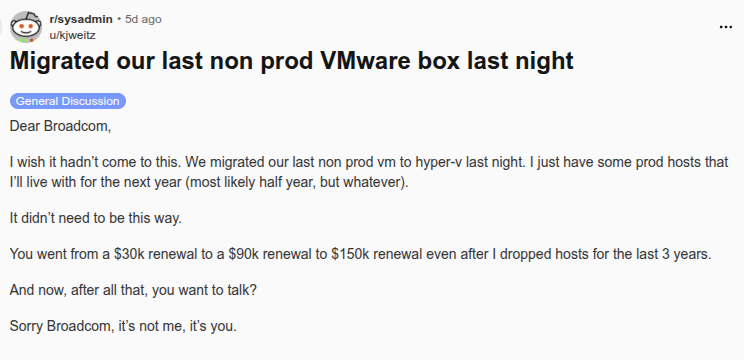
    A screenshot of social media post that reads as follows:

Migrated our last non prod VMware box last night in /r/sysadmin by /u/kjweitz (5 days ago)

(General Discussion)

Dear Broadcom,

I wish it hadn’t come to this. We migrated our last non prod vm to hyper-v last night. I just have some prod hosts that I’ll live with for the next year (most likely half year, but whatever).

It didn’t need to be this way.

You went from a $30k renewal to a $90k renewal to $150k renewal even after I dropped hosts for the last 3 years.

And now, after all that, you want to talk?

Sorry Broadcom, it’s not me, it’s you.
    💬 19🔄 13⭐ 1

Replies

  • 💬 0🔄 0⭐ 0
  • Nazonazokiyoubinbou@urusai.social
    Nov 26, 2026, 3:00 AM

    @nixCraft I never really could understand this one. I know there are a lot of """considerations""" going on like (I guess?) trying to get VC money or whatever, but this just... It really felt the whole time like they were specifically willfully sabotaging VMWare. I can't figure out why on Earth they would, but I really think they wanted to take it down as a product but didn't want to just come right out and cancel it.

    I am honestly amazed that VMWare isn't already gone from all corporate and consumer environments. I hope it will be soon because it really does need to just go away at this point. It isn't right that they can just kill something that was so useful to so many, but the fact is, they did.

    💬 1🔄 0⭐ 0
  • Nov 26, 2026, 5:10 AM

    @nazokiyoubinbou @nixCraft Broadcom likes Oracle-style captive audiences. They want most of their businesses to have a small number of customers which they can literally extort while not really providing support.

    Let’s say your company’s upper management bought in to NSX back when it was merely insanely overpriced and now your whole production environment is built around microsegmentation on a big, flat network. Your options are to either pay whatever Broadcom charges, or pave the environment and start over. And I’ll give you zero guesses why I use that specific example.

    💬 1🔄 0⭐ 0
  • Nazonazokiyoubinbou@urusai.social
    Nov 26, 2026, 5:12 AM

    @bob_zim @nixCraft I feel like this methodology isn't the best when there is one direct competitor and another admittedly much less easy but still extremely capable one.

    💬 1🔄 0⭐ 0
  • 💬 1🔄 0⭐ 0
  • Nazonazokiyoubinbou@urusai.social
    Nov 26, 2026, 5:16 AM

    @bob_zim @nixCraft That's the part that confuses me. It means there is a direct incentive for everyone to move away or never switch to them in the first place. They get a very limited subset of ever shrinking base that never can increase (in any significant way) and eventually they have nothing left...

    What happened to the corporate obsession with the idea that growth can be infinite? Regardless, you can extract more over a larger base than a smaller one even if you can extort the smaller base for a huge amount.

    It just seems like the goal is just to part it out for quick cash no matter the long term consequences...

    💬 1🔄 0⭐ 0
  • Nov 26, 2026, 5:43 AM

    @nazokiyoubinbou To Broadcom and Oracle, “growth” is buying another working company and turning it into another extortion racket. They can do this thanks to the stunning cash flow from the few customers they have who aren’t able to move away quickly enough. As customer count dwindles, support costs fall rapidly, so it becomes basically free income after a few years.

    It’s effectively strip mining but extracting the value from companies rather than from land. Doesn’t make sense to people because it’s so obviously wasteful and needlessly destructive.

    💬 1🔄 0⭐ 0
  • 💬 0🔄 0⭐ 0
  • 💬 0🔄 0⭐ 0
  • 💬 0🔄 0⭐ 0
  • 💬 0🔄 0⭐ 0
  • 💬 0🔄 0⭐ 0
  • 💬 0🔄 0⭐ 0
  • Nov 26, 2026, 6:54 AM

    @nixCraft I have several stories like that with a total of thousands of cores among my customers.

    But there is one positive thing that Broadcom really accomplished:

    Software vendors were FORCED to certify their virtual appliance for QEMU virtualization practically over night.

    How long had I pushed one of my vendors to support Proxmox (software was always running fine, but officially without any support). Now I got it.

    @isotopp

    💬 1🔄 0⭐ 0
  • Nov 26, 2026, 7:39 AM

    @masek
    The actual need for a complete virtual computer operating system is dwindling and inefficient, serverless is a no-brainer when it comes to running whatever app or service you need and cut the crap and bloat that only adds attack surface. Yeah Broadcons business practice stinks and we got lucky when we migrated shortly before they took over but would I go back to virtual Windows server instead of EC2 or better still Vercel/Mongo/Neon etc ....nope. Sure we don't all have the same requirements and some will always need a full VM....
    @nixCraft @isotopp

    💬 1🔄 0⭐ 0
  • Nov 26, 2026, 7:47 AM

    @acesabe @nixCraft @isotopp At home I am down to 2 VMs, the rest is containerized (about two dozen LXC and Docker container).

    VM has the advantage of being a well established interface towards other partners (vendors, managed service partners).

    The delegation of responsibility is clean (that doesn't imply it is handled well).

    So it is mostly organizational stuff that is keeping the VM alive for now.

    💬 1🔄 0⭐ 0
  • 💬 0🔄 0⭐ 0
  • Nov 26, 2026, 7:53 AM

    @kobold This is where AI is currently starting to significantly take load from my shoulders.

    I am not there where I want to be. But during php2shell and java4shell I did a complete 100% update cycle. Something that would have cost me weeks a year ago and now was done in half a day.

    @acesabe @nixCraft @isotopp

    💬 0🔄 0⭐ 0
  • 💬 0🔄 0⭐ 0
  • 💬 0🔄 0⭐ 0
  • 💬 0🔄 0⭐ 0
  • Nov 26, 2026, 8:06 AM

    @nixCraft Broadcom under CEO Hock Tan runs a repeatable strategy: buy mature, entrenched enterprise software/franchise businesses with locked-in customers, then squeeze more revenue from those customers while slashing costs. Short list:

    - CA Technologies
    - Symantec Enterprise Security
    - Brocade

    and (ofc) VMware.

    💬 1🔄 0⭐ 0
  • 💬 0🔄 0⭐ 0
  • 💬 0🔄 0⭐ 0
  • 💬 0🔄 0⭐ 0
  • 💬 0🔄 0⭐ 0
  • 💬 0🔄 0⭐ 0
  • Nov 26, 2026, 12:38 PM

    Greed. They're gambling that fewer customers paying more money is a win. And in the short run, I think it has been. In the longer run, well, that's the gamble.

    @nixCraft

    💬 0🔄 0⭐ 0
  • Nov 26, 2026, 6:18 PM

    @nixCraft It's the same playbook every time.. buy a company, inflate license costs, milk the few customers who are in too deep to easily migrate away. Reduce support staff to a minimum to cut costs, drop open-source or community editions.
    My employer had just finished the migration of about 20k VMs from Xen to VMware when the takeover happened.. now we're already planning the next migration to Proxmox after Broadcom tripled the license fees.

    💬 0🔄 0⭐ 0
  • Nov 27, 2026, 5:18 AM
    When a company based on subscriptions is in decline, the simplest thing to do is attempting to squeeze as much blood from the few stones left as possible. The company is probably going bankrupt in the near future anyway, so why not attempt to keep the revenue stable enough to buy the CEOs a golden parachute?
    💬 0🔄 0⭐ 0