
Login
You're viewing the pawb.fun public feed.
  • Nov 11, 2026, 7:03 PM

    @slyka @f4grx I suspect that if you looked at the wave itself you would see a spike or distortion that slowly crawled across the cycle over a period of 30s.
    E.g. interference at either 49.97 or 50.04 Hz.

    💬 1🔄 0⭐ 1

Replies

  • 💬 2🔄 0⭐ 1
  • Nov 11, 2026, 7:08 PM

    @marshray @slyka the frequency evolution shows in fact a frequency modulation with a chaotic rythm. We could be observing something that is typical of tuning fork oscillators. Maybe torsion or asymmetry of the branches or a beat from the excitation circuit itself. Idk.

    💬 0🔄 0⭐ 1
  • Nov 11, 2026, 7:09 PM

    @f4grx @marshray well, it's probably not what you expect…

    (I was running it at a lower supply voltage here, at full supply voltage the output peaks at around 350V)

    For the measurement I just divided that down, plugged it into my mixer through some capacitive coupling and turned down the highs and mids and boosted the bass on the EQ. I used a metrology grade EQ, of course.
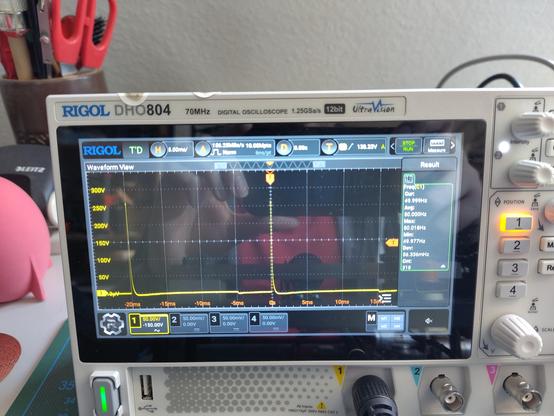
    Image attached toot
    💬 1🔄 0⭐ 3
  • 💬 1🔄 0⭐ 1
  • Nov 11, 2026, 7:43 PM

    @marshray @f4grx as far as I know this thing was used to fire a strobe on some kind of engine tachometer adjustment machine or something? I don't quite remember. there isn't a lot of information on this thing

    💬 1🔄 0⭐ 3
  • Nov 11, 2026, 7:54 PM

    @slyka @f4grx Oh yes I recall seeing the photos of this device.
    Another possibility is a bad filter capacitor or solder joint intermittently allowing mains hum onto the DC power rails.

    💬 0🔄 0⭐ 0