Login
You're viewing the mstdn.social public feed.
  • Jun 25, 2026, 5:45 PM

    Hey Canada - its reported that starting next week, Australians will get 3 hours of *free* electricity each afternoon, all thanks to clean, renewable (not nuclear) energy and storage batteries.
    We have the environment and locations to build wind, solar, hydro and tidal power generation, but instead, one of the first three mega-projects the Federal government is looking at funding is a place to hide nuclear waste.
    And our electricity bills keep going up.

    #Canada #federal #Carney #renewables #renewableenergy #nuclearpower #inflation

    💬 5🔄 21⭐ 7

Replies

  • Jun 25, 2026, 6:59 PM

    @bazcook The real analysis is not so simple. First of all pricing flaws is what got into this climate pickle in the first place. Pricing magic won’t get us out of it .

    Australia, despite its abundant sunshine, still burns lots of coal and gas to backstop the seasonal slumps of renewables on the grid.

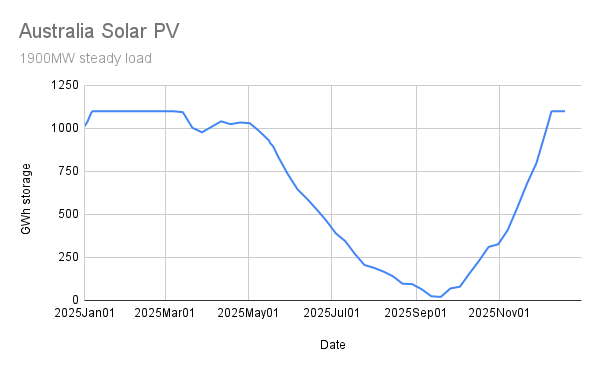
    This graph is taken from my simple study of numerous renewable datasets from around the globe. They all exhibit a similar pattern of unbridgeable amounts of storage required to time shift seasonal slumps.
    energyasicit.ca/WindModel/

    Image attached toot
    💬 2🔄 0⭐ 0
  • Jun 25, 2026, 7:55 PM

    @icanbob - there's always going to be variables, sure. But the government of Alberta's banning of windmill and solar farms while promoting the wholesale demolition of a mountain to access coal (and Ontario's killing off of wind farms while *heavily* promoting nuclear) is hardly going to solve the problem, either.

    💬 1🔄 0⭐ 1
  • Jun 25, 2026, 10:30 PM

    @bazcook We most definitely need all the renewables and nuclear we can install if we are going shift from fossil energy systems quick enough to avoid climate problems. It is my contention that we should first be focusing on doing system wide CO2 optimization (not price optimization) to chart our optimum course. I’m not a believer that our economic models which guide the stories we tell each other are remotely accurate when it comes to energy.

    Fortunately from my simple modelling and analysis I think there is a better way forward.

    energyasicit.ca/EnergyVision/
    energyasicit.ca/VirtualWire/

    💬 0🔄 0⭐ 0
  • Jun 25, 2026, 9:47 PM

    @icanbob @bazcook

    Your graph appears to disregard at least California's and Australia's actual recorded data and experience.

    It also appears to completely miss most of Canada (by MW/h) - e.g. BC, ON, QC.

    Dams are batteries. Always have been.

    Perhaps you should weight your data by MW/h?

    💬 2🔄 0⭐ 0
  • Jun 25, 2026, 10:03 PM

    @icanbob @bazcook

    An exemplar case a modest (by current standards) 100 MW / 129 MWh battery was built in 2017. It infamously took less than 100 days from contract signing to passing tests.

    en.wikipedia.org/wiki/Hornsdal

    Note, especially, in the Operations section, how at 13 days past commissioning it held the entire grid long enough for recovery from a supply outage.

    In the 10 years since that battery system install, the price of MWh storage has fallen by 90%.

    nationalobserver.com/newslette

    💬 1🔄 0⭐ 0
  • 💬 0🔄 0⭐ 0
  • Jun 25, 2026, 10:10 PM

    @Amgine @bazcook All of my analysis use actual real hourly supply datasets from all those jurisdictions including California and Australia. So they represent the actual real state of things not some speculative modelling or hand waving exercise. My model is dead simple. I match a load profile to the grid providers supply dataset at each hourly point. I track the cumulative surplus or deficit by very simple addition using a spreadsheet. I call the surplus “storage” (with no accounting for actual storage tech efficiencies) and adjust that starting amount at the beginning of my sample period such that I never run a deficit. My model is completely open sourced so you are welcome to replicate my results.

    Lately I’ve refined my earlier model featured here
    energyasicit.ca/WindModel/

    to scale the supply datasets to force the total MWh supply to exactly match the total MWh of my load over the period.
    energyasicit.ca/HomeEnergy/
    and used my home load against Ontario’s IESO dataset and 1 GW 24/7 data center type load against California and Texas datasets, both of which have loads of grid batteries.

    💬 1🔄 0⭐ 0
  • 💬 1🔄 0⭐ 0
  • Jun 25, 2026, 10:18 PM

    @Amgine @bazcook If by reservoir you mean water behind a hydro dam the answer is no. In Ontario where I live we get 25% of our power from hydro, but our main “dam” has a massive natural leak in it called Niagara Falls. So in Ontario our hydro is mainly used as additional baseload power. My simple model focused in solar and wind renewables.

    💬 3🔄 0⭐ 0
  • Jun 25, 2026, 10:20 PM

    @icanbob @bazcook

    Checking a source which reportedly contains this quote: “Around 80 per cent of the global population can get 80 per cent uptime solar-plus-storage power for less than $100/MWh, and half can get it for below about $80/MWh.”

    NB: that is both generation and storage.

    💬 2🔄 0⭐ 0
  • Jun 25, 2026, 10:24 PM

    @icanbob @bazcook

    It does have the quote, as part of its 'sceptics test", but I have not found the source of their data; probably Ember.

    💬 1🔄 0⭐ 0
  • 💬 1🔄 0⭐ 0
  • Jun 25, 2026, 10:35 PM

    @icanbob @bazcook

    Here's their source:

    "When one runs the cost numbers using today’s solar and battery costs from the IEA and BNEF, one can see that solar-plus-storage is cheapest exactly in the places where most people live."

    💬 0🔄 0⭐ 0
  • Jun 25, 2026, 10:35 PM

    @Amgine @bazcook My analysis would make me skeptical of that claim. I’m always cautious when an analysis leads with cost numbers. Broken pricing systems got us into this climate mess. Pricing solutions won’t get us out of it. Good old fashioned hard nosed engineering based on actual data will.

    💬 1🔄 0⭐ 0
  • 💬 0🔄 0⭐ 0
  • Jun 25, 2026, 10:31 PM

    @icanbob @bazcook

    It is, however, a massive energy storage system available for renewables - I believe California's system storage is still more than 50% hydro, despite a legendary limited supply.

    But note: your calculation assumes >$300 CAD per MWh storage, yet that is 2.3x the estimated cost of $100 USD for generation and storage in the site I linked. Which suggests you created that page >1 year ago, when storage did cost that much more.

    💬 1🔄 0⭐ 0
  • Jun 25, 2026, 10:45 PM

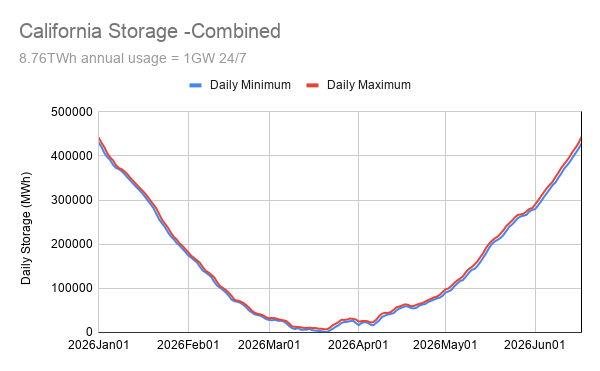
    @Amgine @bazcook I think your numbers are off by a factor of 1000. Let’s use the number $100/kWh because the math is easy. My latest modelling of California CAISO dataset which includes all the installed grid batteries still would require an additional 450GWh of storage to shift the seasonal deficit associated with 1 data center ( 1 GW 24/7). That is $45B/GW firm power for just those seasonal batteries. IMO that is unbridgeable.

    Image attached toot
    💬 2🔄 0⭐ 0
  • Jun 25, 2026, 10:56 PM

    @icanbob @bazcook

    * How cheap is battery storage? ember-energy.org/latest-insigh
    * Utility Scale Battery Storage Cost Guide for U.S. Projects 2026 designtransitionstudio.com/uti
    * Battery storage hits $65/MWh – a tipping point for solar https://
    * Grid-Scale Battery Storage Cost Overview 2026 latestcost.com/grid-scale-batt

    One year ago -
    * Cost Projections for Utility-Scale Battery Storage: 2025 Update research-hub.nlr.gov/en/public

    The US cost guides include property acquisition and site prep apparently.

    1/

    💬 1🔄 0⭐ 0
  • Jun 25, 2026, 11:02 PM

    @icanbob @bazcook

    Which is an important characteristic, but actually separate from the storage cost. E.g. building a battery storage in downtown Toronto is going to raise the project cost.

    Also, Ontario's hydro is … oddly organized? I cannot find hard numbers for hydro production in the places I expected them.

    💬 1🔄 0⭐ 0
  • 💬 1🔄 0⭐ 0
  • Jun 26, 2026, 12:59 AM

    @icanbob @bazcook

    I am sure the data is available. I just find it confusing hydro services are divided into separate entities/corporations, with what looks like overlap.

    💬 0🔄 0⭐ 0
  • Jun 25, 2026, 11:08 PM

    @icanbob @bazcook

    Small notes: California was achieving 100% renewables daily since, iirc, last October, mostly selling the overproduction east but also north while refilling battery systems.

    The current push for new dams in BC is due zero market growth for 10 years, despite the EV uptake (increasing efficiency) so they want to boost demand by opening LNG plants (who all are currently using NG to produce their electricity rather than BC Hydro.)

    💬 1🔄 0⭐ 0
  • Jun 26, 2026, 12:34 AM

    @Amgine @bazcook I’d be very skeptical of that 100% renewable claim. I see no evidence of that in the 2026 CAISO California dataset. That said that dataset only shows supply not load. So it is possible for short periods of time that renewables exceeded load. However there are no sustained points in that dataset where fossil generation was suspended.

    💬 1🔄 0⭐ 0
  • Jun 26, 2026, 1:05 AM

    @icanbob @bazcook

    Yes, never a moment without instant-on backups. And, despite the pumped hydro, they only report storage data on CAISO of the lithium storage - only 16.5 GWh.

    Meanwhile, Australia is reducing projections in WEM due to homeowner solar and storage, which I think is terribly risky. What if WA has a social protest and they all choose to unplug their production/storage?

    💬 0🔄 0⭐ 0
  • 💬 1🔄 0⭐ 0
  • Jun 26, 2026, 3:19 PM

    @notsoloud @icanbob @bazcook

    Like Europe, North America's primary waterways are also surrounded by dense urban regions due the low energy shipping. The primary cause of low water on the great lakes system is not drainage, but over-consumption of a finite resource.

    Perhaps the agreement between the USA and Canada regarding the basin needs greater monitoring requirements, or shift monitoring responsibilities to the other party. I suspect it is simply minor conflict of interest, not intent.

    💬 1🔄 0⭐ 0
  • Jun 27, 2026, 9:45 AM

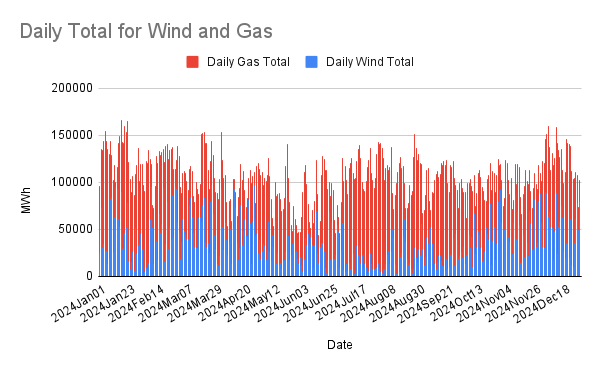
    @Amgine @notsoloud @bazcook As I said before the real “problem” with our main hydro dam in Ontario is that it has a natural leak: Niagara Falls; a major tourist attraction. In fact the hydro facility there has a limited permit to extract water upstream lest the falls get lessened in tourist impact. The result is that generator facility is operated effectively as part of baseload. In Ontario nat gas backstops our main other renewable; wind.

    Image attached toot
    💬 1🔄 0⭐ 0
  • Jun 27, 2026, 10:11 AM

    @icanbob
    It is possible to build a dam upstream of the falls that stems up the water by one meter above normal level. The flows released through the falls and the turbines could be adjusted by the minute as needed for power and tourism. Time varying flows would be handled by raising or lowering the level of the Lakes within the meter.

    The stored energy would be around 50 GWh, not enough for seasonal storage but would definitely kill a lot of gas peakers.

    @Amgine @bazcook

    💬 2🔄 0⭐ 0
  • Jun 27, 2026, 12:29 PM

    @notsoloud @Amgine @bazcook The potential energy from elevated water is calculated using formula
    mgh. Where result is in Joules; m is mass in kg which for water = litres; g=~10m/s2 h=elevation in meters. To convert to kWh=(mgh)/3600000. Let’s group mh and call it litre-meters. So you need ~ 360000 litre-meters of water to equal 1 kWh of storage. An Olympic sized swimming pool has 2.5M litres so 1kWh=0.144OSP-meters.

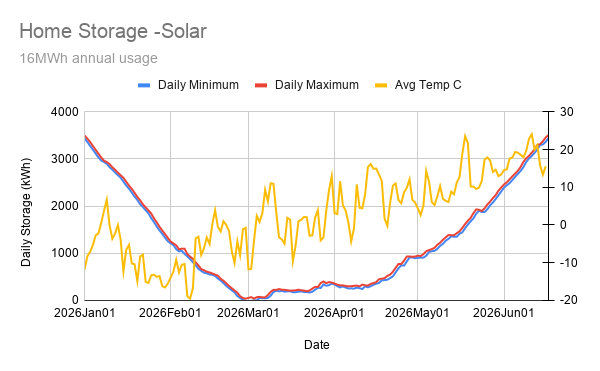
    My 2026 modelling for my home shows I would need 3500kWh of seasonal storage for solarPV. Assuming my home roof to ground is ~10meters.

    So I would need to pump 3500*0.144/10 = ~50 Olympic swimming pools worth of water to my roof height to meet my single home’s seasonal storage requirements.

    IEA states that globally we have 8.5TWh of pumped storage. My modelling for California renewables+grid batteries for 2026 is showing that it would need an additional 450GWh of seasonal storage just to power a load profile equivalent to a 1 GW 24/7 data center.

    That is 450/8500=~0.05 or 5% of global installed pump storage/GW

    IMO believing pumped storage will enable renewables to produce firm power is at best a fantasy not supported by simple physics.
    #pumpedstorage

    💬 1🔄 0⭐ 0
  • Jun 27, 2026, 2:41 PM

    @icanbob @notsoloud @bazcook

    I agree with your numbers *en totale*. Pumped storage, more importantly, is more expensive over the dam life expectancy than current costs for current battery tech - which price I understand you do not accept as fact.

    But it is the numbers being used in bidding, now.

    Still, for places like BC, with >85% hydro production, the legacy infrastructure (and they are discussing 2 new major hydro projects) pumped storage is actually viable, now.

    💬 1🔄 0⭐ 0
  • Jun 28, 2026, 12:47 AM

    @Amgine @notsoloud @bazcook I’m not saying that pumped storage isn’t a viable storage option. What I am saying is that the seasonal renewable supply slumps are not bridgeable with any of our storage technologies.

    💬 1🔄 0⭐ 0
  • Jun 28, 2026, 1:39 AM

    @icanbob @notsoloud @bazcook

    And I am looking at nations and regions which are doing exactly that, and wondering how they are magically different. Only a few have gotten greater than 50% for their slump, but they are progressing, steadily, and increasingly rapidly.

    I do not think any one storage tech can bridge it. But all of them combined can. And some regions, like BC, can meet current storage requirements, if we do not increase demand (LNG, datacentres.)

    💬 1🔄 0⭐ 0
  • Jun 29, 2026, 11:01 AM

    @Amgine @notsoloud @bazcook If I’ve learned anything about energy systems in my 50 years of study it is “no matter how hard you wish something were true, if real world data shows that it isn’t ; then it isn’t”

    💬 3🔄 0⭐ 0
  • Jun 29, 2026, 11:43 AM

    @icanbob
    The Danish plan for full renewables is based on cutting back gas use to the minimum backup level and substitute all of that with biogas. It's pretty much the only thing that can carry through a winter wind lull. Ontario is a bit better off regarding winter solar and with Niagara power, but will probably need something similar.

    Demand flexibility should be explored as well. Not sure how much can be gained by insulating better.
    @Amgine @bazcook

    💬 0🔄 0⭐ 0
  • Jun 29, 2026, 12:11 PM

    @icanbob @Amgine @notsoloud - which would be fine if a number of these ‘real world’ studies weren’t produced by the fossil fuel and nuclear industries and the governments and agencies reliant on their profits.

    💬 1🔄 0⭐ 0
  • 💬 0🔄 0⭐ 0
  • Jun 29, 2026, 4:40 PM

    @icanbob @notsoloud @bazcook

    > 85% of production is hydro. Year round. All the time. Every real world day.

    We just need to cover 15% during a seasonal slump. Here.

    Yesterday someone posted they were offered panels at $0.38CAD/Watt by an Ali Baba bot. Retail, including shipping. It is entirely possible to overbuild production, as is happening in Australia.

    It is also possible to overbuild storage. I do not think it will happen.

    But I also look at roads and highways. So, maybe it will.

    💬 1🔄 0⭐ 0
  • Jun 29, 2026, 4:49 PM

    @Amgine
    Australia has not overbuilt solar, they have underbuilt storage. Everyone has underbuilt storage, because it's so new that it's cheap enough to work and still cheapening. It's also important to remember that it can be perfectly sensible to build so much solar that some of it goes to "waste". I'm so happy to see these low prices, perfect for a little Hormuz sale.

    I don't think storage is pressured to overbuild like roads. People drive on roads and feel directly if they're congested, storage isn't like that.
    @icanbob @bazcook

    💬 2🔄 0⭐ 0
  • Jun 29, 2026, 5:08 PM

    @notsoloud @icanbob @bazcook

    They are beginning to overbuild solar, but in the best, most-organic way.

    Allowing home owners to produce and sell their production into the grid has a high cost - which is mostly borne by the individual. But it makes home solar so much more attractive, gaining all the features of grid supply and the **possibility** to have zero energy costs.

    Homeowners are incentivized to have more production than consumption.

    💬 1🔄 0⭐ 0
  • Jun 29, 2026, 10:14 PM

    @Amgine @notsoloud @bazcook Any renewable grid with battery storage is by definition overbuilt because the electrons going to charge the batteries can’t be used to service other loads at that instant. Similarly when the battery is being discharged to service loads later in time it can’t be simultaneously charged. This is one of the many reasons why batteries are not useful for time shifts of more than a 10s of hours. Seasonal shifts that my model is illuminating are time shifts on order of months. Ie. You have to overbuild the solarPV sufficiently that a sizeable fraction of the summer “surplus” is stored in a battery bank for months until winter heat pump/EV loads need it.

    💬 1🔄 0⭐ 0
  • Jun 29, 2026, 10:42 PM

    @icanbob @notsoloud @bazcook

    This is not my definition of overbuilt. Overbuilding involves capacities which will never be used.

    A house solar + storage system producing and consuming X W/h total per annum would need a crazy level of storage to be offgrid, but is not overbuilt. That same house with solar production of max daily consumption on solar minimus, and storage for 1 day, is not overbuilt, despite producing far more energy than will be consumed.

    Either would need safety margins.

    💬 1🔄 0⭐ 0
  • Jun 29, 2026, 11:56 PM

    @Amgine @notsoloud @bazcook Why are we putting forth arguments without actual data? If you have a dataset from your home and from your electricity supplier it is easy to replicate my model with real numbers.

    As you can see from my graph I would need to have 3.5MWh in storage on Jan 1 because my house load exceeds the solarPV supply continuously until Mar. At that point my 3.5MWh storage is totally discharged. In order to rebuild my store such my home could run for this whole period extra solarPV is “borrowed” from the Mar-June supply to bring storage back up to 3.5MWh. My plan is to run this model for an entire year to get a complete cycle in my graph.

    Image attached toot
    💬 1🔄 0⭐ 0
  • Jun 29, 2026, 5:16 PM

    @notsoloud @icanbob @bazcook

    The point about roads is 'induced demand'. The larger the road system, the greater its congestion. This was not well-known, and seems illogical for some people.

    I was referencing a concern that distributed power generation can eliminate power scarcity as an economic limiting factor, but it could instead lead to over-consumption/inefficiency if the infrastructure build-out is not managed.

    💬 0🔄 0⭐ 0
  • Jun 27, 2026, 2:51 PM

    @notsoloud @bazcook

    As @icanbob points out, the waterfall is part of the international agreement covering the basin.

    But upstream of the falls in the upper great lakes, average water levels have been declining for decades. The provinces and states on either side blame the urban centres on the other side. I do not know, but it seems likely industrial and agricultural use exceed natural repleneshment.

    💬 0🔄 0⭐ 0
  • 💬 0🔄 1⭐ 0
  • Jun 25, 2026, 7:48 PM

    @bazcook

    Australians pay between 25¢ and 45¢/kWh for residential power.

    The last I checked the most expensive provincial rate in Canada was Alberta at 26¢/kWh with the cheapest rates being Quebec at 8¢/kWh for the first 1000kWhs.

    As of March this year:

    Quebec 7.8¢
    Manitoba 10.6¢
    British Columbia 10.97¢
    New Brunswick 14.7¢
    Ontario 14.1¢
    Newfoundland & Labrador 15.8¢
    Nova Scotia 18.3¢
    Prince Edward Island 18.4¢
    Yukon 18.7¢
    Saskatchewan 20.7¢
    Alberta 25.8¢
    Nunavut 35.4¢
    Northwest Territories 41.0¢

    Roughly 85% of our generation is made up of hydro, nuclear, and other renewables.

    💬 0🔄 0⭐ 0
  • DroppieMsDropbear42@blahaj.zone
    Jun 25, 2026, 10:12 PM

    @bazcook@mas.to carn canada, you can do it! imo we're still shit down here... a govt that still actively subsidises & tax-breaks fossilfools, still approves their despicable projects, still perpetrates the farce they care about climate & environment via a debunked "carbon offsets" bullshittery, still fails to turbocharge a national electrification pgm, yada yada. so we're a low bar... surely you can surpass us? pls doooooooooooo!

    #AusPol #WhyTheFuckIsLabor #HahahahaLiebs #NatsAreNuts #GreensYEAH #VoteGreens #VoteProgIndies #PHONkedinthehead #ClimateCrisis #NonLinear #TippingPoints #PositiveFeedbackLoops #FossilFools #RenewableEnergy #ChangeTheSystem #StateCapture #RightToProtest #Biodiversity #WeAreTotallyFscked #Misanthropy #Karma #NativeForests #StopLoggingNativeForests #FsckCapitalism #CognitiveDissonance

    💬 0🔄 0⭐ 0
  • 💬 0🔄 0⭐ 0