Login
You're viewing the mstdn.social public feed.
  • Jun 28, 2026, 12:47 AM

    @Amgine @notsoloud @bazcook I’m not saying that pumped storage isn’t a viable storage option. What I am saying is that the seasonal renewable supply slumps are not bridgeable with any of our storage technologies.


    💬 1🔄 0⭐ 0

Replies

  • Jun 28, 2026, 1:39 AM

    @icanbob @notsoloud @bazcook

    And I am looking at nations and regions which are doing exactly that, and wondering how they are magically different. Only a few have gotten greater than 50% for their slump, but they are progressing, steadily, and increasingly rapidly.

    I do not think any one storage tech can bridge it. But all of them combined can. And some regions, like BC, can meet current storage requirements, if we do not increase demand (LNG, datacentres.)

    💬 1🔄 0⭐ 0
  • Jun 29, 2026, 11:01 AM

    @Amgine @notsoloud @bazcook If I’ve learned anything about energy systems in my 50 years of study it is “no matter how hard you wish something were true, if real world data shows that it isn’t ; then it isn’t”

    💬 3🔄 0⭐ 0
  • Jun 29, 2026, 11:43 AM

    @icanbob
    The Danish plan for full renewables is based on cutting back gas use to the minimum backup level and substitute all of that with biogas. It's pretty much the only thing that can carry through a winter wind lull. Ontario is a bit better off regarding winter solar and with Niagara power, but will probably need something similar.

    Demand flexibility should be explored as well. Not sure how much can be gained by insulating better.
    @Amgine @bazcook

    💬 0🔄 0⭐ 0
  • Jun 29, 2026, 12:11 PM

    @icanbob @Amgine @notsoloud - which would be fine if a number of these ‘real world’ studies weren’t produced by the fossil fuel and nuclear industries and the governments and agencies reliant on their profits.

    💬 1🔄 0⭐ 0
  • 💬 0🔄 0⭐ 0
  • Jun 29, 2026, 4:40 PM

    @icanbob @notsoloud @bazcook

    > 85% of production is hydro. Year round. All the time. Every real world day.

    We just need to cover 15% during a seasonal slump. Here.

    Yesterday someone posted they were offered panels at $0.38CAD/Watt by an Ali Baba bot. Retail, including shipping. It is entirely possible to overbuild production, as is happening in Australia.

    It is also possible to overbuild storage. I do not think it will happen.

    But I also look at roads and highways. So, maybe it will.

    💬 1🔄 0⭐ 0
  • Jun 29, 2026, 4:49 PM

    @Amgine
    Australia has not overbuilt solar, they have underbuilt storage. Everyone has underbuilt storage, because it's so new that it's cheap enough to work and still cheapening. It's also important to remember that it can be perfectly sensible to build so much solar that some of it goes to "waste". I'm so happy to see these low prices, perfect for a little Hormuz sale.

    I don't think storage is pressured to overbuild like roads. People drive on roads and feel directly if they're congested, storage isn't like that.
    @icanbob @bazcook

    💬 2🔄 0⭐ 0
  • Jun 29, 2026, 5:08 PM

    @notsoloud @icanbob @bazcook

    They are beginning to overbuild solar, but in the best, most-organic way.

    Allowing home owners to produce and sell their production into the grid has a high cost - which is mostly borne by the individual. But it makes home solar so much more attractive, gaining all the features of grid supply and the **possibility** to have zero energy costs.

    Homeowners are incentivized to have more production than consumption.

    💬 1🔄 0⭐ 0
  • Jun 29, 2026, 10:14 PM

    @Amgine @notsoloud @bazcook Any renewable grid with battery storage is by definition overbuilt because the electrons going to charge the batteries can’t be used to service other loads at that instant. Similarly when the battery is being discharged to service loads later in time it can’t be simultaneously charged. This is one of the many reasons why batteries are not useful for time shifts of more than a 10s of hours. Seasonal shifts that my model is illuminating are time shifts on order of months. Ie. You have to overbuild the solarPV sufficiently that a sizeable fraction of the summer “surplus” is stored in a battery bank for months until winter heat pump/EV loads need it.

    💬 1🔄 0⭐ 0
  • Jun 29, 2026, 10:42 PM

    @icanbob @notsoloud @bazcook

    This is not my definition of overbuilt. Overbuilding involves capacities which will never be used.

    A house solar + storage system producing and consuming X W/h total per annum would need a crazy level of storage to be offgrid, but is not overbuilt. That same house with solar production of max daily consumption on solar minimus, and storage for 1 day, is not overbuilt, despite producing far more energy than will be consumed.

    Either would need safety margins.

    💬 1🔄 0⭐ 0
  • Jun 29, 2026, 11:56 PM

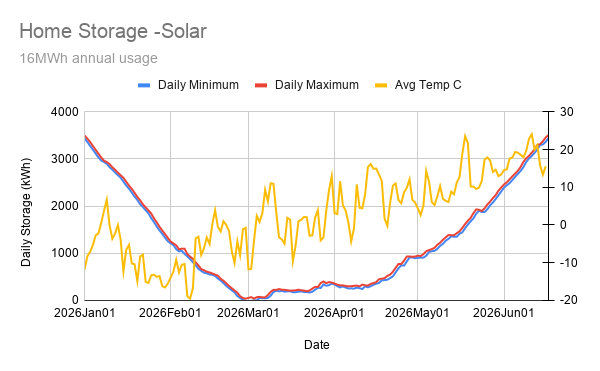
    @Amgine @notsoloud @bazcook Why are we putting forth arguments without actual data? If you have a dataset from your home and from your electricity supplier it is easy to replicate my model with real numbers.

    As you can see from my graph I would need to have 3.5MWh in storage on Jan 1 because my house load exceeds the solarPV supply continuously until Mar. At that point my 3.5MWh storage is totally discharged. In order to rebuild my store such my home could run for this whole period extra solarPV is “borrowed” from the Mar-June supply to bring storage back up to 3.5MWh. My plan is to run this model for an entire year to get a complete cycle in my graph.

    Image attached toot
    💬 1🔄 0⭐ 0
  • 💬 1🔄 0⭐ 0
  • Jun 30, 2026, 12:41 AM

    @icanbob @notsoloud @bazcook

    BC has the same choice. Increase solar/wind production to cover 30% of expected demand during summer + the cost of pumped storage of half, should be enough to get through the year idling 15% of summer hydro production

    Summer is our 'slump', not winter. In the winter it is rain and snow, plus North Pacific storm winds. In the summer our water flows slow, by October we need the rains to start.

    💬 1🔄 0⭐ 0
  • Jun 30, 2026, 11:23 AM

    @Amgine @notsoloud @bazcook My analysis stems from an interest in CO2 optimization. On a predominately hydro grid like BC the CO2 emission level is already very low so there is little to optimize. The real question for jurisdictions like BC is what happens when electrification of things like transport begin to bump into grid capacity limits and climate changed weather patterns disturb seasonal rainfall.

    💬 1🔄 0⭐ 0
  • 💬 0🔄 0⭐ 0
  • Jun 29, 2026, 5:16 PM

    @notsoloud @icanbob @bazcook

    The point about roads is 'induced demand'. The larger the road system, the greater its congestion. This was not well-known, and seems illogical for some people.

    I was referencing a concern that distributed power generation can eliminate power scarcity as an economic limiting factor, but it could instead lead to over-consumption/inefficiency if the infrastructure build-out is not managed.

    💬 0🔄 0⭐ 0