Login
You're viewing the mstdn.social public feed.
  • Jun 29, 2026, 10:42 PM

    @icanbob @notsoloud @bazcook

    This is not my definition of overbuilt. Overbuilding involves capacities which will never be used.

    A house solar + storage system producing and consuming X W/h total per annum would need a crazy level of storage to be offgrid, but is not overbuilt. That same house with solar production of max daily consumption on solar minimus, and storage for 1 day, is not overbuilt, despite producing far more energy than will be consumed.

    Either would need safety margins.

    💬 1🔄 0⭐ 0

Replies

  • Jun 29, 2026, 11:56 PM

    @Amgine @notsoloud @bazcook Why are we putting forth arguments without actual data? If you have a dataset from your home and from your electricity supplier it is easy to replicate my model with real numbers.

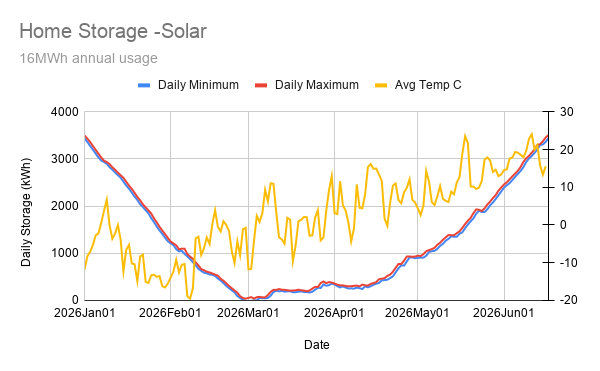
    As you can see from my graph I would need to have 3.5MWh in storage on Jan 1 because my house load exceeds the solarPV supply continuously until Mar. At that point my 3.5MWh storage is totally discharged. In order to rebuild my store such my home could run for this whole period extra solarPV is “borrowed” from the Mar-June supply to bring storage back up to 3.5MWh. My plan is to run this model for an entire year to get a complete cycle in my graph.

    Image attached toot
    💬 1🔄 0⭐ 0
  • 💬 1🔄 0⭐ 0
  • Jun 30, 2026, 12:41 AM

    @icanbob @notsoloud @bazcook

    BC has the same choice. Increase solar/wind production to cover 30% of expected demand during summer + the cost of pumped storage of half, should be enough to get through the year idling 15% of summer hydro production

    Summer is our 'slump', not winter. In the winter it is rain and snow, plus North Pacific storm winds. In the summer our water flows slow, by October we need the rains to start.

    💬 1🔄 0⭐ 0
  • Jun 30, 2026, 11:23 AM

    @Amgine @notsoloud @bazcook My analysis stems from an interest in CO2 optimization. On a predominately hydro grid like BC the CO2 emission level is already very low so there is little to optimize. The real question for jurisdictions like BC is what happens when electrification of things like transport begin to bump into grid capacity limits and climate changed weather patterns disturb seasonal rainfall.

    💬 1🔄 0⭐ 0
  • 💬 0🔄 0⭐ 0