
Login
You're viewing the mastodon.frost.kiwi public feed.
  • Oct 11, 2026, 8:22 PM

    My critique on the announcement though: I’m glad to see srgb-linear and display-p3-linear supported on the canvas context, but, a “linear relationship between pixel values and physical luminance” is an alluring bridge to nowhere. You almost certainly do NOT want this to be the image formation choice in your game.
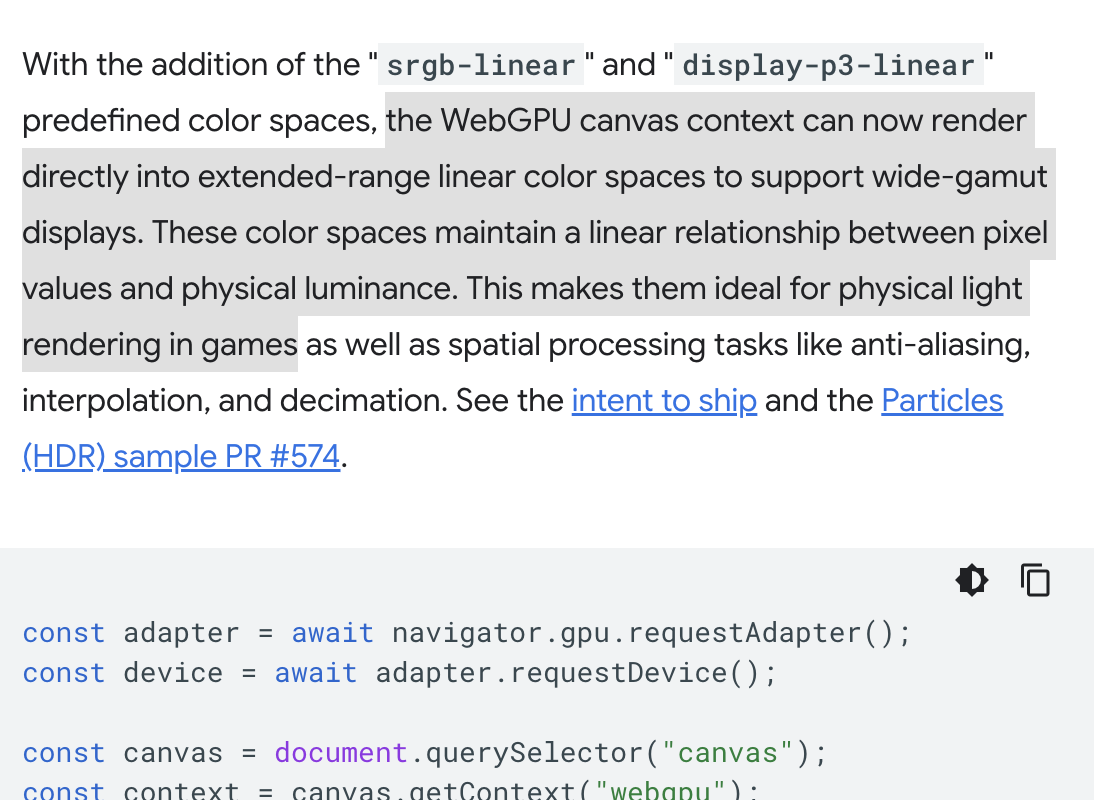

    With the addition of the "srgb-linear" and "display-p3-linear" predefined color spaces, the WebGPU canvas context can now render directly into extended-range linear color spaces to support wide-gamut displays. These color spaces maintain a linear relationship between pixel values and physical luminance. This makes them ideal for physical light rendering in games as well as spatial processing tasks like anti-aliasing, interpolation, and decimation.
    💬 1🔄 0⭐ 0

Replies

  • Oct 12, 2026, 6:05 AM

    "ideal for physical light rendering", ah, yes, *that* bit. I assume that as an *intermediate* rendering target it would be fine, but the window system framebuffer is completely another thing.

    One would never send physical light rendered data to the window system (a browser counts as a window system) because it's not a picture yet.

    @donmccurdy

    💬 0🔄 0⭐ 1
  • Oct 12, 2026, 2:52 PM

    @pq Yep! Unfortunately the target here is as close as a webpage can get to the window system framebuffer—once written it’s too late for the webpage itself to apply tone mapping.

    I assume they’re planning to add some browser-provided tonemapping (PQ?) without telling the webpage much about the display. Not a workable way to make pictures…

    💬 0🔄 0⭐ 0