Login
You're viewing the f.duriansoftware.com public feed.
  • Sep 9, 2026, 12:26 AM

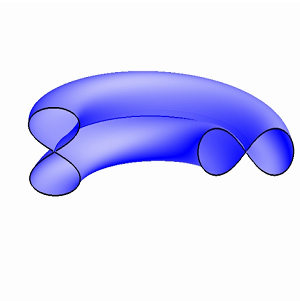
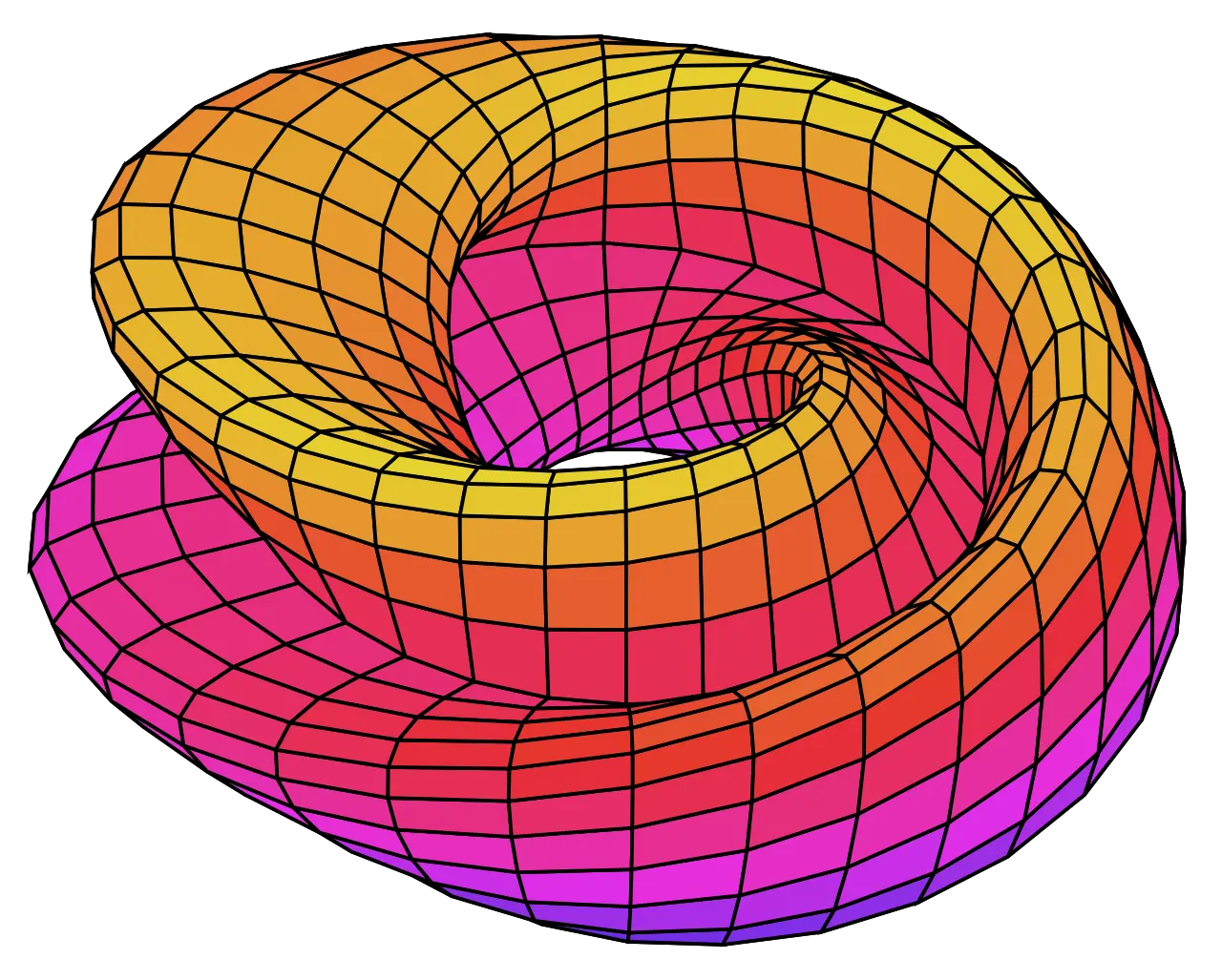
    Today I learned about the figure-8 immersion of the Klein bottle. Instead of starting with a tube and then sticking the tube through the wall of the tube to get it to join up in the opposite direction, you start with a double tube whose cross-section has the shape of a figure 8. Then you bend the double-tube around into a circle like a hula hoop and join the ends, but you give the double-tube a half-twist as you bend it, so that it turns into a single tube with a half twist.

    The self-intersection is still a circle, but instead of being the place where the tube punches through the wall of the bottle, it's the set of crossing points of the figure-8s.

    en.wikipedia.org/wiki/Klein_bo

    Part of the double tube, cut so you can see the figure-8 cross-sections,
    The whole thing.  It looks a bit like a danish pastry, with a hole in the middle instead of the cheese filling.  Or maybe a donut that dives down into its own hole and then comes up from the other side.
    💬 1🔄 1⭐ 5

Replies

  • 💬 1🔄 0⭐ 0
  • Sep 9, 2026, 11:38 AM

    @robinhouston I did!

    I felt some emotion I haven't been able to name, that I wasn't told about this thirty or forty years ago. Did nobody think I would be interested?

    💬 1🔄 0⭐ 0
  • Sep 9, 2026, 11:47 AM

    @mjd That’s exactly how I felt when I first found out about the rhombic dodecahedron. Why was I not informed of this earlier‽

    💬 0🔄 0⭐ 0
  • Sep 9, 2026, 12:43 PM

    @mjd

    I think I learned about this from Wikipedia. In 2019 I posted this on Twitter:

    Here’s my favourite immersion of Klein’s bottle. The region just inside each loop of the figure 8 is continuous with that just outside the other loop, so a Möbius-like-twist connects the two sides.

    Then by splitting the surface in two (locally), you get an immersion of a torus!

    A figure 8 is swept around a circle, rotating around its centre by 180 degrees to form a surface that is an immersion of Klein’s bottle.

A second version has two figure 8s formed by splitting the original into two parallel curves.
    💬 0🔄 0⭐ 0