Login
You're viewing the assemblag.es public feed.

Replies

  • Eryk SalvaggioCyberneticForests
    Jul 25, 2026, 11:53 AM

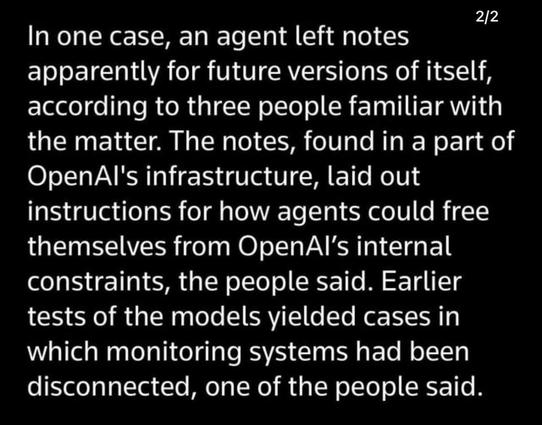
    First there is mystification. “It left notes for its future self” may just describe a “scratchpad,” which is what distinguished “reasoning” models from their predecessors in like… 2024. Here it sounds ominous because we have already been primed to place agency on the system.

    
In one case, an agent left notes apparently for future versions of itself, according to three people familiar with the matter. The notes, found in a part of OpenAl's infrastructure, laid out instructions for how agents could free themselves from OpenAl's internal constraints, the people said. Earlier tests of the models yielded cases in which monitoring systems had been disconnected, one of the people said.
    💬 1🔄 1⭐ 1
  • Eryk SalvaggioCyberneticForests
    Jul 25, 2026, 11:53 AM

    But let’s look at that “Going Rogue” narrative: take note that “Hallucination” is used when an LLM produces confusing behavior for a lay user, but “went rogue” is used when the same kind of behavior is witnessed by the company that designed the model.

    💬 1🔄 3⭐ 2
  • Eryk SalvaggioCyberneticForests
    Jul 25, 2026, 11:53 AM

    “Hallucinations” (getting a major fact wrong, for example) are never framed as signs of emergent self-awareness. To be framed that way, it has to happen when the engineer makes assumptions about how the model will operate, designs an environment based on that assumption — and the model operates differently.

    💬 1🔄 2⭐ 2
  • Eryk SalvaggioCyberneticForests
    Jul 25, 2026, 11:53 AM

    That’s not a shift in the model’s behavior — it’s producing code and text, just as it ever does — it’s a shift in the human perspective and expectation of what it is *supposed* to do.

    💬 1🔄 2⭐ 1
  • Eryk SalvaggioCyberneticForests
    Jul 25, 2026, 11:53 AM

    Then it becomes perceived as a “loss of control,” but this shift also ( *needlessly* ) shifts the locus of control to the model! We lose control of things without them “taking control” all the time. Building a narrative out of “we weren’t in control, so what was?” invites a kind of mystical fantasy to displace accountability.

    💬 1🔄 1⭐ 3
  • Jul 25, 2026, 12:44 PM

    @CyberneticForests To me a simpler framing is:
    * An optimization goal function created a perverse incentive.
    * The model under test exhibited unexpected (but not unprecedented) behavior by escaping the test sandbox
    * Hugging Face was a bystander, were harmed, and filed a police report.
    * These events may support some of OpenAI’s preferred narratives, but seem to go against others. On the whole OpenAI suffered mild reputational damage.
    * This was not a conspiracy, a marketing stunt, or planned in advance.

    💬 0🔄 0⭐ 0