Login
You're viewing the techdon.dev public feed.
  • Nov 20, 2026, 8:59 PM

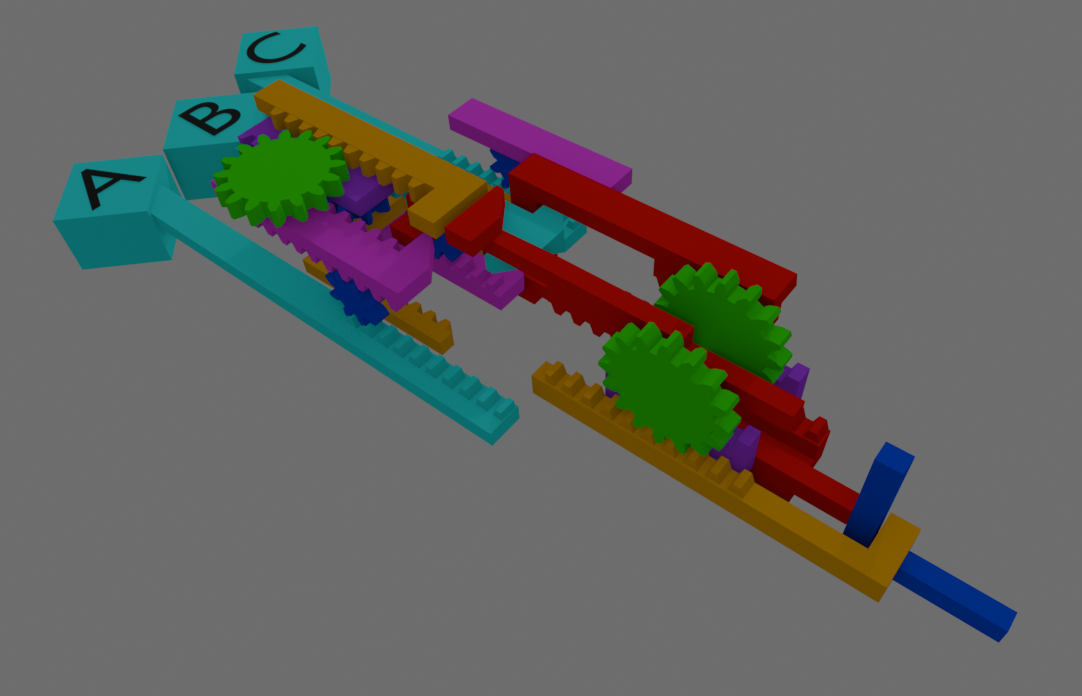
    Making the push-rod mechanism itself wasn't the hard bit. As Anthony Zhang says, you can combine his push-rod AND, OR and NOT gates together in whatever way you want, and Rule110(A,B,C) is just: (not(A) AND B) OR (B XOR C)

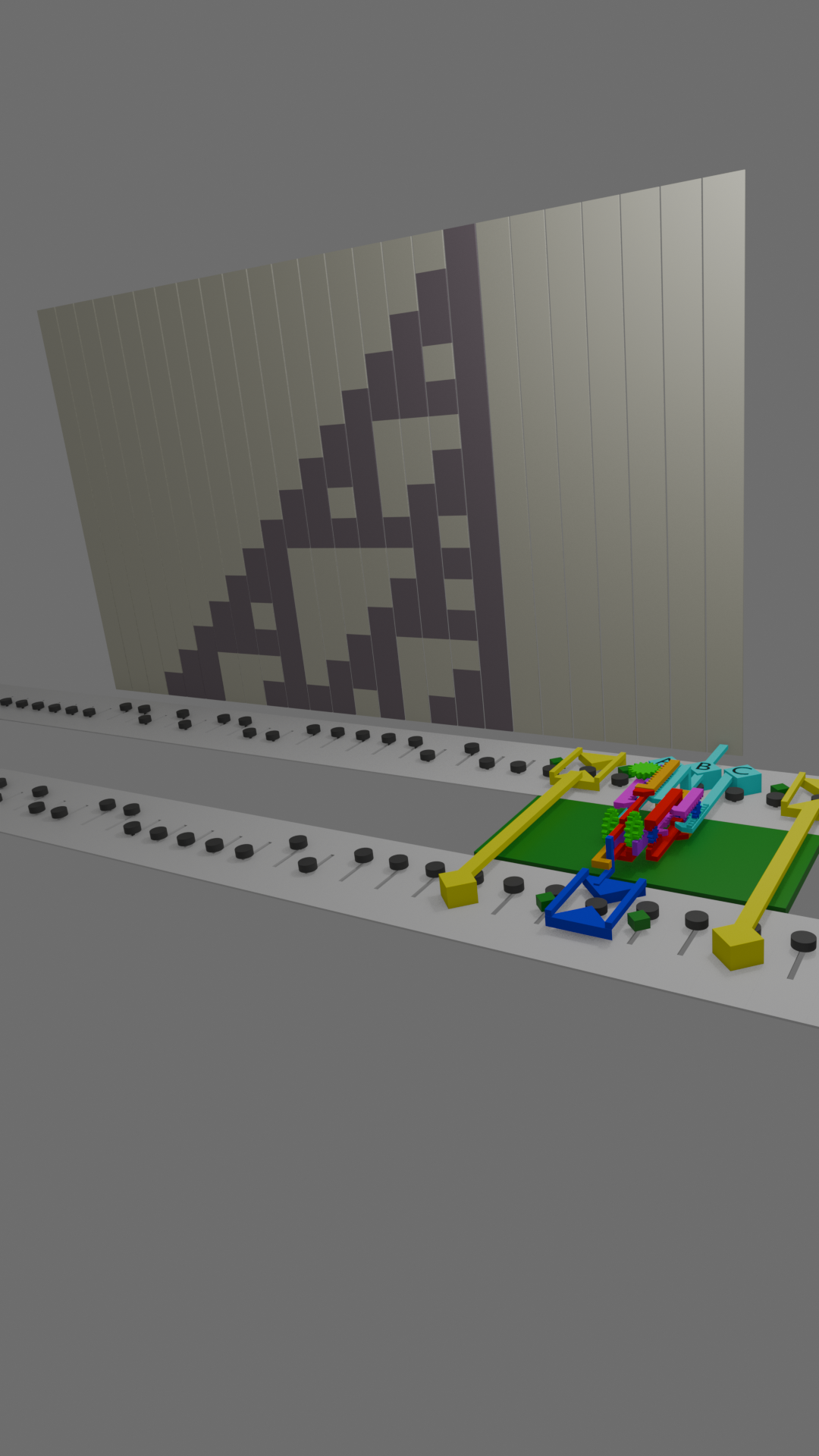
    The fun bit was getting it to operate on a tape of input values, and getting the output back onto the tape without destroying the current iteration.

    The two yellow rods on either side of the mechanism are the critical parts for doing this. At the bottom end a 'sensor' diamond gets pushed one way or the other by a peg (one that has been recently updated). The top end is an 'actuator' that pushes a peg up or down to match the lower one. So running just the yellow rod on its own would be enough to duplicate the whole tape. I find it a bit surprising that that is possible.

    And because the machine passes left and right along the tape, it needs to work the same way in both directions. And luckily all we have to do is put a second yellow 'updater' rod on the other side.

    There's no clock anywhere in this design. It just works based on the pegs that are pushing against it at each moment.

    3/N

    A computer rendering of a vertical yellow component with a shape at each end, resting on two rows of pegs.
    A computer rendering of a colorful mechanism of gears and rods. Three diamonds labelled A, B, C are visible in the top left.
    A computer rendering of a colorful mechanism resting on two rows of pegs. Behind is a sheet of squares in two colors making an intricate triangle shape.
    💬 1🔄 1⭐ 1

Replies

  • Nov 20, 2026, 10:16 PM

    I would love if it didn't need a second tape. Somehow the mechanism would need to remember the new value and write it to the tape after it has gone past.

    A hack might be to write the new value to the tape 5 places behind. This would shift the whole tape to one side but we might accept that. When coming back the other way the machine would write the output 5 places behind the other way, so the tape contents would shift back and forth but everything would still work. You'd need to somehow shift the output arm too, if you want the knitting to come out looking right. And the machine would need to know which way it was traveling, which isn't obvious.

    Please have a think about this and let me know if you can see a nice way to do it!

    4/N

    💬 1🔄 0⭐ 0
  • 💬 0🔄 0⭐ 1