
Login
You're viewing the techdon.dev public feed.
  • Oct 16, 2026, 8:54 PM

    24. Kulu Sé Mama (Juno Sé Mama) #JohnColtrane100

    This piece was born from an unexpected meeting of John Coltrane with the percussionist Juno Lewis. A few days later, they recorded this unique piece built on a poem by Lewis's words and percussions (conch shell, hand drums). It starts with a drum call by Elvin Jones; then come the percussions and the singing. After a while, other voices emerge and concur in a free improvisation. After 18 minutes, musicians pull out and leave us with the bass and percussions.

    We have Coltrane's classic quartet : he plays tenor saxophone, Elvin Jones is on drums, McCoy Tyner on piano and Kimmy Garrison on bass. With them Donald Rafael Garrett plays clarinet, bass and percussion, Pharoah Sanders plays tenor saxophone and percussion, Frank Butler is also on drums and vocals, and Juno Lewis on vocals, percussion, conch shell and hand drums.

    I don't understand the words. In the liner notes, Nat Hentoff tells they are spoken in an Afro-Creole dialect that Lewis calls Entobes. What I hear is something like:

    This is rhythm.
    This is the cry of our ancestors.
    This is the pride that our lives embody.
    This is an everlasting dance.
    This is a prayer.
    youtube.com/watch?v=SlbjP5-KM_s

    💬 1🔄 0⭐ 6

Replies

  • Oct 17, 2026, 8:14 PM

    25. Liberia #JohnColtrane100

    This song was recorded in 1960 with McCoy Tyner on piano, Steve Davis on bass and Elvin Jones, but was only published in 1964 in the album *Coltrane's sound* after Coltrane had moved from Atlantic to Impulse.

    The AAB piece starts with Coltrane exposing the theme while the rhythm section doesn't emphasize the pulsation. At the and of the B part, Jones starts playing a steady rhythm which propels Coltrane's chorus:
    he plays in swing style on the A part and changes to an afro-cuban clave on the B part, and he will do the same for Tyner's chorus. After that, Coltrane takes a riff on the chords of the A part for the final exposition of the theme. The piece ends in a drum roll.

    youtube.com/watch?v=rfH9FvbK1H0

    💬 1🔄 0⭐ 1
  • Oct 18, 2026, 11:35 PM

    26. Equinox #JohnColtrane100

    This is more or less the end of this series of tunes by John Coltrane that show a definite African influence.

    For Equinox, it is mostly limited to the intro part, and the rest is a slow blues on which Coltrane seems to be able to chorus endlessly. The rhythm section sustains the peaceful melody with a characteristic syncopated rhythm that first unbalances (for the first bar) and restores balance (at the end of the second bar).

    Simple as it sounds, I hear this tune as one of my favorite compositions of John Coltrane. It was recorded in 1960, before the advent of his classic quartet, but only released in 1964, in *Coltrane's sound*.

    youtu.be/9Zyr0IDaRXQ

    💬 1🔄 0⭐ 2
  • Oct 19, 2026, 7:16 PM

    27. Trane's Blues #JohnColtrane100

    Let's use yesterday's tune, Equinox, with his harmonic reference to the blues, to start an exploration of John Coltrane playing the blues.

    Codified by W. C. Handy at the beginning of 20th century, the blues form is simple: 12 bars, with a predefinite harmony where you basically only have 12 choices: where in the scale you do start from. (Basic playability concerns limits them further.) At some point, musicians embellished those three I, IV, V chords that constitute the form, and added enrichments, substitutions, secondary progressions.

    In any case, this simple form provides a material that is characteristic of the Afro-American jazz music on which the musicians can express fluently their emotions.

    Coltrane played that form a lot, and it influenced much of his music.

    Here, we listen to Trane's Blues, a piece he had first recorded in March 1956, in quartet, but this is a version that he recorded in May 1956, with Miles Davis as a leader, though it was only released in 1960. Paul Chambers is on bass, Philly Joe Jones on drums, Red Garland on piano.

    youtu.be/U2rcufKnYRQ

    💬 1🔄 0⭐ 1
  • 💬 1🔄 0⭐ 1
  • 💬 1🔄 0⭐ 2
  • Oct 22, 2026, 5:54 PM

    30. Bessie's Blues #JohnColtrane100

    Another blues, by Coltrane's classic quartet, in the 1964 album *Crescent*.
    Coltrane gives two expositions of the theme and leaves the stage to Tyner who I feel first plays quite unusually, and the first rhythmic chords give Coltrane the signal to start his chorus, a large part is in bass/drum/sax trio. The piano comes back for the final exposition.

    youtube.com/watch?v=16AqebffhWM

    💬 1🔄 0⭐ 2
  • Oct 23, 2026, 6:43 PM

    31. Bass Blues #JohnColtrane100

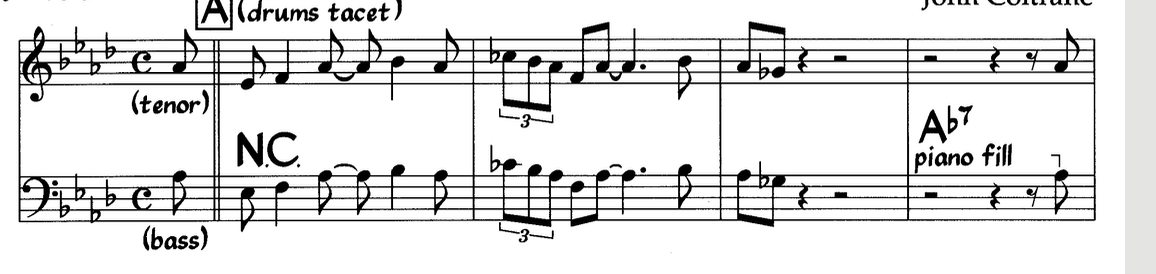
    Yet another blues, in Ab, but this one takes some liberty with the classic form: the theme consists the same (great) rhythmic phrases of (a bit more than) two bars followed by two bars filled by Red Garland on piano, repeated 6 times. The harmony stays in Ab for the first 3 times, Paul Chambers on bass and John Coltrane playing at unison, without drums. Art Taylor enters for the next three phrases and the harmony of the blues start being felt.
    Then the choruses start and the musicians stick to an enriched version of the blues form.

    After four wonderful choruses (Coltrane, then Garland, then Chambers on the bow, then Taylor), the musicians take the first part in the reverse order.

    youtube.com/watch?v=wxcwUsAqsbQ

    Bass Blues. The first four bars of the theme showing the main rhythmic figure.
    💬 0🔄 0⭐ 2