Login
You're viewing the mstdn.social public feed.
  • Jan 5, 2026, 8:17 AM

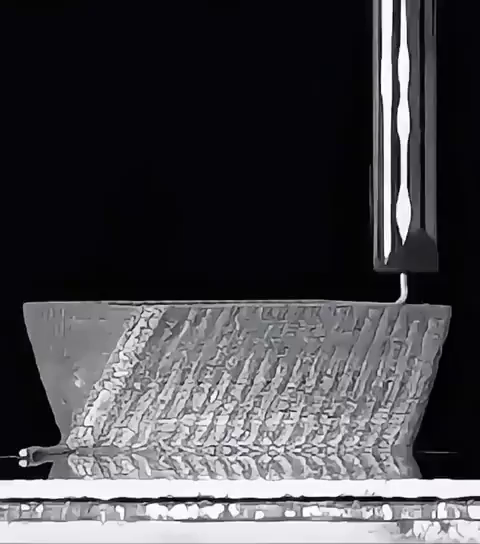
    Neat paper I missed in 2024 - these guys took an ultrasonic wedge wire bonder - the kind that's used to attach wires to chips - scaled it up by 15x, and used it to 3D print aluminium! Pretty cheap to implement, not much to it. Pretty cool. Open access, DOI: 10.3390/ma17102188

    Ultrasonic aluminium wire 3D printing
    💬 6🔄 149⭐ 271

Replies

  • Jan 5, 2026, 8:29 PM

    Darn, this specific post is making rounds on the fediverse for some reason, totally unexpected!
    Hi hello there, I think I make some cool stuff myself, check out my posts.

    💬 0🔄 0⭐ 4
  • 💬 3🔄 0⭐ 4
  • 💬 2🔄 0⭐ 3
  • 💬 1🔄 0⭐ 2
  • 💬 1🔄 0⭐ 0
  • 💬 0🔄 0⭐ 1
  • Jan 5, 2026, 2:46 PM

    @futurebird @spirit532 I know NASA tested 3D-printed rocket combustion chambers and nozzles, and in one test that setup failed catastrophically, due to inconsistencies in the printing process.

    💬 1🔄 0⭐ 0
  • Jan 5, 2026, 2:52 PM

    @Gremriel @futurebird

    This, when properly tuned, would be a lot better than powder metallurgy. But at the same time it's also going to be softer, since you can't really print harder alloys.
    But also, combustion chambers and nozzles aren't exactly your average kitchen towel hook or bike pedal.

    💬 0🔄 0⭐ 1
  • Jan 8, 2026, 6:22 AM

    @futurebird @spirit532 Was curious too. According to paper cited by OP, (§4. Conclusions) at best 75% of the feedstock, "with the elongation being lower for parts when tensile load was applied in the build direction". Parts likely to exhibit brittle fractures at print boundary due to inclusions. Not an engineer, but doesn’t sound terrible if you account for likely applied forces in print design and include sufficient strength margin. Likely useful for low-load temporary replacement parts.

    💬 0🔄 0⭐ 0
  • 💬 0🔄 0⭐ 2
  • Jan 5, 2026, 8:54 PM

    @spirit532 this is unbelievably cool! I would never have guessed it would be that simple.

    If I'm reading correctly, it sounds like the kinematics from a modest CNC metalworking mill would easily handle the needed forces, just need to swap out the tool for a big ultrasonic transducer and tip/wire-feeding system? Not as cheap as FDM but that feels pretty achievable for a hobbyist already!

    I'd be very curious to see how the parts respond to heat treatment. As-is it seems like the parts are basically annealed during the process (and have properties comparable to the annealed input), would whole-part annealing get them closer? Does the gap widen with tempering or do they temper like the bulk material? I hope they keep working on this :)

    💬 1🔄 0⭐ 0
  • Jan 5, 2026, 8:59 PM

    @adrake Don't even need a mill, a router would be fine. Forces for this would be in the single to double digit newton range, and only on-axis vertical.

    No idea on material performance beyond what the paper says, but I imagine it wouldn't be spectacular, especially given the super soft alloy.

    The company appears to be half-dead so I don't think anything will come out of it, but it should be simple to replicate on your own. This transducer is pretty small by the way :)

    💬 0🔄 0⭐ 0
  • 💬 0🔄 0⭐ 0
  • Jan 6, 2026, 10:54 PM

    @spirit532 @glasspusher

    This reminds me of the expression 'aluminum overcast'...the dream of filling the sky with Boeing bombers.

    Convair touted the B-36 as the "aluminum overcast", a so-called "long rifle", giving SAC truly global reach.[3]

    en.wikipedia.org/wiki/Convair_

    There's also this particular B-17

    en.wikipedia.org/wiki/Aluminum

    Maybe we can fill the sky with 3D printed aluminum aircraft?...but not engines of war, and we gotta keep that carbon footprint super low.

    I can dream, can't I?

    💬 0🔄 0⭐ 0