 Dec 26, 2025, 10:18 PM
Tl;dr, there’s — being based on a myth about what dyslexia actually is — and in fact some evidence they make reading even harder.
#typographyDec 26, 2025, 10:18 PMTl;dr, there’s — being based on a myth about what dyslexia actually is — and in fact some evidence they make reading even harder.
#typography
@alis do dynamically written fonts (like kermit by @underware ) improve reading by dyslexics? Has scientific study been done on that?

@alis Interesting. That would mean that visual readers can't be dyslexic (since they are not matching glyphs to sounds).

@wakame @alis my problems stopped when the adults stopped forcing me to read aloud. And they've been coming back whenever I was tasked to read something in the classroom.
Despite that I have read hundreds if not thousands of books. And now, as a grown man I even learned to read aloud for my daughter. Instead of stumbling I'm fixing the reading problems by making stuff up so it still makes sense :D it seems like I'm reading fluently but in fact I'm changing a lot. Ot doesn't have to literally be what's there, right?

@alis let me know if you run into any similar studies of https://en.wikipedia.org/wiki/Atkinson_Hyperlegible
Like a parallel poster, I have found OpenDyslexic jarring to try to read for any length of time. But I've never made a noise about it, assuming that it was helping someone. Sadly, maybe it's not?
 Dec 27, 2025, 8:31 PM
@stylus @alis I think it's more likely that there isn't one single cause of "dyslexia", and therefore a font that helps one person is indeed a font that helps that one person 🙂
Trying to suggest that on font should help all people seems like an over-generalisation.
If you want to know more about OpenDyslexic, you can always ask @antijingoist here. Some research shows positive results - https://opendyslexic.org/related-research
Dec 27, 2025, 8:56 PM@stylus @alis @antijingoist I mean, from a structural level I think the research pointed to is correct - dyslexia is not a visual-processing problem on its own. And people do indeed always sell fake solutions to real problems. But many people with dyslexia also have a set of other differences to deal with, and making their fonts consistent and easy to distinguish often helps them. It won't "fix" them though. No-one rational says that.

@minimoysmagician @stylus @alis me being dyslectic but highly compensated and trained for decades, when I stumbled upon the "special fonts" I wasn't able to recognize if they actually help me or not, thinking that maybe I'm not used to it and that's why it's not doing much for me. I imagined it probably does it for others. I considered replacing fonts on the websites I admin. Your friend might be doing that as well. Like a placebo effect. Only now I'm learning there's no point in it and I'm glad I waited.

@alis So where does this leave the idea that some dyslexic people prefer Comic Sans as a font? I don't think that comes from absolutely nowhere.
 Dec 27, 2025, 9:03 PM
@bersl2 @alis it's a fairly legible font with letters that are distinct from each other - which is what actually helps legibility. same reason Atkinson Hyperlegible is good for some dyslexic people, even though it was designed for low-vision.
the article is talking about fonts like Dyslexie, which are overall less legible but the trade-off was theoretically that they'd be better for dyslexia

@alis reminds me of this graph from Ellis & Young (1996) p. 222. Seems that, at best, "dyslexia fonts" help only in one of all those cases ("visual analysis system"), and if so then only if that cognitive process is not completely broken.
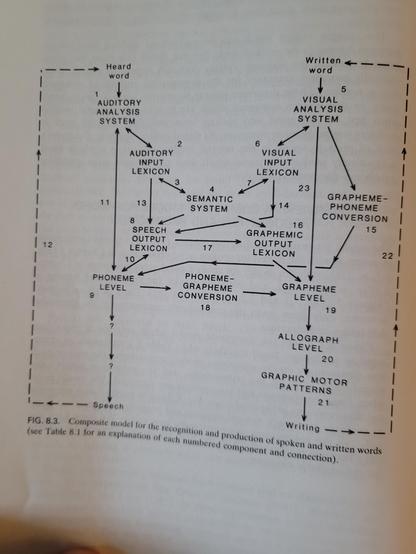

That's not true. There is some decent evidence and it fould no benefit in dyslexia fonts.
That's a huge difference!