
codinginquarantinecodinginquarantine@corteximplant.com
Apr 24, 2026, 5:19 PMI couldn't stop thinking about this so I had to make it and share it
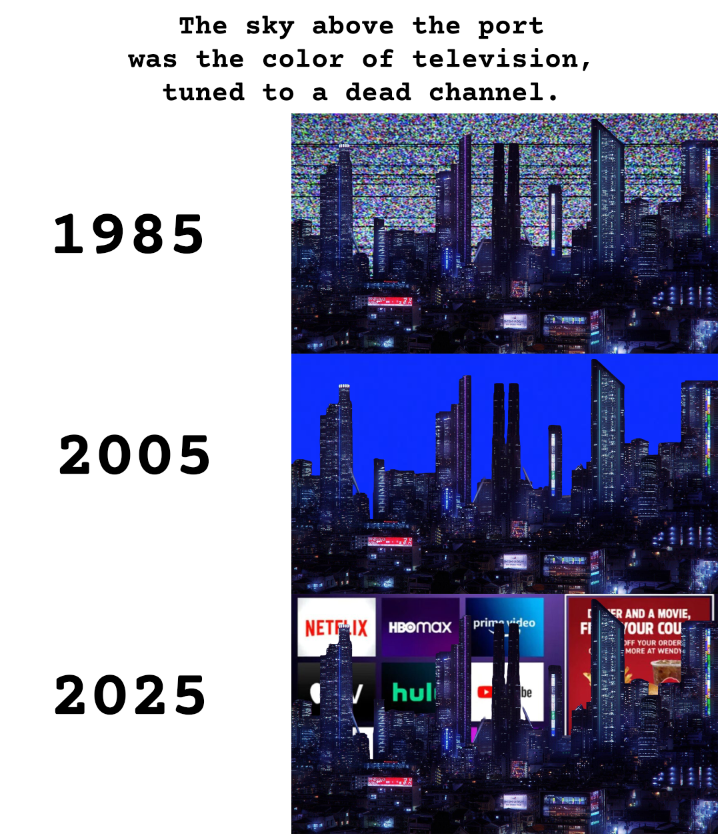
I couldn't stop thinking about this so I had to make it and share it

I lol'd at the image.
"however", most NTSC TVs in the '80s would have shown a purely black and white signal.
The technical reasons why are interesting to me, and now I'm infodumping on you. Not because I hate you or your image.
The north american television system (NTSC) was adopted in 1941 and was a purely black and white system. These TVs would certainly have displayed static as black & white as there was literally no capability to display color.
Color NTSC, adopted in 1953, had to be compatible with existing B&W sets, and had to allow color TVs to receive and display B&W content correctly. They way they chose was adding a hidden signal on each line that told a color-capable set to display that particular line in color. This signal is called the "NTSC colorburst".
(Many modern NTSC receiving devices use color or black & white for the entire frame or field (or maybe don't support B&W at all?), but this is not what real CRT TVs and monitors did. This makes a particular difference for correctly displaying Apple II graphics: The split screen modes should display clear text in the bottom rows, not color-fringe artifacts! So .. this is not to say there weren't TVs that could have had the same "bugs" and displayed color static. I'd love to know if some did! I also don't know about other systems such as SECAM or PAL in this respect)
The random background noise of static is very unlikely to meet the requirements of the colorburst, so a color TV would fall back to the mode for B&W content.
The wikipedia article on video noise shows the kind of static I expect...
https://en.wikipedia.org/wiki/Noise_(video)

@stylus
Nice infodump, I like it
@codinginquarantine