Login
You're viewing the functional.cafe public feed.
  • Nov 19, 2026, 7:59 AM

    Daniel Meyer in 2002 coined the term 'snowball' for the equivalent in 3D, so let's look at some snowballs! The one he was referring to jumps from adding triangles to adding cubes. The class of shape is a shell-tree, it is a tree that self-contacts into a water-tight 'shell' (the set complement of a tree).
    (2/7)
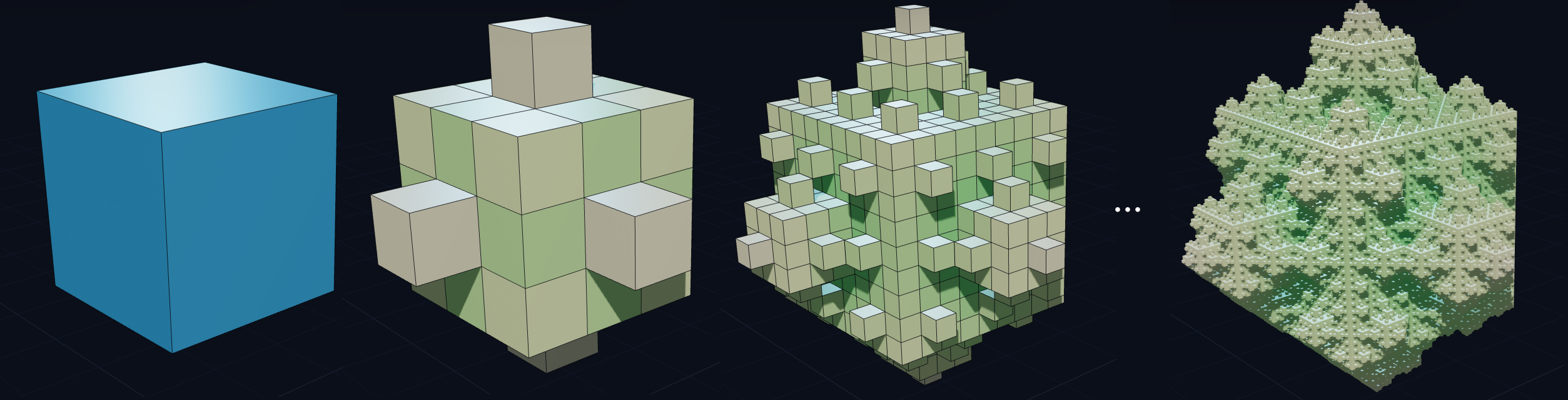
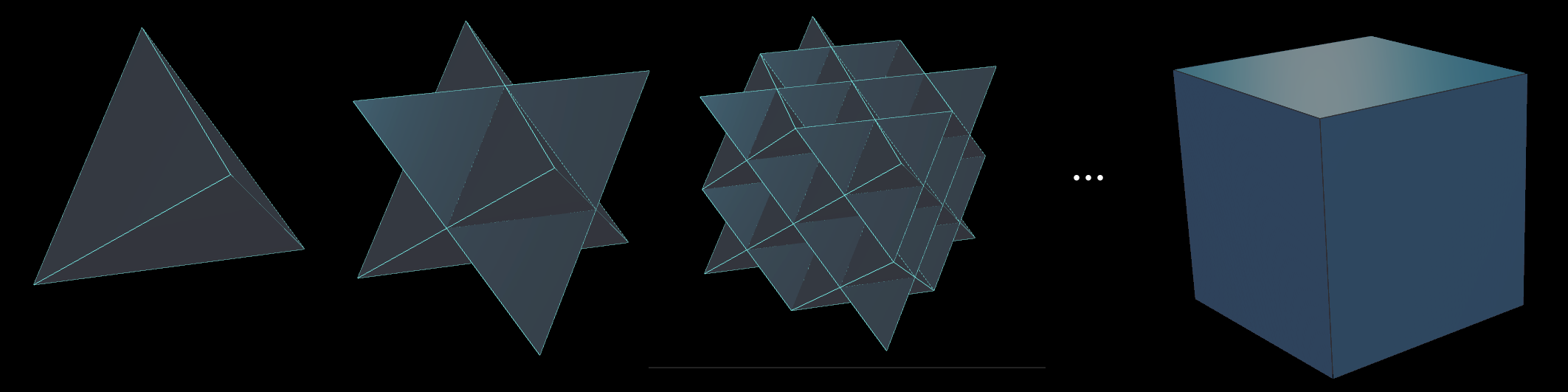
    showing the 0,1,2 and n'th iteration of repeatedly adding a cube to the centre of each face of a cube.
    💬 1🔄 1⭐ 5

Replies

  • Nov 19, 2026, 8:05 AM

    It's very simple but it already has a 2D equivalent, where you add child squares to a square.

    Instead we can add child tetrahedra to a tetrahedron, placing one in the centre of each face with half the edge length.

    This is a tree-solid, it is a tree that self-contacts to fill space and so form a solid, with the limit set being just a cube.

    However, the limit-set of the boundary is not a cube, it forms a void-shell, meaning it has no volume (being a boundary) and is a shell, so encloses a tree.
    (3/7)

    0,1,2 and n'th iteration of the tetrahedral Koch snowflake.
    💬 0🔄 1⭐ 5
  • Nov 19, 2026, 8:12 AM

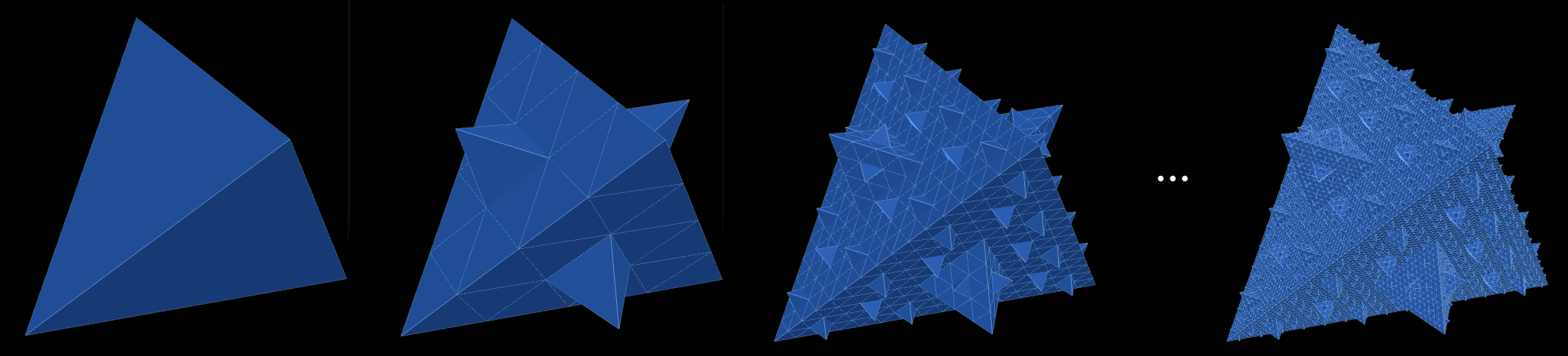
    That's a much closer 3D equivalent, but I think we were all hoping for something nice and spikey like the Koch snowflake is in 2D. One way to achieve this is to make the added tetrahedron smaller, for instance by subdividing each triangle into 16 smaller ones and adding the extra tetrahedron on the central triangle.

    This generates a tree structure, specifically a tree-tree meaning it is a tree whether the boundary is included in the solid or not. This is what we think of as a standard tree- a hierarchy of protrusions. The 2D Koch snowflake is also a tree.
    (4/7)

    0,1,2 and n'th iteration of adding a smaller tetrahedron to each tetrahedron face.
    💬 0🔄 1⭐ 6
  • Nov 19, 2026, 8:16 AM

    This is nice but the child is a bit small compared to the parent. Instead we can use a larger child tetrahedron like this one.

    The downside is that it overlaps itself, making it technically a sponge (it has handles).
    (5/7)

    0,1,2 and n'th iteration of larger tetrahedron version of koch snowflake.
    💬 0🔄 0⭐ 7
  • Nov 19, 2026, 8:21 AM

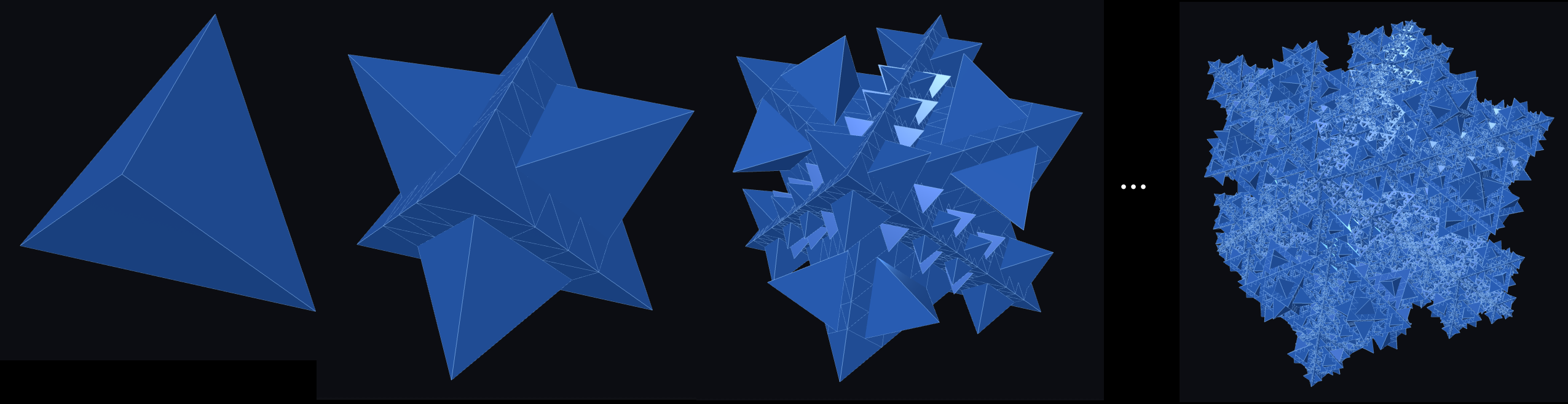
    One way to keep the larger child while reducing the chance of overlap is to stick the added child tetrahedron farther from the grandparent, in this version the added tetrahedron is glued to the peak of the pyramid on all three sides.

    It looks very spiky and 'Koch snowflakey', but unfortunately it has some slight overlaps, making it also a sponge in terms of classification.
    (6/7)

    0,1,2 and n'th iteration of this 'pyramid peak' version of the Koch snowflake.
    💬 0🔄 0⭐ 4
  • Nov 19, 2026, 8:26 AM

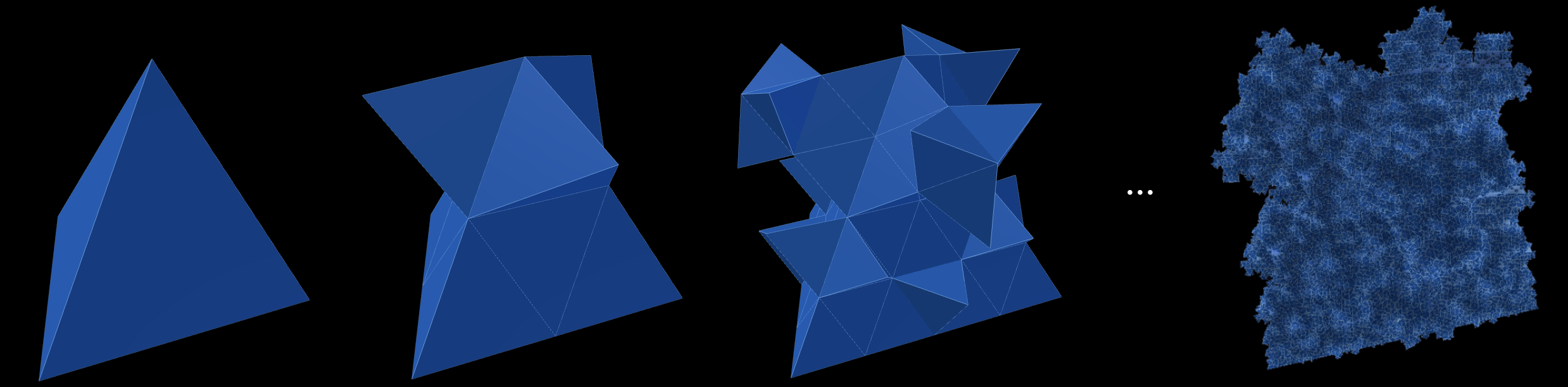
    It *is* possible to get large children with no overlap, and we can keep another nice property of the Koch snowflake too, that its bend angle is a free parameter.

    But you lose a couple of things... the shape gluing on is a rhombus-based pyramid, and it isn't in the centre of each facet.

    Nevertheless, it is a tree just like the Koch snowflake, so this one is my favourite 'snowball', it even has a bit of a puffier appearance. The image below is for the largest bend angle before self-contacting.

    Here's an interactive viewer: glslsandbox.com/e#4851.17
    and more info on my blog here: tglad.blogspot.com/2026/11/koc

    (7/7)

    0,1,2 and n'th iteration of variable angle pyramidal recursive shape.
    💬 0🔄 0⭐ 10
  • Nov 19, 2026, 8:31 AM

    @TomL Really cool thread! I had just started thinking how one would add pyramids to triangular faces, but through a different path: by wondering about starting from a octahedron...

    💬 1🔄 0⭐ 0
  • Nov 19, 2026, 8:46 AM

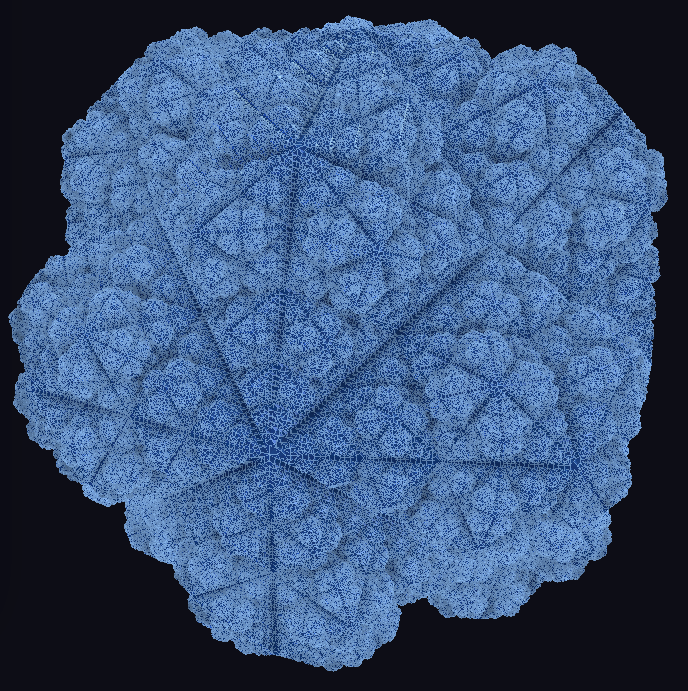
    @SylviaFysica a fun idea to make the 'snowball' more ball-like. Here is the above fractal applied to the faces of a rhombic dodecahedron:

    rhombic pyramid fractal applied to the faces of a dodecahedron.
    💬 0🔄 2⭐ 8