Login
You're viewing the functional.cafe public feed.
  • May 7, 2026, 8:30 AM

    Typical ML argument: "If I can read something legally, why can't I train an LLM on it?"

    Humans are capable of reading things and later writing a similar thing that is still a copyright violation. If I go and write a book that follows the plot line of Star Wars, that's still a copyright violation, even if no text is literally the same. If I play the melody to a song on my piano and release it without the appropriate mechanical cover license, that's also a copyright violation.

    The reason this does not happen often is that, as humans, we are aware that that's plagiarism and there are rules. Sometimes it happens by accident, and people still get sued and lose.

    LLMs have no such awareness and routinely output things which are blatant copyright violations when appropriately prompted. That means the model weights encode that work, and therefore, are themselves a derivative work.

    Your brain encodes a massive amount of copyrighted information. You are not a walking copyright violation because humans aren't data, can't be copied and distributed en masse, have human rights, etc. This is why "mind reading machines" are a classic dystopian plot point (monetizing your thoughts etc).

    An LLM is not a human, does not have human rights, nor human privileges. It is data, and if it encodes copyrighted information, that's a derivative work. If you aren't following the license of the training data, that's a copyright violation.


    💬 11🔄 67⭐ 79

Replies

  • May 7, 2026, 8:31 AM

    Yes, this means that anyone downloading "open" models potentially puts themselves in as much legal risk as downloading a movie does.

    Just *using* a cloud based LLM may or may not be safe depending on how a bunch of legal unknowns go, if the output happens to not qualify as a copyright violation. Of course, since you have no idea whether it will, you're basically playing copyright Russian roulette.

    💬 3🔄 7⭐ 24
  • May 7, 2026, 8:41 AM

    BTW, there is almost certainly a model size and architecture threshold here. If I train an image upscaler on copyrighted data, for example, it's quite improbable that it will be able to generate copyrighted data from an unrelated input (for typical upscaler designs and sizes). Most likely that is safe.

    Is there a size threshold for LLMs where, for typical training data distributions, the LLM is highly unlikely to "memorize" any copyrightable information? Is that size threshold a usable LLM? These are open questions (that nobody seems to be interested in researching).

    I'm willing to bet if such a size threshold exists, it's much smaller than the minimum LLM size useful for "general purpose" prompting though.

    💬 1🔄 4⭐ 15
  • May 7, 2026, 8:44 AM

    @lina

    "You stand accused of downloading and then redistributing the BritDonnaAguilera model, which is able to generate music extremely close to that of popular pop singers."

    💬 0🔄 1⭐ 2
  • 💬 0🔄 0⭐ 2
  • 💬 0🔄 0⭐ 2
  • May 7, 2026, 6:01 PM

    @lina I don’t know if I will redistribute the vibecoded test suite I wrote. The only LLM-generated code I have published were trivial bugfixes that were clearly based on my own code.

    💬 0🔄 0⭐ 0
  • May 7, 2026, 8:41 AM

    @lina just considering the LLM itself as a derivative work, wouldn't it be legal to train one on CC BY-SA or GPL text as long as the weights are released under the same license? (Which wouldn't seem like a big deal for those "open" models)

    💬 3🔄 0⭐ 3
  • May 7, 2026, 8:55 AM

    @florian @lina Both of those licenses need you to give attribution to the original authors and include the license text. But if you do that for your LLM-outputs somehow, it could be fair game.

    💬 0🔄 0⭐ 3
  • May 7, 2026, 8:57 AM

    @florian It would, if and only if:

    1) You train only on compatible license content
    2) You meet all the attribution requirements of those licenses (this is a big one)
    3) Your weights are licensed under a compatible license themselves (usually the same for most copyleft licenses)
    4) You understand that the output of the model may be copyrighted and require the same licensing and attribution (making the model unsuitable for, say, creative generation for publishing, but it would still be fine for a local voice assistant or something like that) and make your users aware of this.

    Unfortunately, I haven't been able to find any models that meet any of those conditions, let alone all of them (other than KL3M which credibly claims to be trained on PD and non copyrightable content only).

    💬 2🔄 0⭐ 4
  • May 7, 2026, 9:02 AM

    @lina actually attribution might still be a major hurdle, you can totally supply all the attribution strings for your training corpus with the model, but is it really attribution if you can't point to where in the model a specific persons work is encoded (which you can't obviously)?

    💬 2🔄 0⭐ 2
  • May 7, 2026, 9:10 AM

    @florian I don't think there's any need to care about where a work is encoded. You do need a list of all authors though.

    I think there's some flexibility in that you might not need to literally list every individual, though IANAL. For example, if you train on Wikipedia (only), you could plausibly get away with specifying the exact database dump you used (where the edit history data is available) without having to extract and collate the author list yourself. But if you're scraping something like GitHub that does not make explicit dumps available, yeah, you'd better at *least* list every project and commit ID you scraped (and even that might not be enough).

    💬 1🔄 0⭐ 3
  • May 7, 2026, 5:43 PM
    @florian @lina > (which you can't obviously)?

    You can. But none of them do it in part because it's storage-heavy and it kills performance.
    💬 0🔄 0⭐ 0
  • Nov 19, 2026, 5:04 PM

    @lina @florian
    I think point 1 needs more emphasis: if you trained on some GPL code and some CDDL code, you need to follow the copyleft clauses of both licenses, which are contradictory. So your model is not redistributable.

    💬 0🔄 0⭐ 0
  • 💬 0🔄 0⭐ 0
  • Nov 20, 2026, 7:53 AM

    @vincent @florian All those models train on data sets without consent and nobody uses them with strict attribution of the output or respecting licensing properly, so as far as I'm concerned none of them are ethical, even if in principle you could put together a giant attribution list for the weights themselves.

    KL3M is the only one I've found that believably is trained on PD content only.

    💬 1🔄 0⭐ 0
  • Nov 20, 2026, 8:41 AM

    @lina @florian > even if in principle you could put together a giant attribution list for the weights themselves

    That would be useless as an attribution anyway as not all weights relating to those inputs would be used. It needs to be tracked per-output. Which as far as I understand is effectively impossible to accelerate with current hardware and would require full CPU-only compute (and so slop engines must die, by impracticality and ethics alike).

    💬 1🔄 0⭐ 0
  • Nov 20, 2026, 8:47 AM

    @lina @florian That said copyright must still be abolished because the notion of owning the idea of a melody is absolutely disgusting.

    Attribution & provenance remain desirable, however.

    💬 1🔄 0⭐ 0
  • Nov 20, 2026, 9:06 AM

    @lispi314 @florian There is no way to partition the weight set per output. For all practical purposes, all weights are collectively a derivative work of all training inputs. It's not individual storage. Its like one of those crypto money laundering machines, nobody knows and nobody can know where the copyright came from. Every single time you add a copyrighted work to the input, effectively all weights change.

    💬 1🔄 0⭐ 0
  • Nov 20, 2026, 9:09 AM

    @lina @florian It's fully possible to do it, while keeping track of every single input for every single weight.

    (This means it most likely is stored as a graph database.)

    It increases the memory and compute requirements while preventing all current acceleration, but it remains technically possible. It is entirely prohibitive to interactive/non-batch use, yes.

    And it is the bare minimum necessary for being compatible with even just Creative Commons attribution requirements.

    That it's impractical isn't my problem. If they can't find a practical way to do it, then maybe they shouldn't do it at all? :ms_robot_upside_down:

    💬 1🔄 0⭐ 0
  • 💬 1🔄 0⭐ 0
  • Nov 20, 2026, 9:49 AM

    @lina @florian I'm the primary source.

    I have worked with graph databases. Everything the neural nets do can be done dynamically, slowly, in CPU compute with a graph database.

    There is zero magic there.

    One can add an appropriate reference to inputs at every point necessary and eat the storage cost, too.

    It is prohibitively expensive? Possibly, but that is irrelevant to its technical feasibility.

    (Besides with small purpose-specific machine learning applications it's actually perfectly fine.)

    💬 1🔄 0⭐ 0
  • 💬 1🔄 0⭐ 0
  • Nov 20, 2026, 10:03 AM

    @lina @florian Are you seriously trying to argue that a few steps of linear algebra can't be blown up into equivalent operations on a graph of more complex data?

    This is incidentally one of the things graph databases were being boasted about for in the first place, before it became trendy to use GPUs for the whole thing.

    💬 1🔄 0⭐ 0
  • Nov 20, 2026, 10:07 AM

    @lispi314 @florian LLMs are not "a few steps of linear algebra", that is hyperbole.

    There is a nonlinear component in every layer that is a critical part of what makes it work. Otherwise it would indeed collapse to one big matmul.

    Unless you've studied all this, backpropagation, gradient descent, etc., and have at least a toy PoC of how your claimed approach would work, unfortunately I'm going to have to assume you don't know what you're talking about. Sorry.

    💬 1🔄 0⭐ 0
  • Nov 20, 2026, 10:10 AM

    @lina @florian My point is about computational equivalence.

    There is nothing fundamental involved that cannot be translated to CPU compute (it works on emulated GPUs). And there is nothing there which cannot be translated to graph storage operations.

    I'm effectively suggesting keeping a debug trace of the entire thing around, instead of discarding it or not generating it in the first place.

    Or did I miss some important computability theory part involved here? I don't think I did.

    💬 1🔄 0⭐ 0
  • Nov 20, 2026, 10:15 AM

    @lispi314 @florian And I'm saying every piece of training data contributes to every weight, and every weight contributes to every output, if not strictly speaking then at least in principle. Just like diffusion steps in cryptography, when you mix things together enough you lose the ability to map output to input.

    Of course LLMs work on CPUs, and people run them on CPUs, and people do studies on what different neurons do, and all these kinds of things have been attempted. I'm not sure why you keep bringing up GPUs, what hardware you run this on is irrelevant, what matters is the model architecture. You will find a million CPU only implementations starting with llama.cpp CPU only modes.

    I saw someone implement an LLM in excel once ffs.

    Again, I'm so sorry, but this sounds like a serious case of "I know this field and I bet it can be used to solve every problem" from someone who doesn't have any experience with this specific problem. Of course you can keep a "debug trace" of the entire thing, and that debug trace is going to tell you that numerically your output is affected by every input in the end.

    If you think otherwise, please go implement your approach on a toy LLM that runs efficiently on CPU and publish a paper about it, I'm sure you'd get cited a lot.

    💬 1🔄 0⭐ 0
  • Nov 20, 2026, 10:18 AM

    @lina @florian

    Please go implement your approach on a toy LLM that runs efficiently on CPU and publish a paper about it, I'm sure you'd get cited a lot.

    Whyever would I do that when the entire reason I bring up the idea is to give them what I expected to be an intractable challenge (I'm very much suspect a minimum of exponential growth of compute and storage requirements) that just kills their field (at best) or otherwise at least mitigates its harms?

    💬 1🔄 0⭐ 0
  • Nov 20, 2026, 10:20 AM

    @lispi314 @florian Because if you prove that it's numerically possible to extract provenance from an LLM that would be an *excellent* argument for regulations that require it, and since it's most likely impossible to implement efficiently at scale, that indeed would be a very good way to throw a wrench in the works of the entire industry. Which is what you want, no?

    💬 1🔄 0⭐ 1
  • 💬 0🔄 0⭐ 0
  • 💬 0🔄 0⭐ 0
  • 💬 0🔄 0⭐ 1
  • 💬 0🔄 0⭐ 2
  • Leelooleeloo@c.im
    May 7, 2026, 11:20 AM

    @lina
    Unfortunately the lawmakers and courts have been bought by the people who own these LLMs.

    💬 0🔄 0⭐ 0
  • May 7, 2026, 1:56 PM

    @lina If I retell Star Wars with different character names, not as a publication but just around a campfire with my family, that still isn't illegal, right? Lucasfilm/Disney only get to send in the legal team to black-bag me if I try to, e.g., publish a wax cylinder of my campfire stories (as sincere non-parody). Just saying a plot aloud isn't a problem, nor is sketching Mickey Mouse on a napkin, right?

    💬 1🔄 0⭐ 0
  • May 7, 2026, 3:32 PM

    @paul The story is still copyrighted, but telling it to your family wouldn't count as a "public performance" so wouldn't infringe copyright. Telling it to a crowd at a park probably would, though.

    Copyright of characters is complicated and varies by jurisdiction. That said, Mickey Mouse is in the public domain now, so your sketch is totally fine as long as you aren't trying to sell it or pass it off as legitimate Disney merchandise (because Mickey is still trademarked).

    (Disclaimer: IANAL, this is just my understanding.)

    💬 2🔄 0⭐ 0
  • May 7, 2026, 3:54 PM

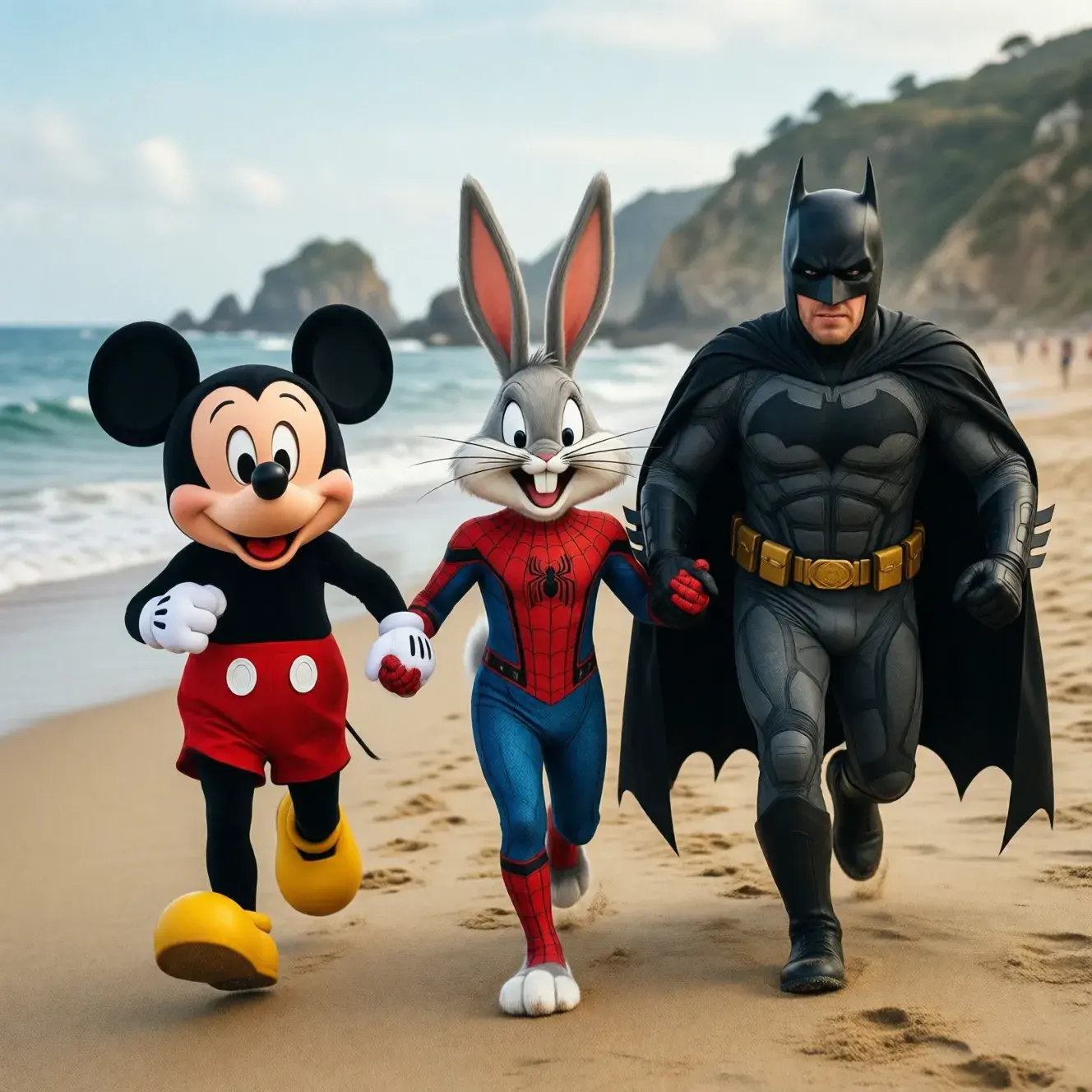
    @lina On a related note, does camp fall under parody law if it's not intentional? Like, this image is probably covered because "Bugs Bunny + Spiderman" but I didn't specifically prompt for that. Diffusion models are just bad at multi-subject stuff.

    Image attached toot
    💬 1🔄 0⭐ 0
  • 💬 1🔄 0⭐ 0
  • May 7, 2026, 4:07 PM

    @lina Need to make sure you end up in a state court with a sense of humor. So, like, avoid the 5th circuit.

    💬 0🔄 0⭐ 0
  • May 7, 2026, 5:40 PM
    @lina @paul It's horrendous that people have truly tried to kill public storytelling & sharing of stories.

    How is this not disgusting to more people?
    💬 1🔄 0⭐ 0
  • May 7, 2026, 7:17 PM

    @lispi314 @lina The legal framework does become philosophically intractable for a lot of edge cases. It's especially indefensible when the original IP depended on a folktale with unknown authorship. Feels like Monsanto patenting genes; very "Wait, they can DO that?"

    💬 0🔄 0⭐ 0
  • May 7, 2026, 7:20 PM
    @paul @lina Even in general, most of the remotely valid arguments for copyright that I've heard are really more arguments against capitalism.
    💬 0🔄 0⭐ 0
  • May 7, 2026, 5:41 PM
    @lina > This is why "mind reading machines" are a classic dystopian plot point (monetizing your thoughts etc)

    All the copyright aspects don't matter if that atrocity is abolished though.

    And the notion of not having backups is existential horror.
    💬 0🔄 0⭐ 0
  • May 7, 2026, 5:53 PM

    @lina US and EU law seems to be pointing in the direction of the model providers being potentially liable, but model users not being unless they do something stupid (like prompting the model to get those violations out).

    💬 0🔄 0⭐ 0
  • May 18, 2026, 5:14 AM
    @lina Another take: An industrial regulation created by publishers to curtail competition, descended from and modeled on the state censorship law that it replaced, shouldn't be our framework for figuring out the ethics of LLMs nor, that matter, the ethics of anything else.

    There are plenty of critical things one can say about LLMs, but the fact that training them involves copyright violation just puts them in the same company as, say, jazz musicians. It's not a point against them; it might even be a point in their favor.
    💬 0🔄 0⭐ 0
  • May 18, 2026, 5:48 AM

    @kfogel My argument does not require any system of copyright beyond basic author's moral rights. Since LLMs can reproduce copyrighted works, it follows that the copyrighted work is embedded in the LLM. Any interpretation that dismisses this to the extent the original author would have no interest nor control in their work when it is in the form of LLM/AI output (or any intermediate form capable of producing such output, or any output that is derivative, which LLMs can also do) would require essentially complete abolition of copyright as we know it, or otherwise would become a backdoor capable of negating the effect of any system of copyright.

    While endless discussions could be had about the flaws of copyright legislation as it exists today, I don't think you'll find that "copyright shouldn't exist at all" is a very popular take, especially among creative fields.

    Should you wish to make an argument against copyright-based opposition to GenAI, I think you'll have to present a workable and popularizable alternate system of copyright first to have a credible argument.

    Either that or get UBI rolled out first, but good luck with that when the billionaire class is busy taking the world's money to deploy and run AI. And those billionaires are, morally, the furthest thing from jazz musicians.

    💬 1🔄 0⭐ 0
  • May 18, 2026, 5:52 AM

    @kfogel TL;DR if you want to argue copyright shouldn't be the foundation of an ethics argument, you're going to have to first build up the ethics of copying creative works from first principles, because "it's always ethical to copy" isn't going to get a lot of people on your side.

    💬 0🔄 0⭐ 0
  • Nov 19, 2026, 6:58 PM

    @lina
    I don't recall copyright being about ideas. Writing a story with the same plot as Star Wars with different words, images is not a copyright violation by any means. You can't copyright ideas (even patents can't). Copyright is not as restrictive, and that's a good thing.

    💬 1🔄 0⭐ 0
  • 💬 1🔄 0⭐ 0
  • Nov 20, 2026, 8:15 AM

    @lina
    I'm not convinced avvo is really a good source in any way, but, even per your source, what I said still holds :

    > The entire work is considered, but its unprotectable elements get disregarded. Disregarded elements include themes, ideas, facts, and obligatory to the genre or cliche scenes , called "scenes a faire," such as doomed young lovers, with a scene of angry parents forbidding the love. The original creative elements, such as tone, setting, dialogue,

    💬 0🔄 0⭐ 0