Login
You're viewing the functional.cafe public feed.
  • Dec 17, 2025, 9:40 AM

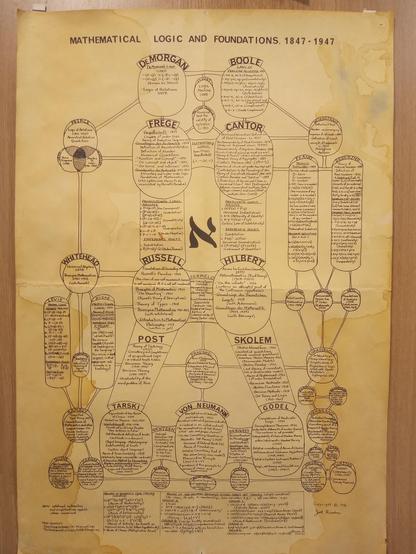
    Yesterday I went to visit my old Philosophy Department, and I saw this poster on one of the professor's doors (bearing the title "Mathematical Logic and Foundations 1847-1947" and crediting Joel Friedman as its author, and providing 1976 as the creation year), and I felt that I have to share it on Mastodon (if nothing else, then just for the sake of writing alt text ;D)

    It's around 3MB, so sorry about that, but I didn't want it to reduce it to make sure the letters remain legible.

    I also found this write-up about the poster: dailynous.com/2014/10/28/mathe

    At the top, there's the inscription:

MATHEMATICAL LOGIC AND FOUNDATIONS 1847-1947

below is a diagram that resembles a two-headed creature.

The left head is captioned "DeMorgan", and it contains "DeMorgan's Laws (1847)" and "Logic of Relations (1859)"

The right head is "Boole" and it contaions "Laws of Boolean Algebra, 1847"

Between is a smaller circle captioned "Jevons" with "Logic Machine (1869)", and right below it - "mrs. Ladd-Franklin" with "Numerical test for validity of syllogism (c. 1880)"

Then at the level of chest there are Frege and Cantor with numerous contributions.

At the same level is left arm, with a Venn Diagram of Peirce, Venn and Schroeder. The right arm is Weierstrass. Then Frege is connected to Russell (at the level of pelvis) with a strip captioned "propositional logic", and Cantor is similarly connected to Hilbert with "predicate logic". In the middle of pelvis is Zermelo.

The left arm is extended to the fist captioned "Whitehead". The right arm consists of two long forearms captioned Peano and Dedekind, which reaches three fingers? - Brouwer, Lovenheim and Weyl.

Now from the pelvis there are monster's two legs: Post and Skolem, and there's a "Fraenkel" circle dangling between them. The left foot of the monster is Tarski, the right foot - Goedel, and between them is von Neumann. There's also Gentzen and Bernays placed between the 3 feet. There's also Lewis, Nicod, Wittgenstein, Lukasiewicz, Schoenfinkel, Herbrand, Church, Turing and a few others
    💬 5🔄 25⭐ 39

Replies

  • Dec 17, 2025, 9:58 AM

    @PaniczGodek This took a long while to make, I bet.

    One of the silver linings of covid was that the differentials class I was taking had video lectures. The lecturer decided, that as he didn't have a time limit, he's going to go over the evolution of the principles in short, and those that want to skip can just skip it. He introduced Weierstrass' and, I think, Dedecand's approach to the limits and epsilon.

    Ofc it took more time, but it made me much more immersed in the subject.

    💬 2🔄 0⭐ 1
  • 💬 1🔄 0⭐ 0
  • Dec 18, 2025, 6:22 AM

    @filip @PaniczGodek If they are, they aren't being advertised openly and I can't find them. Also, iirc they were in Finnish. However, MIT has openly accessible course lectures that might cover these topics.

    What I found is tricky in maths (being hard put aside) is that, as you don't know what you don't know, it's not obvious to find topics that click for you. However, maps like this help to pin point some of the names and topics related. Following those breadcrumbs should lead to the sources.

    💬 0🔄 0⭐ 0
  • Aug 21, 2026, 12:10 AM

    @rojun @PaniczGodek C.S. Peirce was apparently one of the last holdouts who preferred infinitesimals to limits. I’ve been nerd-sniped into digging into his philosophy, and I have this weird idea that the distinction played a role. (1/2)

    💬 1🔄 0⭐ 0
  • 💬 0🔄 0⭐ 0
  • 💬 0🔄 0⭐ 1
  • 💬 0🔄 0⭐ 1
  • 💬 0🔄 0⭐ 0
  • 💬 0🔄 0⭐ 1