@jimmylittle
I normally don't engage, but I am putting things for the record here.
Caveat: I am only discussing generative large language models. I will call them genllm for clarity.
You claim a fear that avoidance of genllm will lead to less secure software. I assume you claim this from one or both of two positions commonly held inthese discussions. One, genllm are better able to identify security flaws than humans. Two, genllm are better at writing secure code. I contest one becuase 'better', besides being subjective, is being defined by the companies profiting who make unverified claims at a pace that people without billion dollar budgets struggle to contest, though we often prove them as fraud. Regardless of success, if we look at cost, paying humans the amount it cost to generate every actual security flaw identified, I would contest it would have been cheaper than the true material and energy costs of genllm. I contest two because I know how this technology works and it can only reproduce code to the quality of the lowest common denominator of the code it was trained on, which was written by humans, and the input from the prompt, also written by humans. These models do not understand anything, they just reproduce likely results based on human work, with no comprehension of why.
These aren't sentient beings, they have not beaten humans at anything cost for cost, and it is no more dangerous than script kiddies have always been. This tech, from a security perspective, is as dangerous as any script kiddie would be when subsidized with nation-state scale budgets.
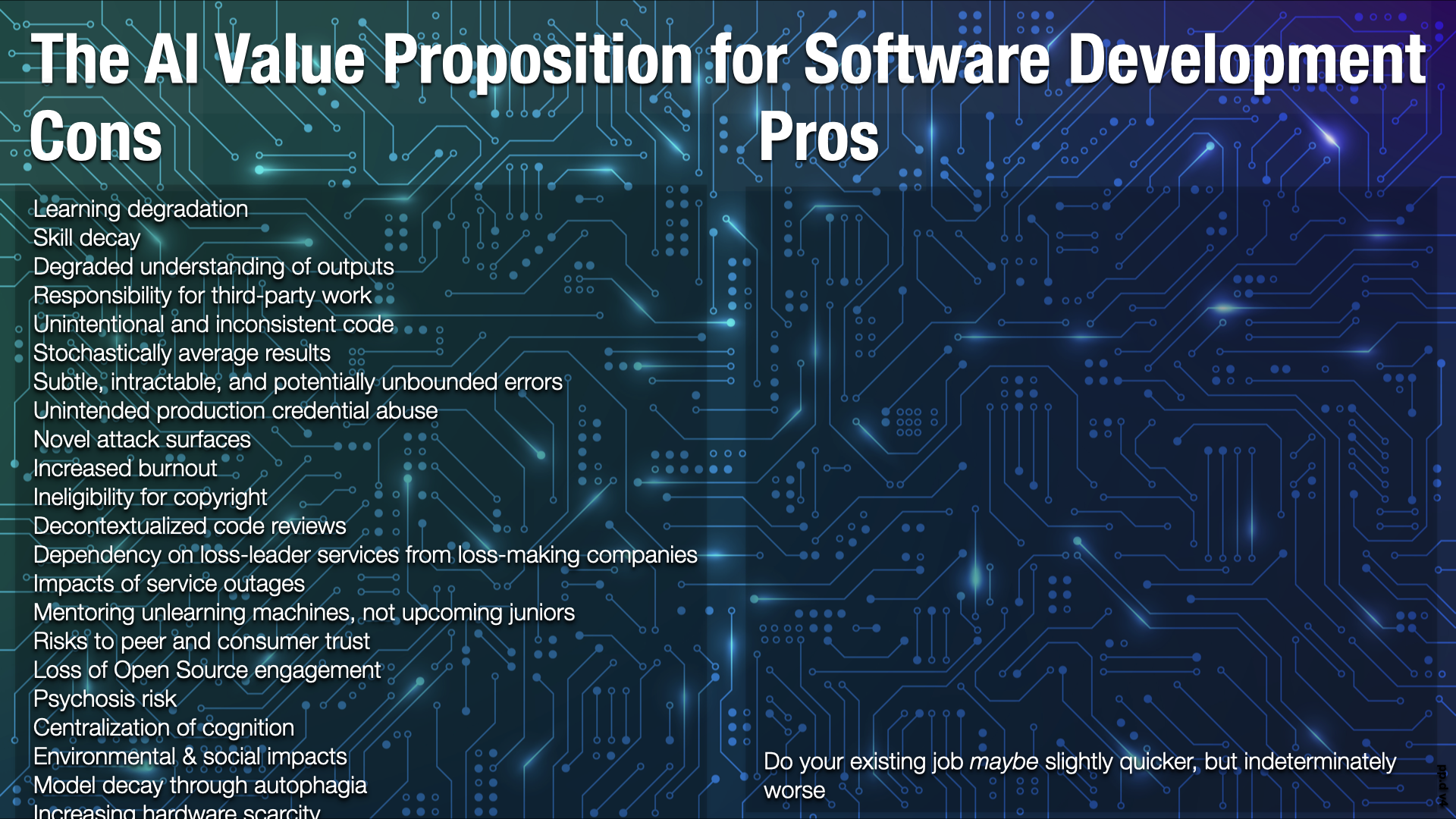
In short, your comment is the defensive hype and gaslit psychosis I was referring to. I mean that not as an insult, we humans are all vulnerable to such things, but as a blunt and honest plead that you reassess your perspective through a more objective lense.
@EdCates