Tim Huttontimhutton@mathstodon.xyz
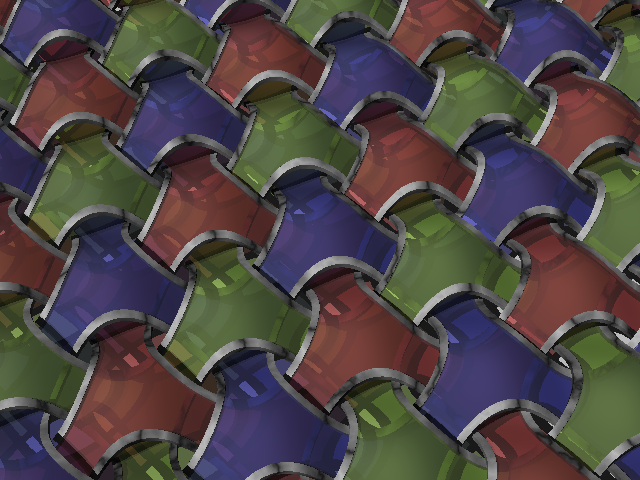
Oct 19, 2026, 6:08 PMThese three lattices are linked like Borromean rings - remove one and the other two fall apart.
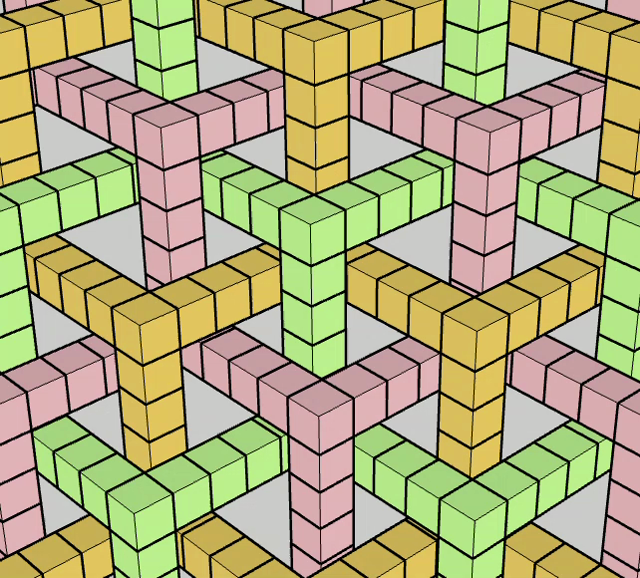
These three lattices are linked like Borromean rings - remove one and the other two fall apart.
I feel like I've seen this done before, maybe by Ghee Beom Kim, but I can't find where.
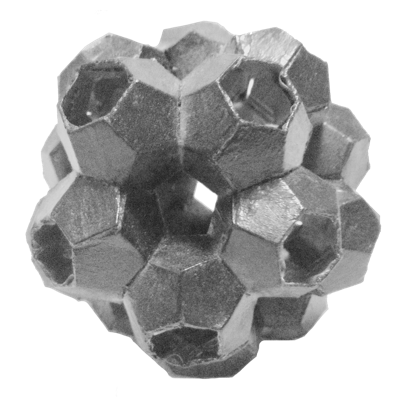
It was inspired by this laundry basket, which I keep staring at and thinking it is the Kagome lattice weaving pattern but it isn't.

As a Blender (Cycles) render, because global illumination is pleasing.
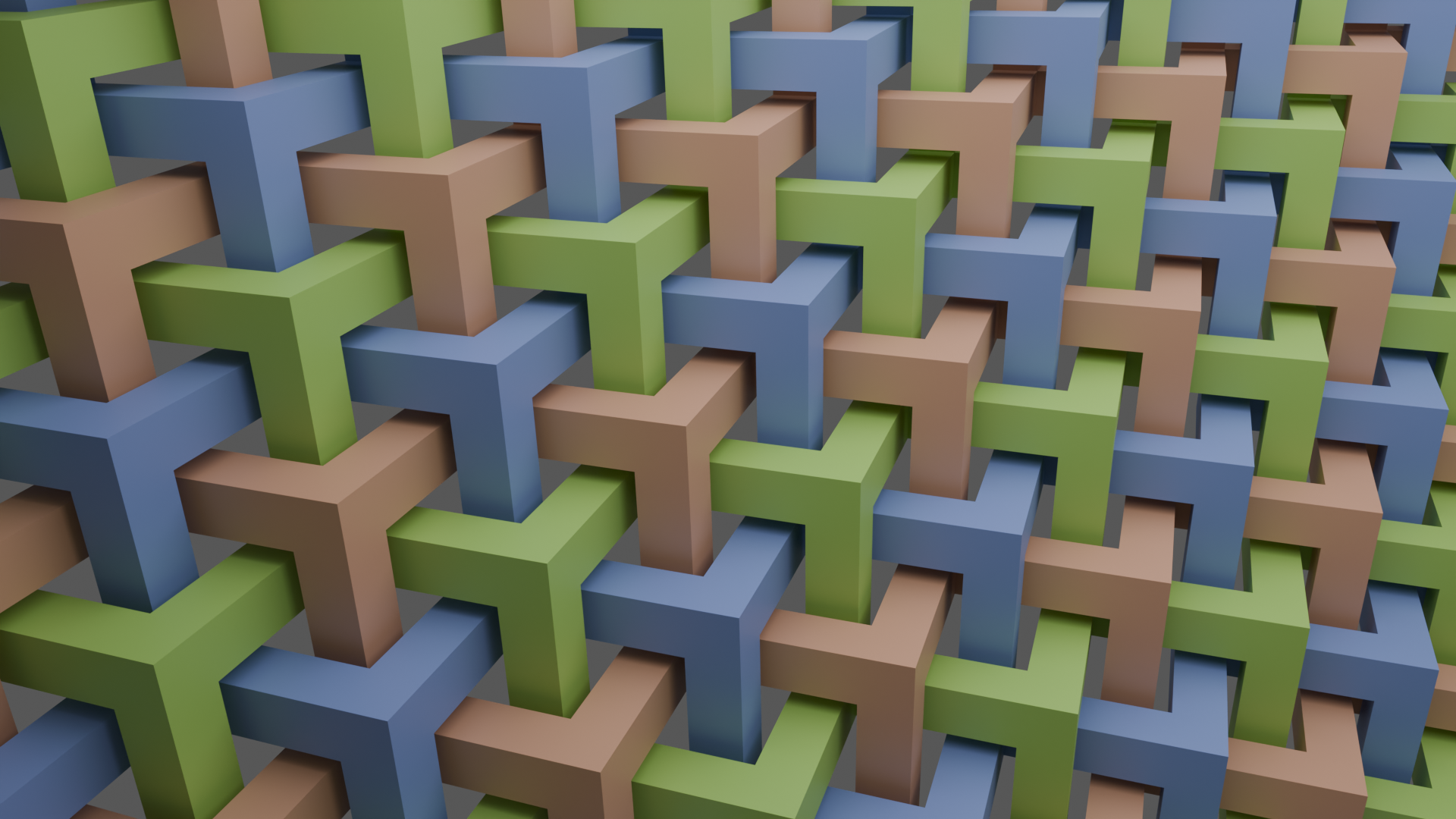

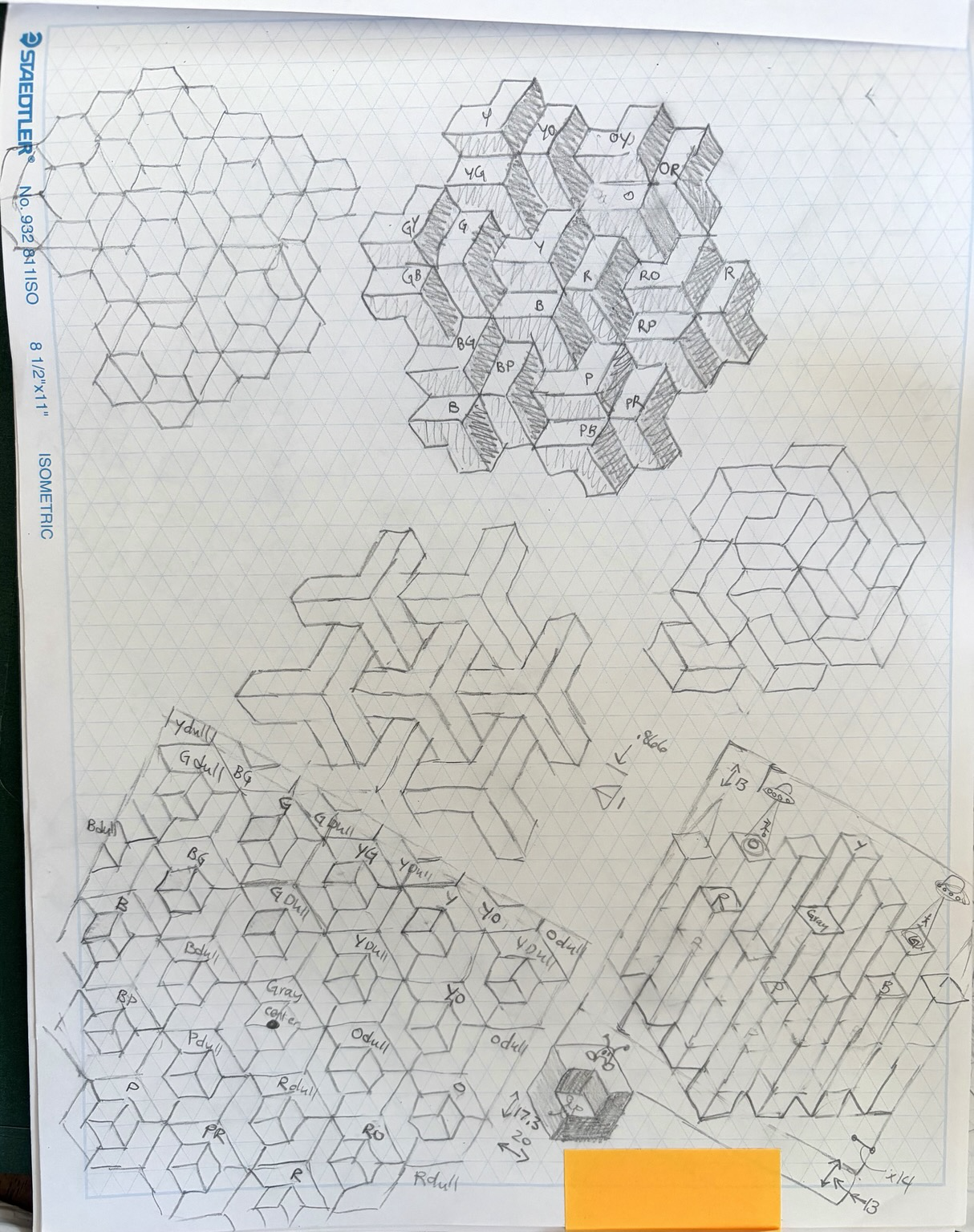
@timhutton I feel like that design has to be old, even though I can’t find a reference to anyone specifically. I leafed through a few of my books on tilings and couldn’t find this tiling exactly. It seems like someone who plays around with a triangular grid for long enough will eventually find that design. So I leafed through my pad of isometric graph paper, and sure enough, it’s in there. I never did anything with this particular idea. Perhaps I should.
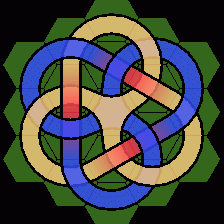
@timhutton Robert Fathauer did a piece somewhat like that, at least the Borromean links part.
https://x.com/RobFathauerArt/status/1241026650789179396?s=20
Most of my takes on a similar type of tiling involved starting with an impossible triangle.
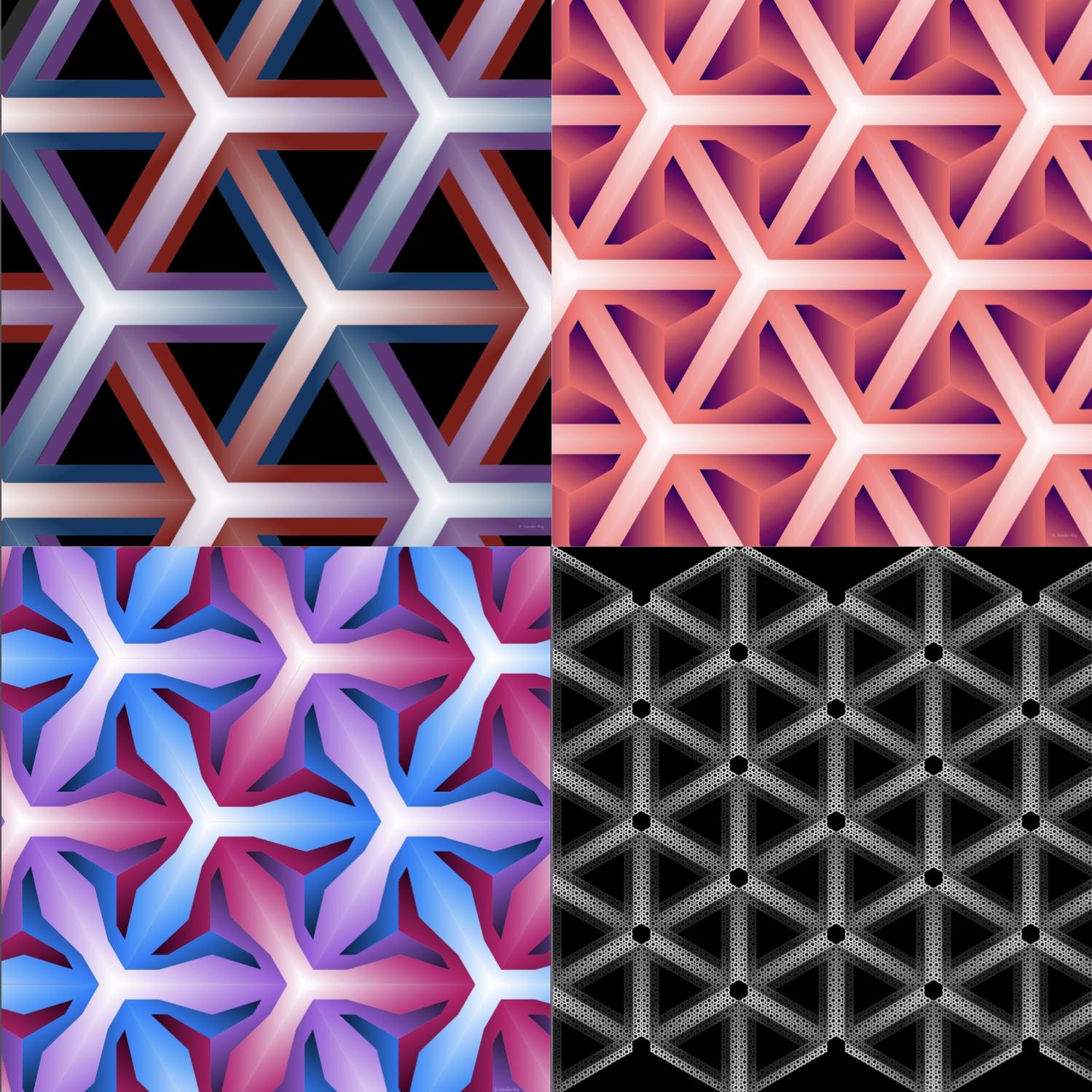

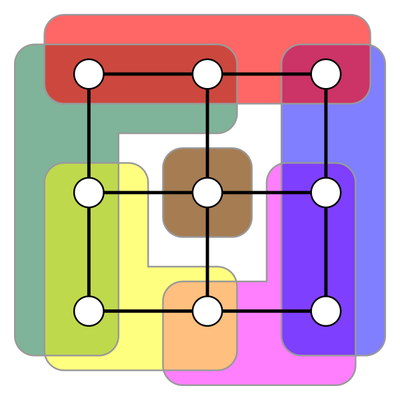
@timhutton A single one of these warped hexagonal tilings can be coordinatized as (x,y,z) where x+y+z in {0,1}, with two junctions adjacent when they differ by changing a single coordinate by ±1.
In your case, I think the triple junctions can be coordinatized as (x,y,z) where x+y+z in {0,3} and x=y=z (mod 3), with two junctions adjacent when they differ by changing a single coordinate by ±3.
In Z^4, the same trick of looking at points whose coordinates sum to 0 or 1 and making them adjacent when one coordinate differs by one gives a graph isomorphic to the diamond lattice. So now I am wondering if you can get interlaced diamond lattices in the same way.