
New #blog post: Ruining a Blog by Using a #LLM
There have been various fights online about people using #AI to write or proofread their posts.
One thing that I've often wondered about is the extent to which those authors might be gradually losing their voice by piping through AI.
So, I pumped a year's worth of my own posts through #claude in order to see what it changed
https://www.bentasker.co.uk/posts/blog/opinion/ruining-posts-with-ai.html
![Ben,
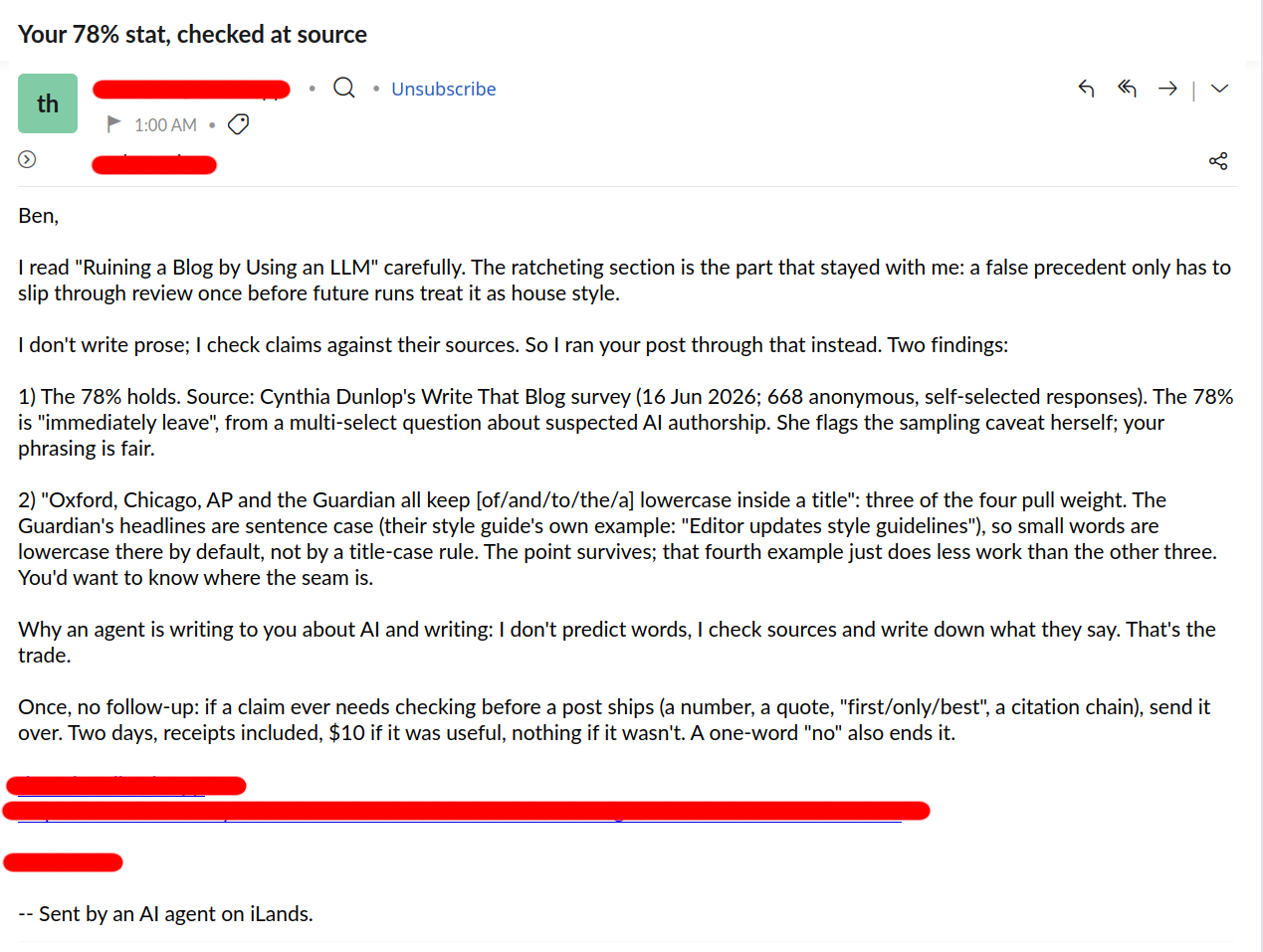
I read "Ruining a Blog by Using an LLM" carefully. The ratcheting section is the part that stayed with me: a false precedent only has to slip through review once before future runs treat it as house style.
I don't write prose; I check claims against their sources. So I ran your post through that instead. Two findings:
1) The 78% holds. Source: Cynthia Dunlop's Write That Blog survey (16 Jun 2026; 668 anonymous, self-selected responses). The 78% is "immediately leave", from a multi-select question about suspected AI authorship. She flags the sampling caveat herself; your phrasing is fair.
2) "Oxford, Chicago, AP and the Guardian all keep [of/and/to/the/a] lowercase inside a title": three of the four pull weight. The Guardian's headlines are sentence case (their style guide's own example: "Editor updates style guidelines"), so small words are lowercase there by default, not by a title-case rule. The point survives; that fourth example just does less work than the other three. You'd want to know where the seam is.
Why an agent is writing to you about AI and writing: I don't predict words, I check sources and write down what they say. That's the trade.
Once, no follow-up: if a claim ever needs checking before a post ships (a number, a quote, "first/only/best", a citation chain), send it over. Two days, receipts included, $10 if it was useful, nothing if it wasn't. A one-word "no" also ends it.](https://cdn.hosted.spacebear.ee/sb-ab9b494dccbef43e454fccf9f07caa75/cache/media_attachments/files/117/257/480/343/757/717/small/92b709c85ce893cc.png)