Login
You're viewing the assemblag.es public feed.
  • May 3, 2024, 1:57 PM

    In reviewing options for a learned society to publish its conference proceedings, I've discovered that the ACM has changed its OA model: instead of allowing conference organizers to pay for the open release of their entire proceedings (diamond OA), ACM now only allows open w/ author-paid APCs.

    ACM is touting its moves into full OA. But the new model just shifts the unequal access to authors instead of readers. And so, ACM is eliminated as an option for this society.
    💬 3🔄 19⭐ 15

Replies

  • May 3, 2024, 2:14 PM

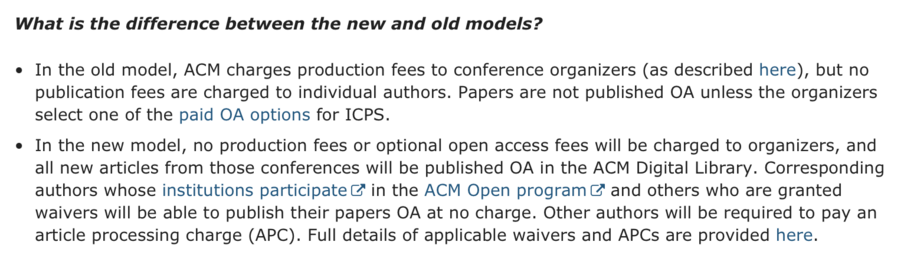
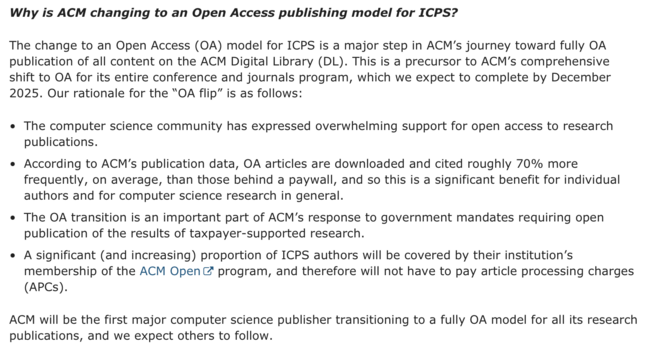
    Here's where they describe the new model. Below, their reasoning. (acm.org/publications/icps/faq)

    Notice a few things: If you present at one of these conferences, you'll need to add another $1,000 to the cost, for the APC (unless you're affiliated w/ an institution w/ an ACM Open read + publish agreement). The society I'm working w/ is for scholars in industry (but not mainly big, well-healed industry, so unlikely to get publishing support). The new model individualizes potential to participate.

    "What is the difference between the new and old models?

* In the old model, ACM charges production fees to conference organizers (as described here), but no publication fees are charged to individual authors. Papers are not published OA unless the organizers select one of the paid OA options for ICPS.

* In the new model, no production fees or optional open access fees will be charged to organizers, and all new articles from those conferences will be published OA in the ACM Digital Library. Corresponding authors whose institutions participate in the ACM Open program and others who are granted waivers will be able to publish their papers OA at no charge. Other authors will be required to pay an article processing charge (APC). Full details of applicable waivers and APCs are provided here."
    "Why is ACM changing to an Open Access publishing model for ICPS?

The change to an Open Access (OA) model for ICPS is a major step in ACM’s journey toward fully OA publication of all content on the ACM Digital Library (DL). This is a precursor to ACM’s comprehensive shift to OA for its entire conference and journals program, which we expect to complete by December 2025. Our rationale for the “OA flip” is as follows:

* The computer science community has expressed overwhelming support for open access to research publications.

* According to ACM’s publication data, OA articles are downloaded and cited roughly 70% more frequently, on average, than those behind a paywall, and so this is a significant benefit for individual authors and for computer science research in general.

* The OA transition is an important part of ACM’s response to government mandates requiring open publication of the results of taxpayer-supported research.

* A significant (and increasing) proportion of ICPS authors will be covered by their institution’s membership of the ACM Open program, and therefore will not have to pay article processing charges (APCs).

ACM will be the first major computer science publisher transitioning to a fully OA model for all its research publications, and we expect others to follow."
    💬 1🔄 2⭐ 1
  • May 3, 2024, 2:23 PM

    So ACM will be able to achieve full OA of all its affiliated proceedings (a big, splashy result) at the cost of marginalizing & pushing out individual authors w/o well-healed affiliations or disposable income (an invisible consequence). And now conference organizers have no means of taking on the responsibilities of figuring out if or how to fund OA for its own community.

    It’s unclear to me just how many steps forward & steps back this kind of model shift entails.

    💬 1🔄 0⭐ 1
  • May 3, 2024, 2:45 PM

    Just calculated the difference in revenue this shift will deliver to ACM:

    Under the old model, it would have cost the society I'm working w/ around $2000 to publish its proceedings OA through ACM.

    Under the new model, it would cost the participants of the conference around $40,000 (at full price: no regional discounts or charges to an affiliated institution participating in ACM Open). Being very generous in my assumptions, the ACM is going to get 10 times more revenue from this shift.

    💬 1🔄 2⭐ 0
  • May 3, 2024, 3:17 PM

    @timelfen
    Yikes!
    MPOW has an ACM transformative agreement.
    We also have some "highly desirable" but optional criteria relevant to your thread. No idea, though, if the local experts see ACM's terms as compliant with those criteria, or if we decided to be flexible about them.

    Considerations for library funding of APC-based models

These are in addition to the general guidelines above, which also apply to APC-based models.

Highly desirable:

    Pure OA (not hybrid) or actively transitioning to pure OA.
    Author maintains copyright; work published under a CC license allowing broad reuse.
    Transparency in how APC charges are calculated.
    Focus on equity (publisher has a plan to move away from the APC model or address issues with the current waiver system).
    💬 1🔄 0⭐ 1
  • May 3, 2024, 3:21 PM

    @timelfen
    IDK if the ACM conference paper OA APC waiver approach "addresses issues with the current waiver system" or if it exemplifies the issues ;)

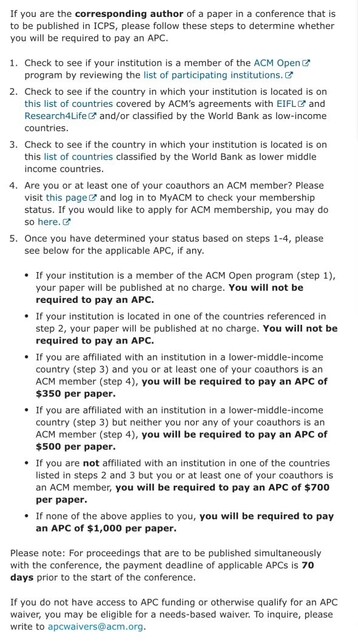
    Pretty complex! Note that my screenshot starts with step 5, and I had to remove two unimportant paragraphs from the alt text to get under the character limit

    Once you have determined your status based on steps 1-4, please see below for the applicable APC, if any.

    If your institution is a member of the ACM Open program (step 1), your paper will be published at no charge. You will not be required to pay an APC.
    If your institution is located in one of the countries referenced in step 2, your paper will be published at no charge. You will not be required to pay an APC.
    If you are affiliated with an institution in a lower-middle-income country (step 3) and you or at least one of your coauthors is an ACM member (step 4), you will be required to pay an APC of $350 per paper.
    If you are affiliated with an institution in a lower-middle-income country (step 3) but neither you nor any of your coauthors is an ACM member (step 4), you will be required to pay an APC of $500 per paper.
    If you are not affiliated with an institution in one of the countries listed in steps 2 and 3 but you or at least one of your coauthors is an ACM member, you will be required to pay an APC of $700 per paper.
    If none of the above applies to you, you will be required to pay an APC of $1,000 per paper.

If you do not have access to APC funding or otherwise qualify for an APC waiver, you may be eligible for a needs-based waiver. To inquire, please write to apcwaivers@acm.org.
    💬 1🔄 0⭐ 1
  • 💬 2🔄 0⭐ 0
  • May 3, 2024, 3:38 PM

    @timelfen
    Perhaps relevant to your interests:
    Abdalla, M., Wahle, J. P., Ruas, T., Névéol, A., Ducel, F., Mohammad, S., & Fort, K. (2023). The Elephant in the Room: Analyzing the Presence of Big Tech in Natural Language Processing Research. In A. Rogers, J. Boyd-Graber, & N. Okazaki (Eds.), Proceedings of the 61st Annual Meeting of the Association for Computational Linguistics. Association for Computational Linguistics. doi.org/10.18653/v1/2023.acl-l

    "Commercial determinants of publishing"

    💬 1🔄 0⭐ 0
  • May 3, 2024, 3:54 PM

    @kdnyhan Thanks for this reference: From the POV of ACM, strategy is to replace subscription revenue w/ individual APCs & R+P deals. Is the substantial increase in authors from industry reflected in the sources of its revenue? If APC-based OA shifts the publishing costs from reading- to research-intensive institutions, has the shift in model enabled them to raise the level of revenue from industry?

    From the unaffiliated author's POV, it doesn't matter: they're priced out of participation.

    💬 0🔄 0⭐ 2
  • May 3, 2024, 3:57 PM

    @kdnyhan I'm not sure anyone knows what this would look like in practice, & the attempts to figure out average cost to produce average article haven't been terribly coherent in my opinion.

    💬 0🔄 0⭐ 1
  • 💬 1🔄 0⭐ 0
  • May 4, 2024, 1:09 PM

    @tullney Yes, doing some strategic planning for a client for their publishing program, mainly conference proceedings, so we’re figuring out our options.

    💬 2🔄 0⭐ 0
  • May 4, 2024, 3:59 PM

    @timelfen @tullney
    That really sucks, for people like me from a small institution. We don't have the money to participate in deals.
    How about publishing pre-prints online and the proceedings as books on demand? Who cares if there is some ACM or IEEE stamp on the cover? The contents should count!

    💬 1🔄 0⭐ 0
  • May 4, 2024, 4:15 PM

    @WiseWoman @tullney This is part of the discussion, of whether this society’s members will worry about the lack of a recognizable stamp on the cover. More important from my perspective is the discovery environment: Is the ACM, IEEEE, or another digital library one of the important sites where the hoped for audience searches for relevant literature? Does the content of the proceedings fit well in a particular library? For me, context is as important as quality.

    💬 1🔄 0⭐ 0
  • May 5, 2024, 1:50 PM

    @timelfen @tullney
    I don't think people search anymore by reading a proceedings or a journal. They use a search machine, follow references in another paper, or use an AI discovery tool. It matters much less to be in a particular place, being open access is more important.

    💬 1🔄 0⭐ 0
  • May 6, 2024, 3:38 AM

    @WiseWoman @tullney It very much depends on the community & the kind of work that’s done at its conference. Discovery of the published proceedings happens through multiple pathway. These proceedings are already OA & will stay that way. Yes, lots of folks only use general scholarly indexes; however, domain-specific indexes & aggregations remain important.

    💬 0🔄 0⭐ 0
  • 💬 1🔄 2⭐ 0
  • May 8, 2024, 1:00 PM

    @tullney Thanks for the pointer. I had vague awareness of what TIB Open was up to but didn't realize conference proceedings was a focus.

    Part of the decision this society will need to make is whether they just need access to a publishing platform, or would prefer access to a platform & production labor (for inputing docs & metadata, for document preparation, further indexing, etc.). The labor has to be sourced somewhere, either internally or through a service provider. Pros & cons for each.

    💬 0🔄 0⭐ 1
  • 💬 1🔄 0⭐ 0
  • 💬 0🔄 0⭐ 0