Andrew Zonenbergazonenberg@ioc.exchange
10/9/2026I wish I had a friend named Claude who was an engineer or software dev.
We could have so much fun trolling people.
I wish I had a friend named Claude who was an engineer or software dev.
We could have so much fun trolling people.
If you're ever looking for an Italian restaurant and don't have a phone or map, but do have a gamma spectrometer, just look for 511 keV annihilation lines and follow them to their source. If you find them from multiple restaurants, the weaker line is the one to eat at.
No matter how well they try to clean cooking utensils between making pasta and antipasto, some mixing is unavoidable which creates a distinct gamma signature.
A smaller annihilation peak is a good sign of more thorough cleaning and better general food safety practices.
The landscaping service has arrived to trim the bushes in our front yard.
He's great, doesn't even bill us

like ignoring all of the social/ethical issues around LLMs this seems a straightforward "we are going to stop R&D on our products and jack up costs to improve profitability, but only if the competition promises not to make a better cheaper product" collusion proposal.
They're not quite openly price fixing but with how much training costs, everyone agreeing not to spend seven figures on something together has the same net effect
Soo according to Anthropic (https://www.anthropic.com/institute/recursive-self-improvement) they are thinking of slowing or halting frontier model development, but only if their competition does so as well and they have a nuclear-disarmament-style inspection process to verify this is the case.
There's two possible reads on this, of course.
The cover story is that they are worried about the models self-improving and becoming God and running away etc. Because they're vibe-coding 80% of their new stuff and model collapse is totally not a real thing.
My preferred interpretation is that training costs are getting out of hand, they are terrified of shareholders finding out how much they are spending on training when they go public, so they want to cut back but they're afraid of falling behind and losing their edge so the only way they're willing to do so is if they can be assured the competition isn't out-spending them.
There has to be an antitrust case here if somebody is willing to bring one (good luck in today's political climate but hey I can dream)
The existence of truth tables implies the existence of falsehood sofas, opinion chairs, and misinformation footrests.
It's been a few months and I have a lot of new followers so, periodic reminder: I make extra capacity in my home lab facilities available on a best-effort basis to support noncommercial/hobby/open source projects who would otherwise not be able to afford them.
Services are generally provided free of charge if they're not a major time/consumable commitment on my part, or on a cost-recovery basis for anything particularly large. If you're not making money from the project I won't take a profit either.
Capabilities are constantly growing and currently include (but are not limited to):
* Time/frequency measurements to < 1e-11 accuracy
* VNA measurements to 8.5 GHz
* Oscilloscope measurements to 16 GHz
* BERT measurements to 25 Gbps
* Large-area CNC optical microscopy
* IC decapsulation and simple wet etch deprocessing
* Metallographic embedding and basic cross section polishing
* Basic wet chem for sample prep
* UV-VIS-NIR transmission/emission/reflection spectroscopy
* Advanced PCB rework (inner layer circuit edits etc)
* High core count/memory computing (up to 64 vCPU / 384GB RAM fairly easily, 128 vCPU / 512GB RAM if I trust you enough to run the thing outside a VM)
There's probably more things I'm forgetting to mention but I think this is most of it.
EDIT: I almost forgot, EM field simulation in Sonnet
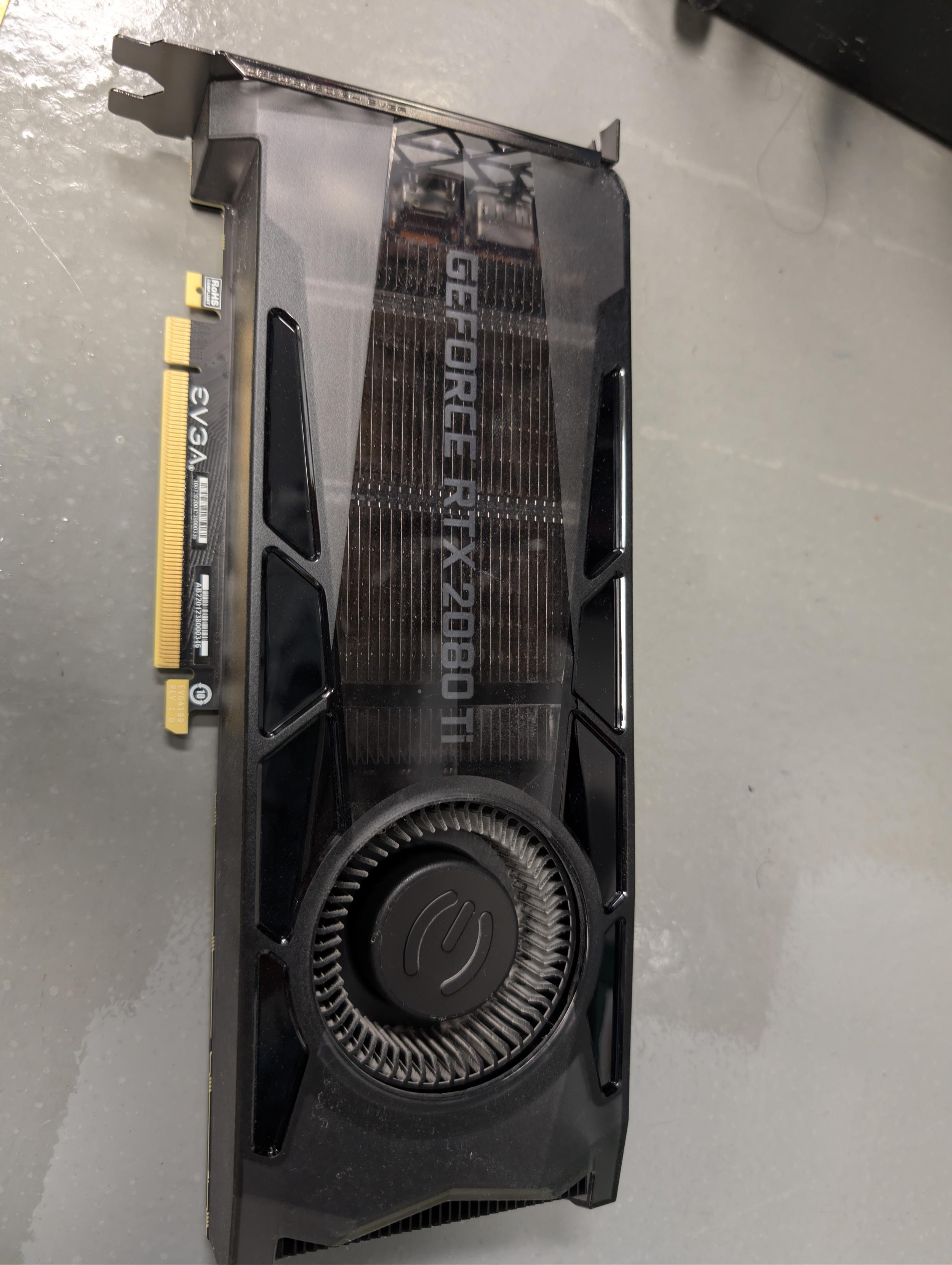
This 2080 Ti probably has plenty of life left in it. I'll keep it but haven't decided where I'll rehome it yet.
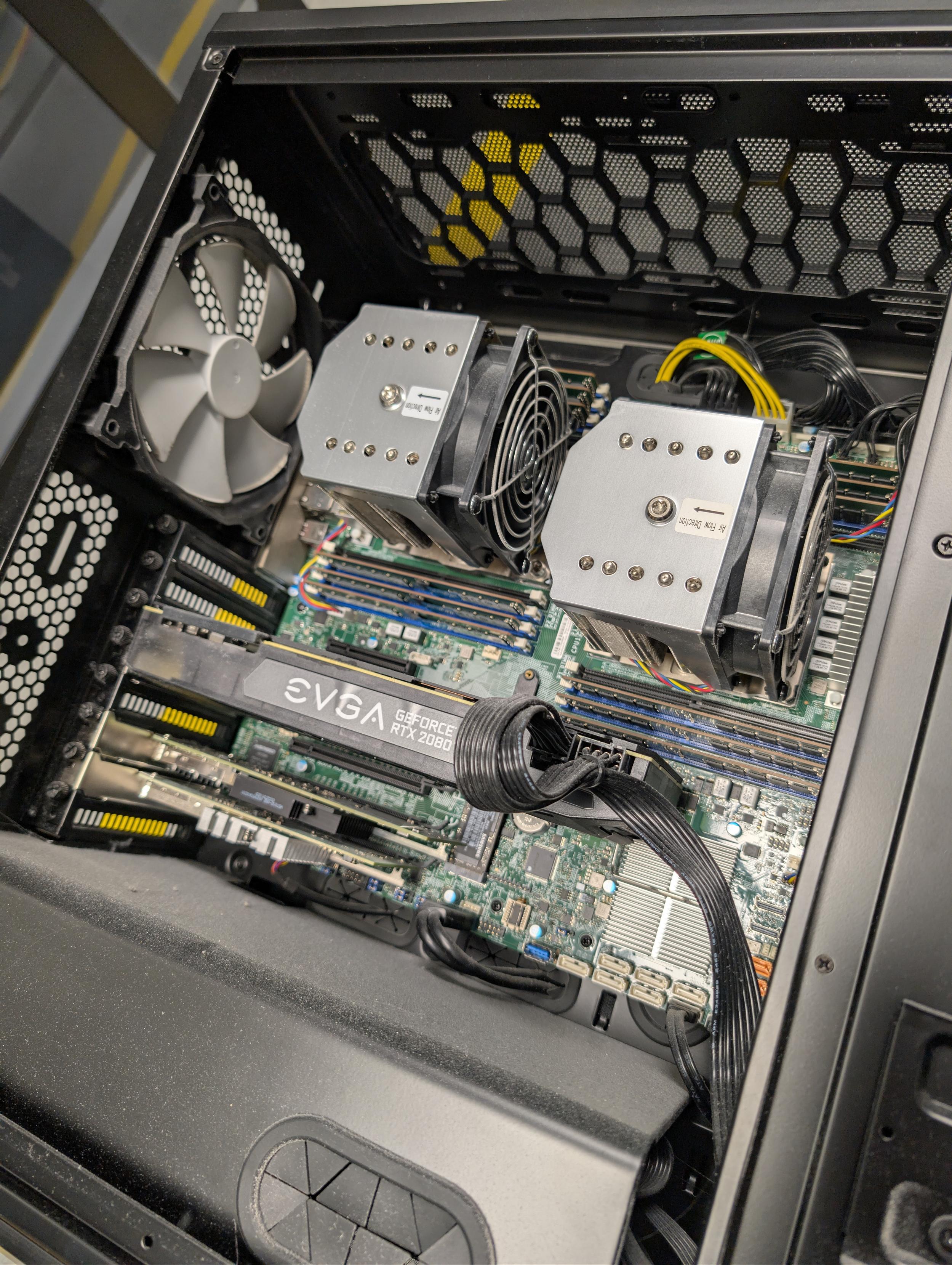
Finally upgrading my 2017 vintage office workstation. Got another round of eBay and dumpster dived parts in so out with the old and in with the new.
The existence of toblerone implies the existence of related triangular hydrochocolate chains such as the base alkane (toblerane), as well as the closed ring form (cyclotoblerone)
Not enough developers understand the responsibilities of having a large userbase and how important preserving freedom of users is.
Every time you change the way something works, the cost of that change is borne by your entire userbase. If you have a million users and you move a button and everyone spends 30 seconds figuring out where it went, that's 8333 hours of wasted effort. At $150/hr for a somewhat average tech salary, you've cost your userbase $1.25M with that one change.
Sometimes breaking changes are unavoidable, but the more fundamental the change and the more extensive the retraining users need, the more cautious you need to be about doing it.
It's not just about your "creative expression" or some manager's vision of "the right" way to do things. If you can possibly add a preference to keep a workflow the way it does, add it.
Even today in ngscopeclient it hurts me every time I make a change that breaks a workflow. I rationalize it as "better now than later, while the userbase is small", and we're still very much in "experimental" stage in the v0.x series. But I do it fully understanding that I'm throwing a lot of people off every time I merge a dialog into something else, etc.
I don't know how many users we have since we have no analytics or telemetry, but it's enough that I'm sure every small change I make turns into thousands of dollars of wasted time at minimum.
bellow(n): a singular part of a set of bellows
An EEPYROM
Mouser has apparently CDN-blocked me from browsing their site. I can load the homepage fine, but any attempts to visit a product page give a denied message.
I emailed them about it and got a vague message back about "behavior patterns that resembled automated site scraping activity" and linking me to their paid search API. Apparently trying to view one product page after looking up a P/N in the search box qualifies as scraping?
Anyway, I guess I'm taking my business to Digi-Key.
If you're driving one of those billionaire limos with a hot tub in it, but you have no passengers...
Can you use the car pool lane?
Shower thought: how would you build a purely mechanical (no electrical components) light/dark detector?
My initial thought is two coiled bimetallic strips, one at ambient temperature in a shadowed space and another exposed to light and painted black to absorb as much as possible. Then some kind of comparator gizmo to check which one is longer.
I think that'll do nicely.
Not bad for a 4-layer board.

Breaking thread since it was getting long. Here's some beauty shots of the board.
To recap, this is the culmination of a series of crimes against PCB humanity that began back in May when I scored some $3500-list-price Kintex UltraScale+ FPGAs for $55 each on AliExpress.
I decided silicon this sketchy needed to go on an equally sketchy PCB. So I designed (and back burnered for a bit due to life happenings) a 4-layer PCB, 2S2P stackup, on OSHPark. For the lulz.
Because come on, who doesn't want to put two lanes of 100GbE and four of 25GbE on a cheap batch-fab PCB?
There were a few bugs in the design that I successfully worked around with various levels of sketchiness, including DIY via-in-pad filling for some vias that I accidentally put in BGA pads (forgetting for a second that I wasn't doing this board at a "real" fab with plated and filled vias) and didn't catch during design review.
Power rails - all OK although the on/off and PGOOD signals on VCCINT don't work due to what I suspect is a bad rework job
Supervisor MCU - performing nominally
Main MCU - responds over JTAG but not further tested to date
FPGA - appears fine, successfully ran a trivial test bitstream that echoes an input clock out an LVDS HPIO pair.
Tonight's goal is to try and bring up some of the GTYs and at least get a PRBS out.


What do you call it when you're writing a paper about whales and need to reference prior work?
A cetacean citation.
Got most of the new L431 hooked up, have a bit more to go. Good progress so far.