Tl;dr: I recreated a key bit of the quantum mechanics in cesium clocks in Mathematica, and it is rather pretty because it's just three matrices multiplied. It explains why cesium clocks have two microwave cavities with a long gap in-between, as the gap makes it more sensitive to tuning errors
So I just understood a cool aspect of Cesium beam clocks that I hadn't known before (you know, being a theorist and all...), namely Ramsey spectroscopy.
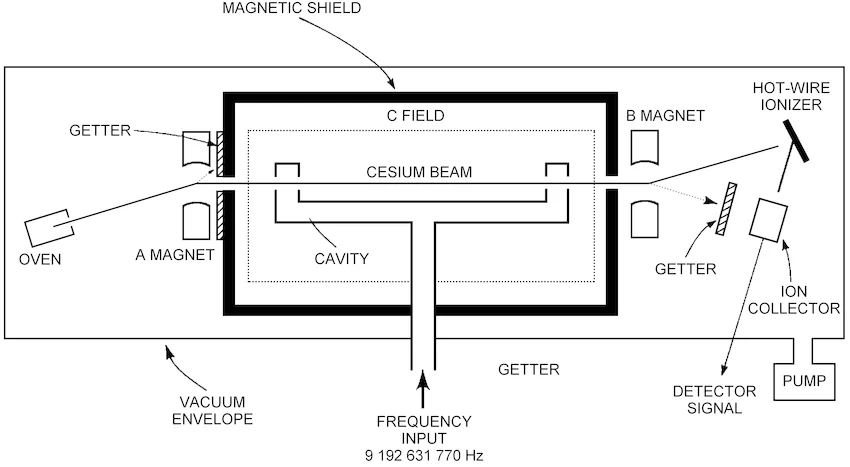
So I looked at the schematic here, and was wondering why the microwave cavity in the Cesium standard is apparently divided into two cavities with a gap in between. That didn't seem to make sense and I first thought I maybe misunderstood it, but no: One actually subjects the cesium to the microwaves, then lets it fly a bit all unperturbed, and then subjects it to the microwaves once more.
So why the gap? 1/3
#physics #quantumphysics #hamradio # electronics #scienceedu #scicomm