
Brandon Rohrerbrohrer@recsys.social
Oct 18, 2026, 7:39 PMFor the handful of you who are following along this journey, the artisanal language model I'm building to do proofreading is getting more mature.
https://brandonrohrer.org/alms_blended.html
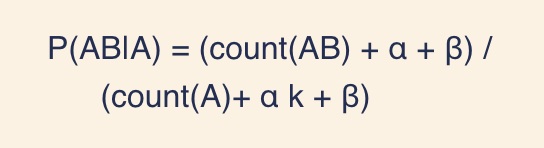
One big step forward is the addition of additive smoothing (alpha) and upward-biased additive smoothing (beta) parameters. These helped to avoid false detections and increase precision - an important precursor to building ensemble models.
. It's most common manifestation is the F1:
F1 = 2 × precision × recall /
precision + recall
The product over the sum of precision and recall gives a single metric that balances the concerns of them both. When they are both scaled from zero to one (rather than expressed as a percentage), multiplying by 2 ensures that F1 will also fall between 0 and 1, with larger being better.
Often in a particular application, recall is more important than precision or the other way around. There is another formulation of the F-score that allows us to put a finger on the scale.
Fρ = (1 + ρ2) × precision × recall /
ρ2 × precision + recall
The factor ρ represents how much more important recall is than precision. For example, ρ = 2 indicates that recall is twice as important as precision, that is, that suffering two false positives is just as bad as a single false negative.
(Fρ is usually presented as Fβ, but since we're already using β for upward-biased additive smoothing that would have been confusing.)](https://cdn.masto.host/recsyssocial/media_attachments/files/117/463/603/757/739/047/original/6268e4ba10930df9.png)