
dataramadatarama@hachyderm.io
Oct 22, 2026, 3:30 PMIgor has gone to sleep early.
I require pictures of lizards being cute.
Igor has gone to sleep early.
I require pictures of lizards being cute.
I suppose I can deliver some pictures of lizard cuteness myself. My usual provider went to sleep early today, so I must substitute random internet lizards instead.

@ehproque There is something very civilized about how monitor lizards fight. Either combatant is perfectly capable of murdering the other, but instead they have a very structured wrestling match, the lethal weaponry never comes out, and the loser gets to walk away in peace.
@datarama see? Just a bit rough but still a cuddle :)
@ehproque Shingleback skinks *actually* cuddle - after a fashion. They form lifelong monogamous pairs, but they don't usually stay together all year - they meet in the spring, mate and raise one or two (absurdly large) young, and then they separate only to meet up again next year.
Anyway, the phase between "meet up in the spring" and "mate" is some 6-8 weeks of incredibly adorable nuzzling each other, basking together side by side, giving each other gentle little nudges, and tongue-flicking each others' snouts.
(They live for 50+ years, so that's a lot of exclusive lizard cuddling.)
@ehproque Monkeytail skinks live in large extended families - typically an adult pair and their young of up to 4 years of age (though most leave home at about age 1 - some stick around for longer, for some reason). It's not unusual that there are two adult pairs, in which case it's usually two siblings and their partners. They will adopt orphaned young, and if a family member goes missing, the entire group will actually start what appears to be a coordinated search!
Lizards are great.
(and virtually everything we know about their surprising social lives and cognitive faculties has been learned within the last 20 years.)

@datarama Komodo dragon on Rinca, Indonesia. Look at that beautiful dark eye!
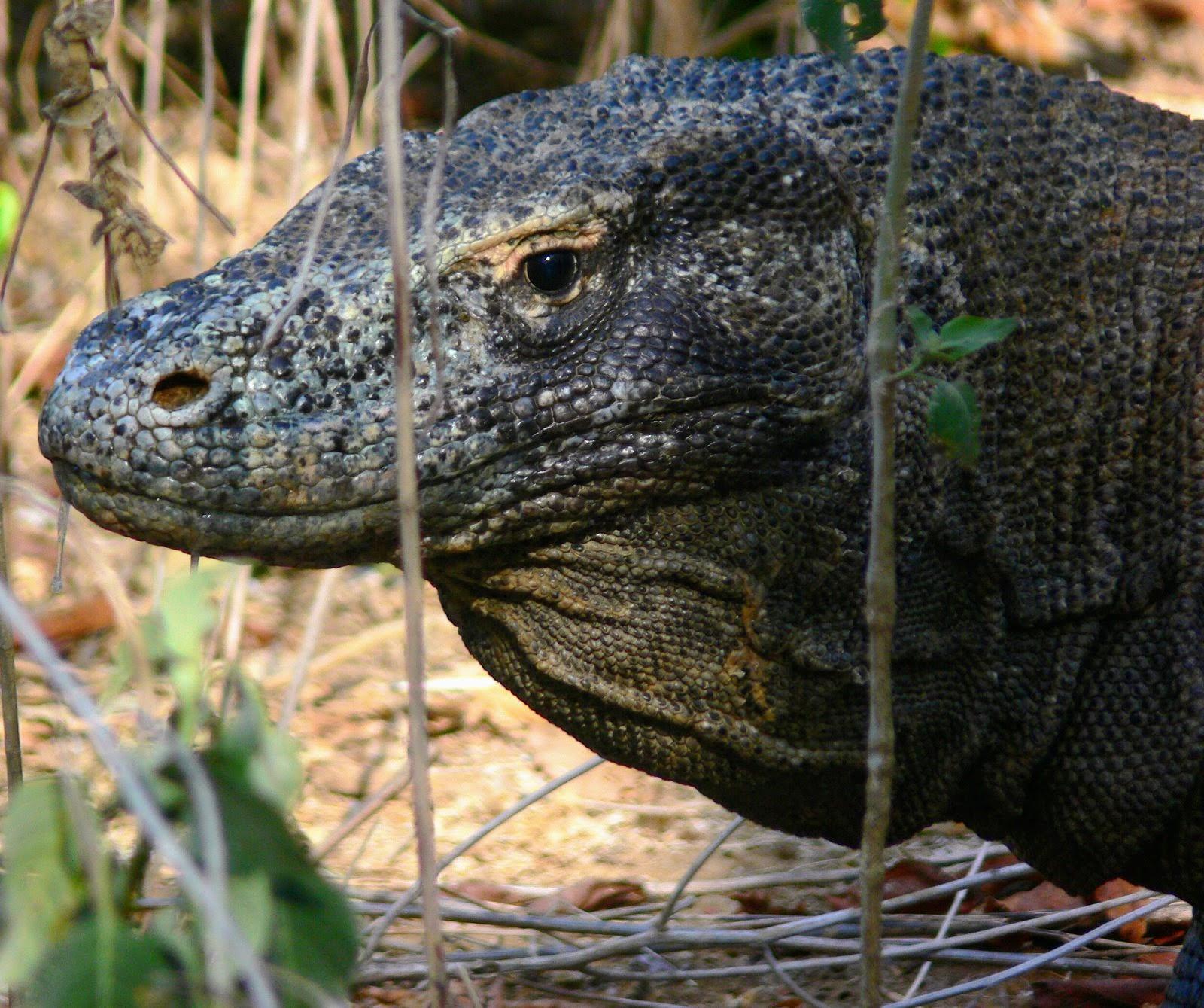
@meyltje I swear, lizards (especially varanids) have some of the most expressive eyes in the entire animal kingdom.
@datarama
Ramble:
Yes! I was so surprised to see their large, dark eyes. Cliché: one expects an 'evil' animal like the Komodo dragon to have scary 'reptilian' eyes, cliché ends. I am susceptible to this way of thinking myself, not liking herons and certain gulls just because they have unpleasant light eyes...
Visiting the dragons on their home islands was interesting: they are clearly very dangerous, supremely well camouflaged, and one did start to hunt us right away. They are also quite magnificent with the softest eyes. Still don't wish to get to close to their mouths 😬
@meyltje Here's a video of Igor from this summer. I love how easy his gaze is to follow.
And also, that wink at the end! He's such a charmer.

@meyltje Fun fact about lizard eyes!
In mammals, the pupil's contracting and dilating is entirely controlled by the autonomic nervous system - but in lizards, it's under the control of the central nervous system. For them, changing the size of their pupils is a voluntary and conscious act.
This, according to Igor's vet, makes it an absolute nightmare to perform eye surgery on them. And snakes are even worse, due to the transparent fused spectacle covering the eye.
(I am somehow overjoyed to know that there are people in the world who are able and willing to perform eye surgery on lizards and snakes in need.)
@datarama Indeed! And super interesting 🤩
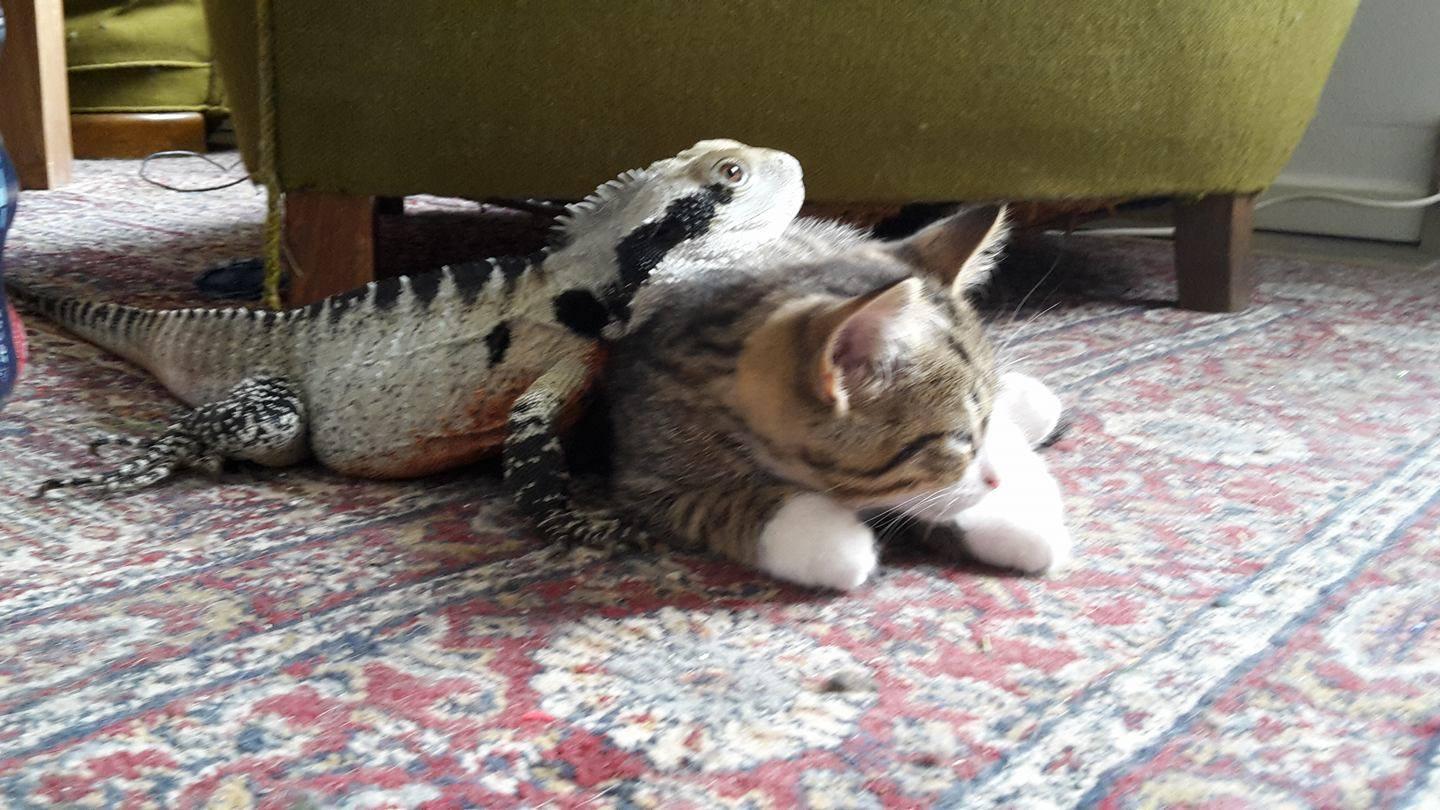
@meyltje Here is one of my old pictures of lizard cuteness, though some of the cuteness is not lizard-provided.
(Australian water dragon and common housecat.)
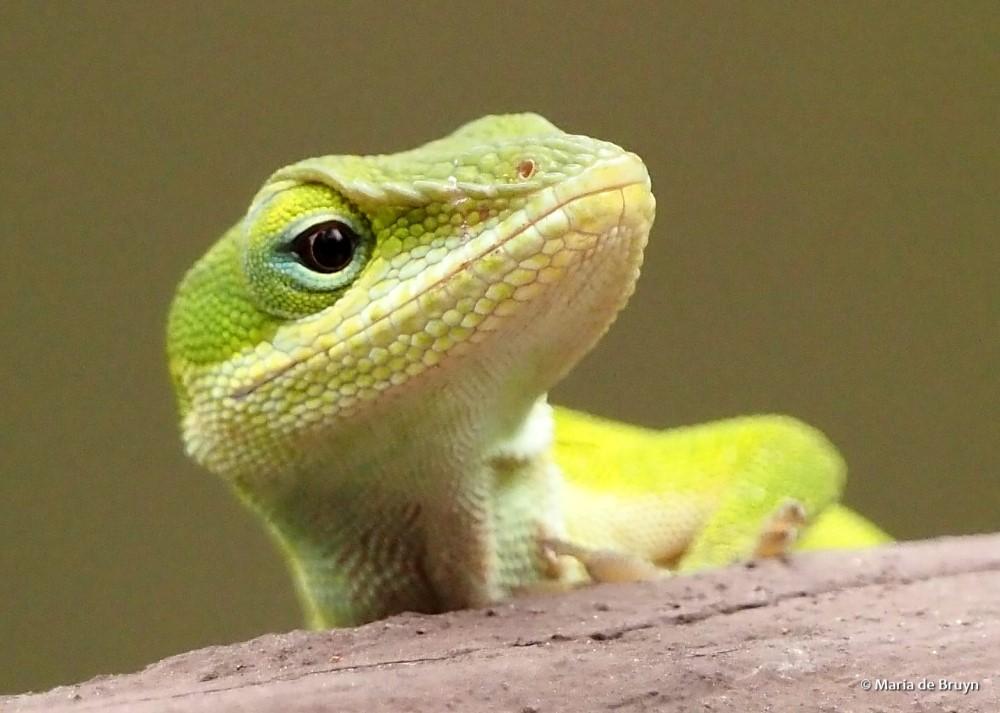
Here's a green anole. He's not really doing anything particularly cute, but LOOK AT THAT FACE!!!!
I can tell he's a he because of the flap of skin under his throat. That's his dewlap, and he can extend it to a large, bright red semicircle. This is the sort of thing that impresses the ladies if you're an anole - that and showing off your pushup routine. Anoles are great at doing pushups; they will often do a demonstration.
Also, they're crazy smart, and they handily outperform rodents and songbirds on several animal cognition tests. They can learn new tricks by watching other animals do them, learn to manipulate objects using their snouts or mouths, and are *extremely* adaptable. It turns out that even if your brain is the size of a peppercorn, living in tree canopies and competing for your main food source with birds that can kill you, you'll end up with an extremely well-optimized peppercorn.
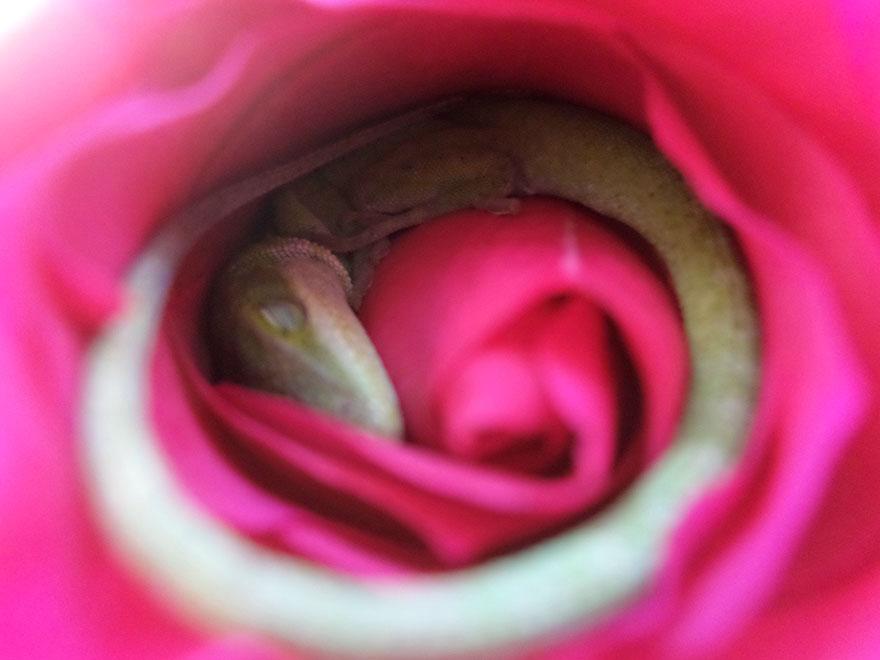
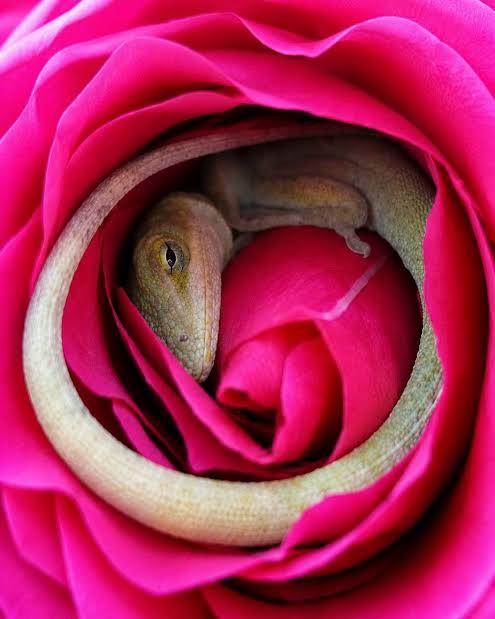
Here's another green anole, sleeping in a rose.
The name "green" anole is a bit silly, because they can change colours. They're usually green if they're in a good mood, and become a dull grey-brown if something's bothering them. Females will often switch to a warm chocolate brown when in the company of a male they're interested in.
Like chameleons, the colour change is completely involuntary; they have no control over it and any camouflage it provides is entirely coincidental. Sorry to say, they're less nature's ninja assassins and more nature's mood rings.
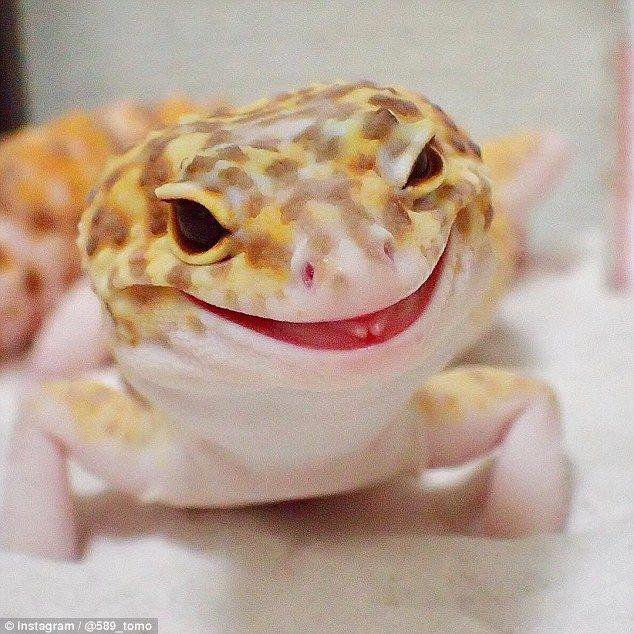
And here's an adorable leopard gecko.
All lizards have rigid facial muscles, so the "smile" isn't actually an expression of emotion. That is not to say that lizards can't express being contented and feeling pleased, they just don't do it using their faces. Lizard body language is often pretty easy to read if you're familiar with them.
Leopard geckos are a bit unusual among geckos, because they don't have the famous adhesive* toepads - but they *do* have movable eyelids. Such is the gecko character point allocation - either you get magic super-climbing, or you get eyelids.
*) They're not actually "sticky". They are covered in billions of tiny recursive hair-like structures which exploit van der Waals forces to hold on using literally atomic-scale interactions. No gunk involved.
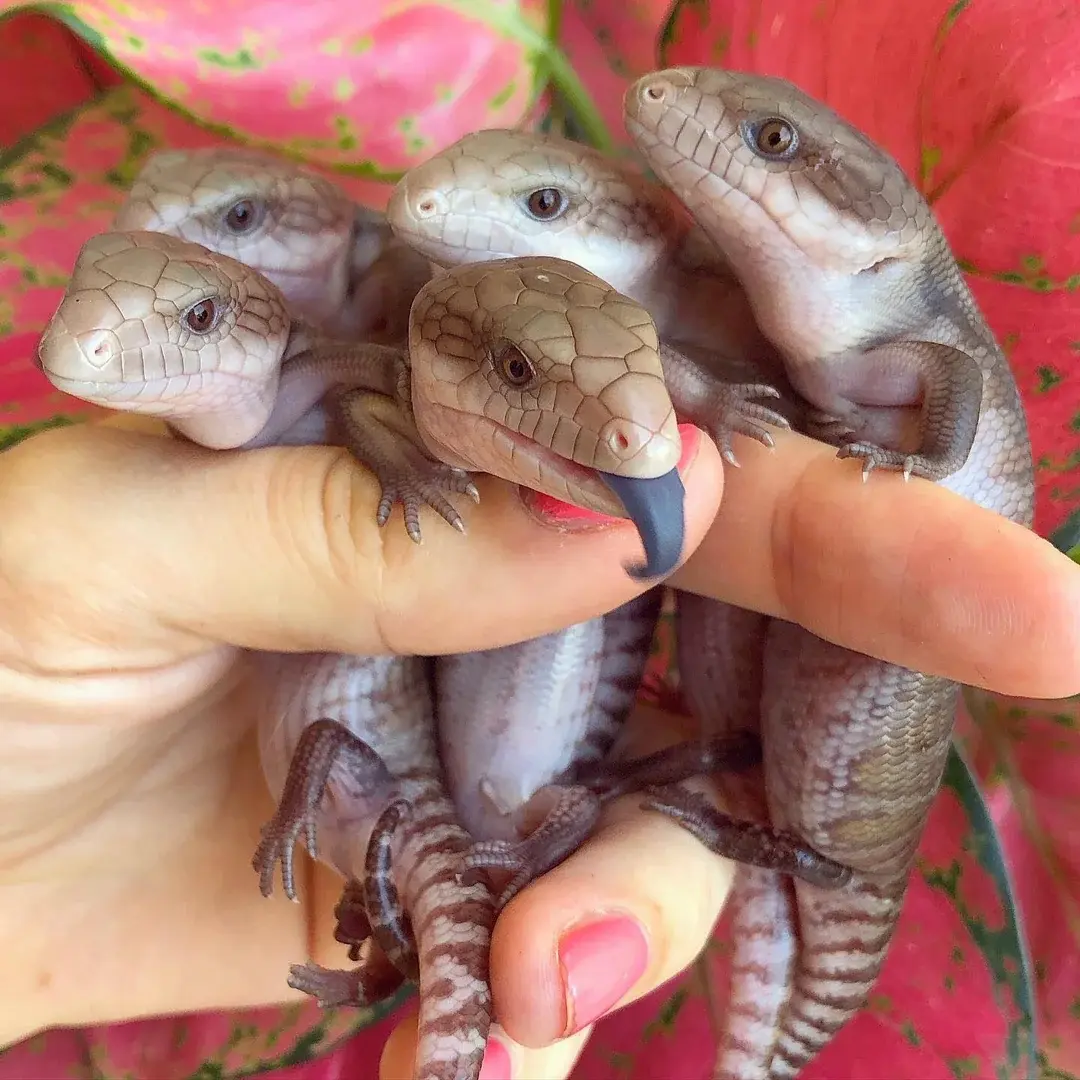
And here's a handful of little baby blue-tongue skinks! I can tell they're less than a week old because they aren't trying to kill each other. Newborn blue-tongues sometimes stick around their siblings for a short while, but part ways early and live an entirely solitary life afterwards.
You can see the little outie bellybutton on the one in the front! Blue-tongue skinks have an almost mammal-like reproductive system with placenta and umbilical cord and everything. After their first shed the bellybutton almost entirely heals over; it is almost invisible in adults. (I can't find Igor's.)
A fun fact about baby blue-tongues specifically is that they are exactly as intelligent as the adults. If faced with an entirely novel problem, there is zero difference in either puzzle solving or learning ability between a 1-week-old baby and a 15-year-old adult. This is extreme, even by reptile standards. Adults do have the advantage of experience and memories, so if faced with a not-entirely-novel problem, they will outperform babies because they can draw on things they've learned in the past.
(Igor has solved a cat puzzle feeder, and I've taught him to wipe his mouth in a kitchen towel. Blueys are generally considered among the smarter reptiles; they can also be clicker and target trained.)
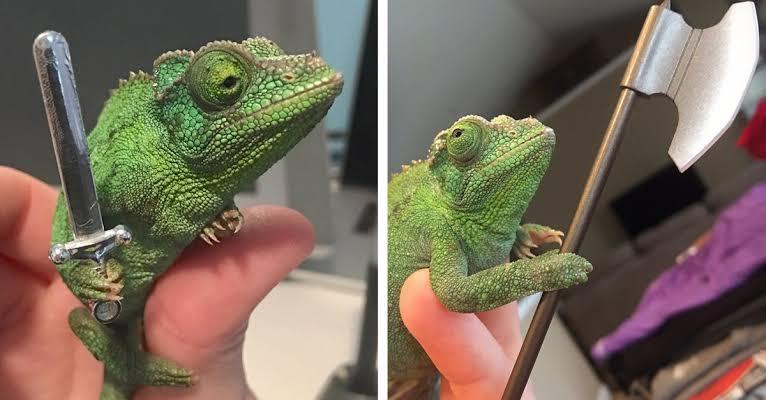
And here's a brave chameleon warrior, ready to go to a LARP or perhaps a HEMA tournament. She's a Jackson's horned chameleon - the reason she isn't actually horned is that she's a she (the males have large triceratops-like horns).
Chameleons are very curious and will usually reach out for pretty much any object that comes within their field of view. They grab anything their hands, tail or feet come into contact with, and they have a *very* strong grip.
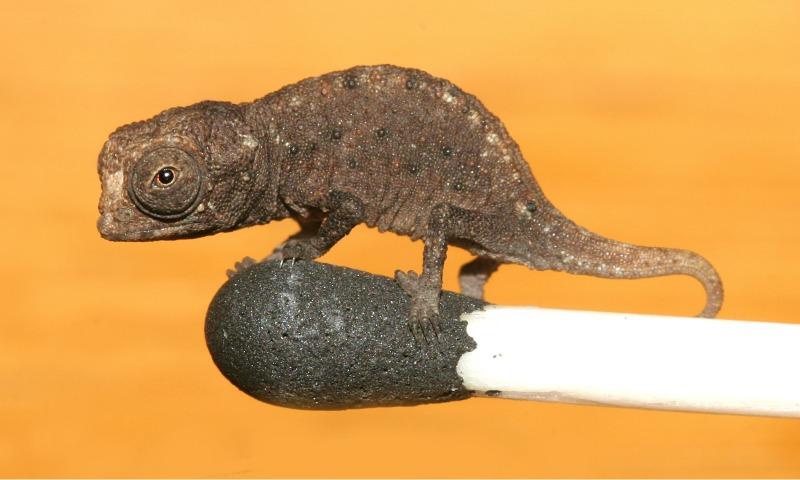
Speaking of cute chameleons, here's a Brookesia micra, the second-smallest amniote vertebrate in the world. (Another chameleon, B. nana, is even smaller - and there are a few amphibians smaller still).
This one is a juvenile - and yes, that's a match it's sitting on, for scale. They can grow to a majestic 1.5 cm snout to vent for a full-grown adult male.
They only live on Madagascar, weren't discovered by humans until well into the 2000s, and unlike most chameleons they generally roam the ground rather than climbing trees. They eat fruit flies, mites, ants and other tiny invertebrates.
Also, they can't change colour at all! None of the truly tiny chameleons can, it appears that this ability requires a minimum absolute size to work.
This lovely cuddly couple is a pair of shingleback skinks. And yes, these two are in fact a couple, and they are in fact cuddling.
Closely related to the blue-tongue skink, shinglebacks form lifelong monogamous pairs. They don't live together all year, but in the spring a bonded couple will track each other down (sometimes over very long distances), mate and raise a young or two, and then part ways until the next year. After they meet up and before they start mating, they usually have a 6-8 week long period of the most absurdly cute behaviour - they nuzzle and nudge each other, lick each other's faces, and snuggle up next to each other.
Their newborn are *enormous* (roughly equivalent to giving birth to a four-year-old), and the father is on guard duty while the mother recovers. While he doesn't help his young forage (no reptile does), he does watch over them and will defend them against predators. In the period where he's guarding first his mate and then his kids, he doesn't usually eat anything himself ... for about 2-3 months.
The mother is unable to eat near the end of the pregnancy (due to the enormous embryos), and has to focus on recovering and feeding afterwards.
They live for 50+ years, and if a shingleback dies, its mate will often sit vigil over the dead body for up to a week, and will often refuse to eat for months afterwards.
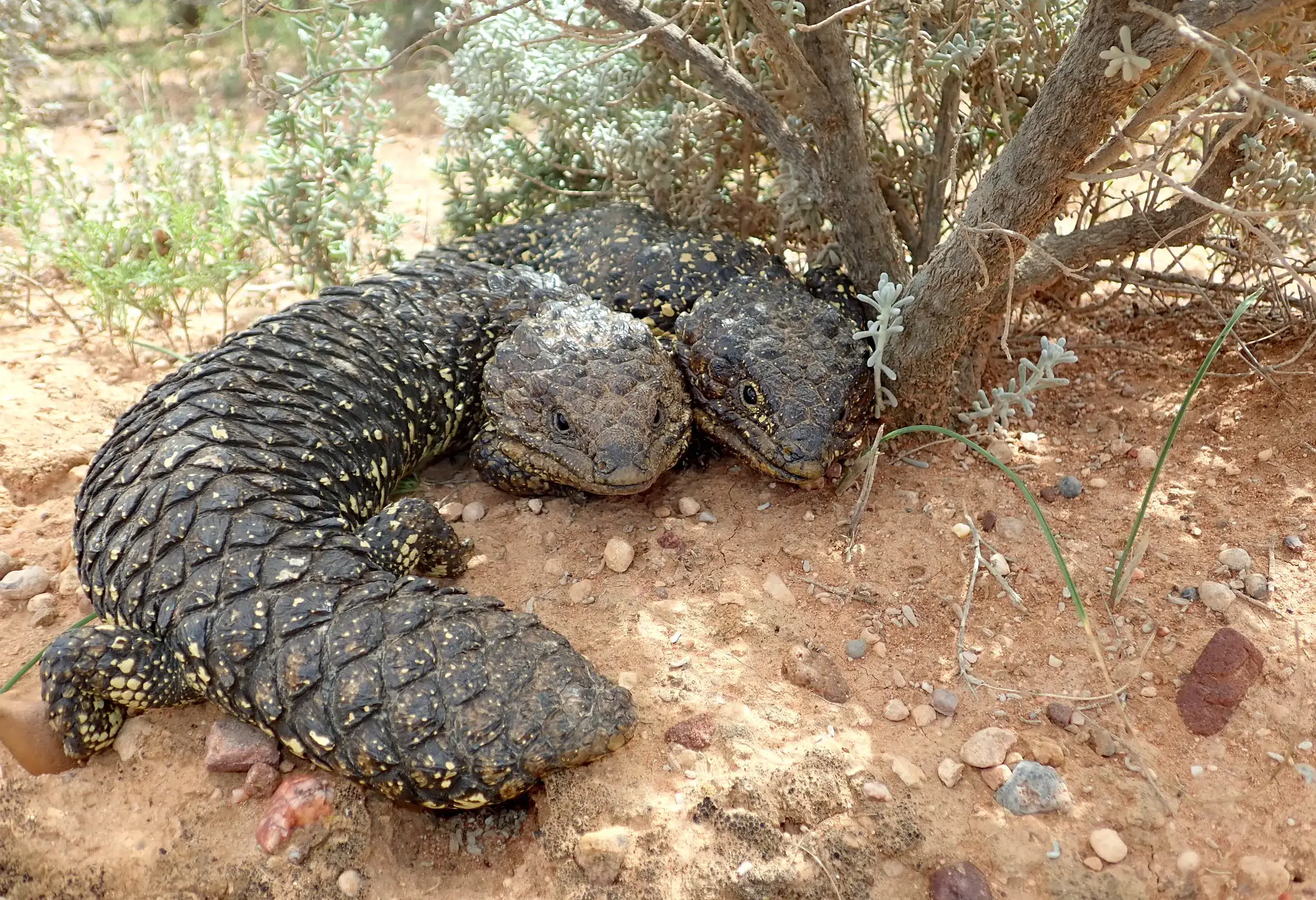
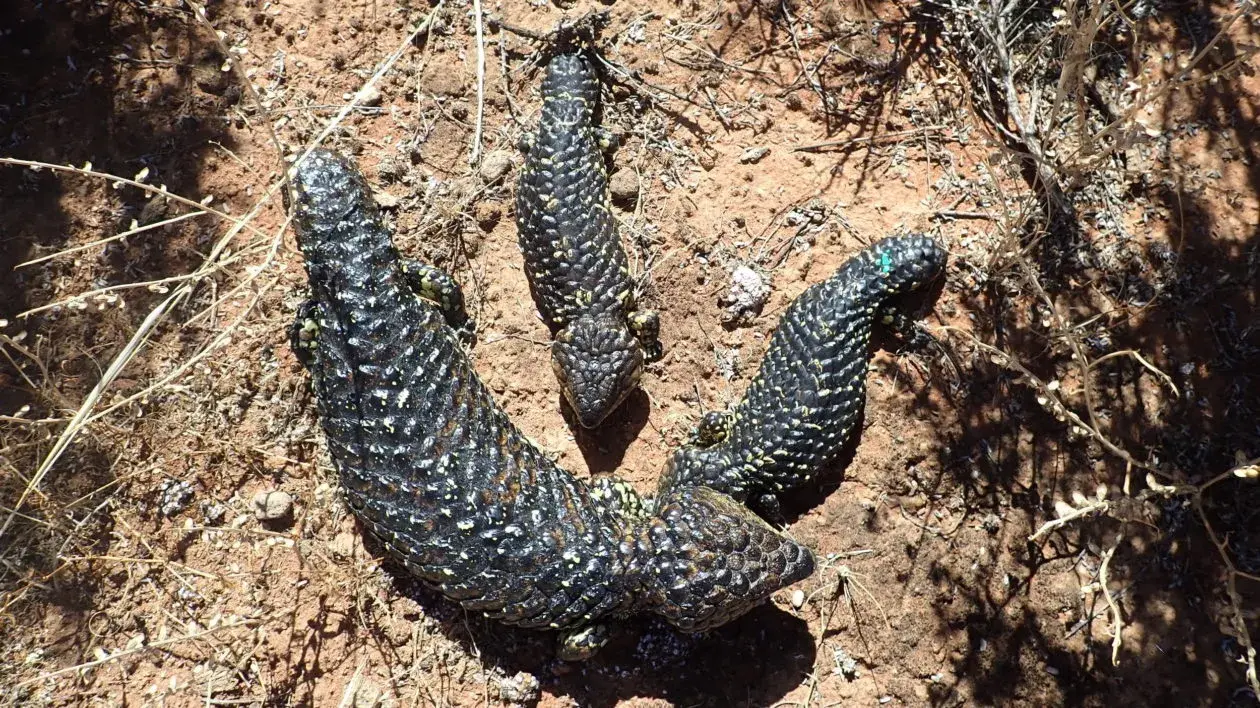
Here is a shingleback mum with her two newborns. As I said - there's a reason the father assumes most of the parental duties immediately after birth - the mother is exhausted and starved. (He also guards the mother - and he often doesn't eat anything himself for 2-3 months because this is a full-time job).
Shinglebacks are a good candidate for "world's worst pregnancy".
Taken by the same photographer, after they accidentally awakened the little anole.
(Because they're resting their chin on the flower, I can't see if this is a male or a female. But if she's female, she's not dreaming about hot anole boys.
Yes, lizards almost certainly do dream. They have REM sleep like humans, and their brains follow the same brainwave patterns as dreaming humans, albeit in shorter cycles than ours. It's a point of debate whether reptiles and mammals evolved complex sleep brain patterns independently, or if an early ancestor of both lineages did. This ancestor would be an amniote from *after* our shared ancestry split off from that of the amphibians - amphibians don't appear to have REM sleep or any direct analogue.)
Anole footnotes:
I had a green anole as a pet, when I was a little kid. He was my first pet lizard, and he lived to the age of 8 - which is quite respectable for an anole. He was named Speedy, for obvious reasons. Their leg muscles basically seem to be spring-loaded; they can perform a leap from a stationary start so rapidly and explosively that your eyes can't track them. It almost looks like they teleport, and their sprints are equally impressive. Mine regularly caught insects *in mid-air*.
He quickly realized that I wasn't going to hurt him, and also quickly learned that big apes watching him wasn't dangerous. But he was a bit shy and didn't like handling - so I didn't press that. At the time I also didn't really know how to build trust with lizards yet (and managing that with an anole is *not* a beginner project - they're very smart, but they're also very small, and they're quite aware of that.)
Already then, I was *convinced* that he dreamt when he slept. He'd change colour multiple times in his sleep - and sometimes he'd even assume "fighting colours", with the distinctive black eye stripes and everything. Also sometimes his eyelids would start twitching wildly. I figured that the normal green-to-brown-and-back colour change could just be a temperature thing, but couldn't come up with a better explanation for the full fighting colourscheme than that he was probably dreaming he was having a fight. I felt very pleased when science eventually corroborated my hunch some 30 years later; it is now generally accepted that lizards almost certainly dream.
In the last six months or so of his life, he was clearly getting old - he slowed down quite a bit, and he got cataracts and started losing his eyesight. He was entirely blind for the last couple months of his life. He adapted shockingly well to being blind, and could remember exactly where the food and water bowls were, so he had no problem keeping himself fed. More importantly, he remained bright green (indicating a happy and safe anole) most of the time. He'd even sometimes still show off the dewlap and do a pushup routine.
A footnote on anole brains:
We* used to think that lizards were terribly stupid reflex automata operating entirely on instinct and with no capability for learning or higher cognitive function. When animal neurology studies began, we could see that reptile brains don't have the complex layered cerebral cortex you see in mammals - they do have a cortex, but it's smooth and simple. Case closed, right?
Well, it turned out we were looking in the wrong place. Reptile forebrains' dorsal ventricular ridges have a very high neural density, with stellate neurons in extremely interconnected clusters that don't really resemble anything mammals have. And it turns out *that's* where neural activity lights up when a lizard needs to solve a complex cognitive task. Anoles specifically have proportionally enormous forebrains - *less* of their overall brain area is dedicated to simple motor automation than in birds and mammals.
Also, unlike mammals, reptiles have rapid neurogenesis throughout life, and their activities and experiences affect where new brain tissue grows. They actually *physically restructure their brains* as well as rewire connections.
*) Nobody who spent any significant time watching or interacting with lizards believed this.
