
Login
You're viewing the ruby.social public feed.
  • Nov 16, 2026, 2:56 AM

    I do not know and for the moment I don't want to dwell upon how the science nerds of the 1980s transmogrified into the right-wing creeps who swarm round Michael Shermer and Steven Pinker and other such "dark intellectual" celebrities. My concern right now is with the "evangelism".

    "Technology evangelism" was a real social force, real enough for a Wikipedia article (q.v. en.wikipedia.org/wiki/Technolo ) which reveals the extent to which this phenomenon of the technology evangelist was linked specifically to #Apple. There was a reason for the evangelism: already, by the late 1980s, the shape of the personal #computing landscape was freezing into a particular corporate shape that was hostile to smaller newer startups like Apple. Already it was tough to establish a foothold in the market and that's what inspired the "evangelism".

    And then:

    In 1987, Steve Ballmer introduced the technology evangelist role at Microsoft to build excitement and drive adoption of Windows and its development tools.[10]

    Uggggggh. It was inevitable though. This is the way of corporations and governments alike: there's nothing they won't try to copy. Obviously Ballmer must have thought it was monstrously unfair that Apple's stuff was inspiring genuine affection, a brand loyalty that was stronger than the cold hard business logic that would tell most people that Apple computers were a joke.

    But hang on a moment. Should anyone, ANYONE, have been affectionate for a personal computer?

    (cont'd)
    💬 1🔄 1⭐ 3

Replies

  • Nov 16, 2026, 3:09 AM

    One can be legitimately affectionate towards an individual computer, just as one can feel warm and friendly towards a car or a trusty power tool. But what Apple and Steve Jobs had lashed up was something rather less friendly and more sinister: they had pretended to be like the rebels in Star Wars, a symbol of liberation, but when all was said and done they were still just another corporation and Jobs's chief concerns were always burnishing his own self-image and establishing a corporate empire. These are leaden, oppressive goals that no quantity of clever marketing can turn into revolutionary fire...

    ...except they did try REALLY hard to do just that, and they almost succeeded. To this day, even as Apple doubles and trebles down on making their products friendly chiefly to technofascists, there are still human beings who want to believe that there's something magical about Apple, something special. Apple and Steve Jobs (who a sense has never really died, in the same way that Big Brother and Ronald Reagan have never died) continue to robe themselves in the glamour of the Good Capitalists. Elon Musk and Elizabeth Holmes and a heap of other grifters all wear their own copies of Jobs's Good Capitalist costume.

    We have not been allowed to have any other sort of hero. We have not been permitted any other sort of rebellion--just as the Star Wars Rebellion is (sadly) trapped within a corporate prison, so are we all.

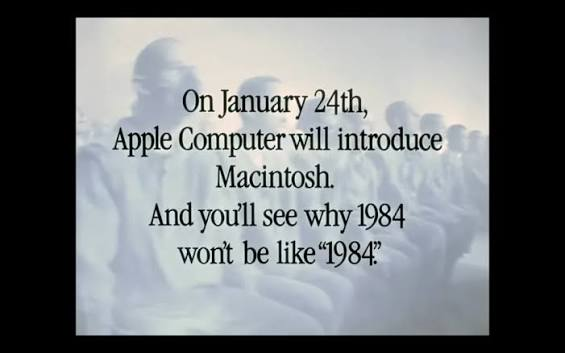
    Indeed 1984 wasn't like 1984. It was worse. Eventually #Apple made us all glad and excited to buy our own stylish personal telescreens, and bragged of how we could now carry them around in our own pockets.

    ~Chara of Pnictogen

    "On January 24th, Apple Computer will introduce Macintosh. And you'll see why 1984 won't be like '1984.' [sic]"

The closing title card of the infamous 1984 advertisement for the Apple Macintosh, directed by Ridley fucking Scott
    💬 0🔄 4⭐ 5