Rhodocollybia butyracea
https://www.mushroomexpert.com/Rhodocollybia_butyracea.html
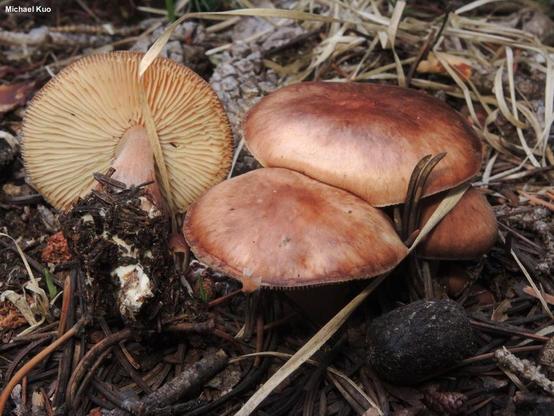
Ecology: Saprobic (see discussion above); decomposing the litter of conifers—especially pines; late summer and fall (also winter and spring in warmer climates); fairly widely distributed in North America. The illustrated and described collections are from Colorado and Illinois.
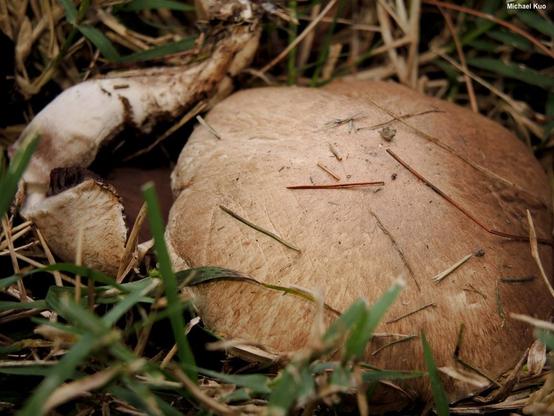
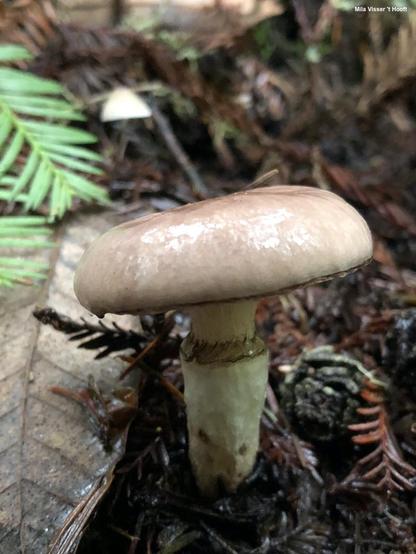
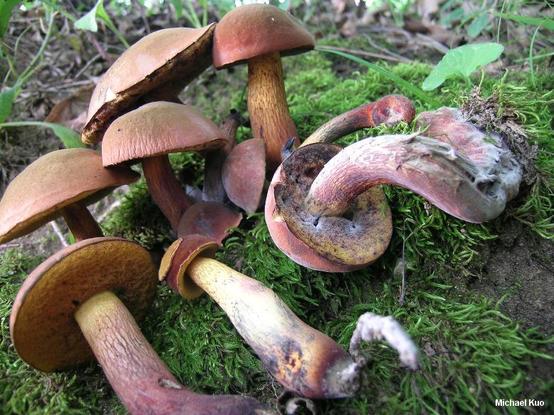
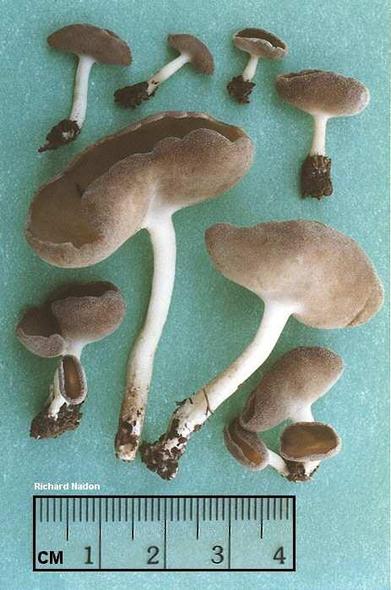
Cap: 2-6 cm across; convex, becoming broadly convex or nearly flat; moist, with a greasy feel, when fresh; bald; reddish brown to brown, fading to cinnamon.
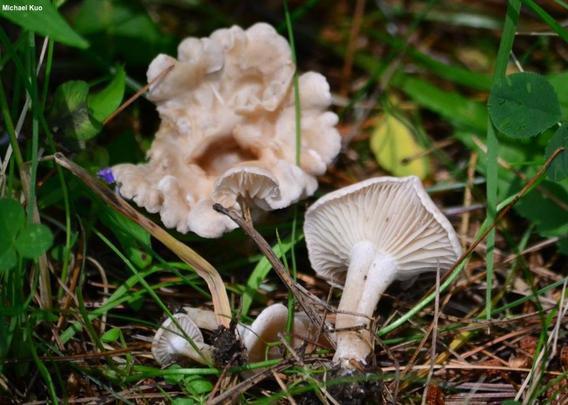
Gills: Narrowly attached to the stem or nearly free from it; close; short-gills frequent; whitish; often developing finely jagged edges.
Stem: 3-8 cm long; and 1-2 cm thick; usually slightly to moderately club-shaped; moist or dry; bald; whitish to buff above; colored like the cap below; often with a whitish dusting when fresh; becoming hollow; basal mycelium white.
Flesh: Whitish; unchanging when sliced.
Odor and Taste: Not distinctive.
Chemical Reactions: KOH gray on cap surface.
Spore Print: Whitish or, with a thick print, faintly pinkish.
Microscopic Features: Spores smooth; 8-10 x 4.5-6 m; ellipsoid; smooth; hyaline in KOH; at least a few (often many) dextrinoid. Basidia 4-spored. Pleurocystidia not found. Cheilocystidia inconspicuous; subclavate to subcylindric; often lobed or with projections; up to 40 m long. Pileipellis a cutis; elements 2.5-7.5 m wide, smooth or brownish-encrusted, clamped at septa.
#mushrooms #fungi #mycology #shrooms #mushtodon #sporespondence #floraspondence