Login
You're viewing the oslo.town public feed.
  • Oct 9, 2026, 3:56 AM

    @timtfj Completely agreed. A lot of good letters got thrown out for 'practical' reasons over the centuries.

    I used to do hand letterpress (type setting by hand) so I understand the difficulties of dealing with a huge tray of letters. But in our present digital era, we don't have to physically handle letters to use them!


    💬 2🔄 0⭐ 0

Replies

  • Oct 9, 2026, 4:04 AM

    @dancingtreefrog One thing using þ and ð would do is make it easier for English people to grasp Welsh pronunciations—Welsh uses <dd> for /ð/ and <th> for /θ/, so they're both <th> in English spelling. It would make it obvious which is which.

    💬 1🔄 0⭐ 0
  • Oct 9, 2026, 7:34 AM

    @timtfj I remember learning the International Phonemic Alphabet when taking literature at university. The idea of an alphabet aimed at recording the actual "as pronounced" sound of any language appealed to me. Of course, it has difficulties with differences in pronunciation, which translate to different spellings, even within the same language. But I thought the *idea* was great.

    💬 1🔄 0⭐ 0
  • 💬 0🔄 0⭐ 1
  • Oct 9, 2026, 7:57 AM

    @benjamin @timtfj Understood. I think part of it was to capture "the sounds the speaker actually used" vs "the official sound of the language".

    I just think it makes studying individual words more difficult if you have to adjust for how a speaker in one part of the UK (for instance since the UK is jammed full of dialects) from the same word as spoken by someone else in the UK.

    Sometimes I think the real purpose was so singers could sing any language without understanding a word they said! 😉

    💬 0🔄 0⭐ 3
  • Oct 10, 2026, 12:08 AM

    @dancingtreefrog @benjamin Well I'm not an expert either, but the phonetic alphabet is used a lot in writing about things like regional accents or pronunciation changes over time.

    There are different levels of precision too—phonemic transcriptions that indicate speech sounds but not what accent to say them in, or stricter transcriptions that try to show the exact sound made.

    💬 1🔄 0⭐ 0
  • Oct 10, 2026, 12:17 AM

    @dancingtreefrog @benjamin Talking of different accents, I had a weird experience at university when a new student I'd not spoken to before came into the shared kitchen and said "Have you got a cap I can borrow?", which I was baffled by. "A *cap*?" "No, a cap! You know, to drink out of . . . ! " He meant a cup, but I'd misunderstood by thinking I'd hear a Northern accent when actually he had a strong London one.

    💬 0🔄 0⭐ 0
  • Oct 9, 2026, 4:31 AM

    @dancingtreefrog The Wikipedia article suggests it was because the type was made in the Netherlands and Belgium, though that's disputed on the talk page. en.wikipedia.org/wiki/Thorn_(l I think I also read a while ago that a lot of the early printers in the UK came over from there, but I may be misremembering. Especially since I didn't read it in English.

    💬 2🔄 0⭐ 0
  • Oct 9, 2026, 5:30 AM

    @timtfj Well, Johannes Gutenberg was German. Did German use thorn?

    It doesn't look like Old High German used thorn:
    en.wikipedia.org/wiki/Old_High

    I think languages in the Netherlands and Belgium were closer to German than they were to English. And England back then had very close trading ties with the Netherlands

    So maybe the letter set the printers brought over to England didn't include thorn to start with?

    💬 0🔄 0⭐ 0
  • katherine montaltokatherine_montalto@zirk.us
    Oct 9, 2026, 3:59 PM

    @timtfj @dancingtreefrog I've read that in couple of places that it was because the first printing presses brought to England were brought by the Dutch. The book, The Book-Makers A History of the Book in Eighteen Lives, has a whole chapter about it.

    💬 1🔄 0⭐ 0
  • Oct 9, 2026, 7:05 PM

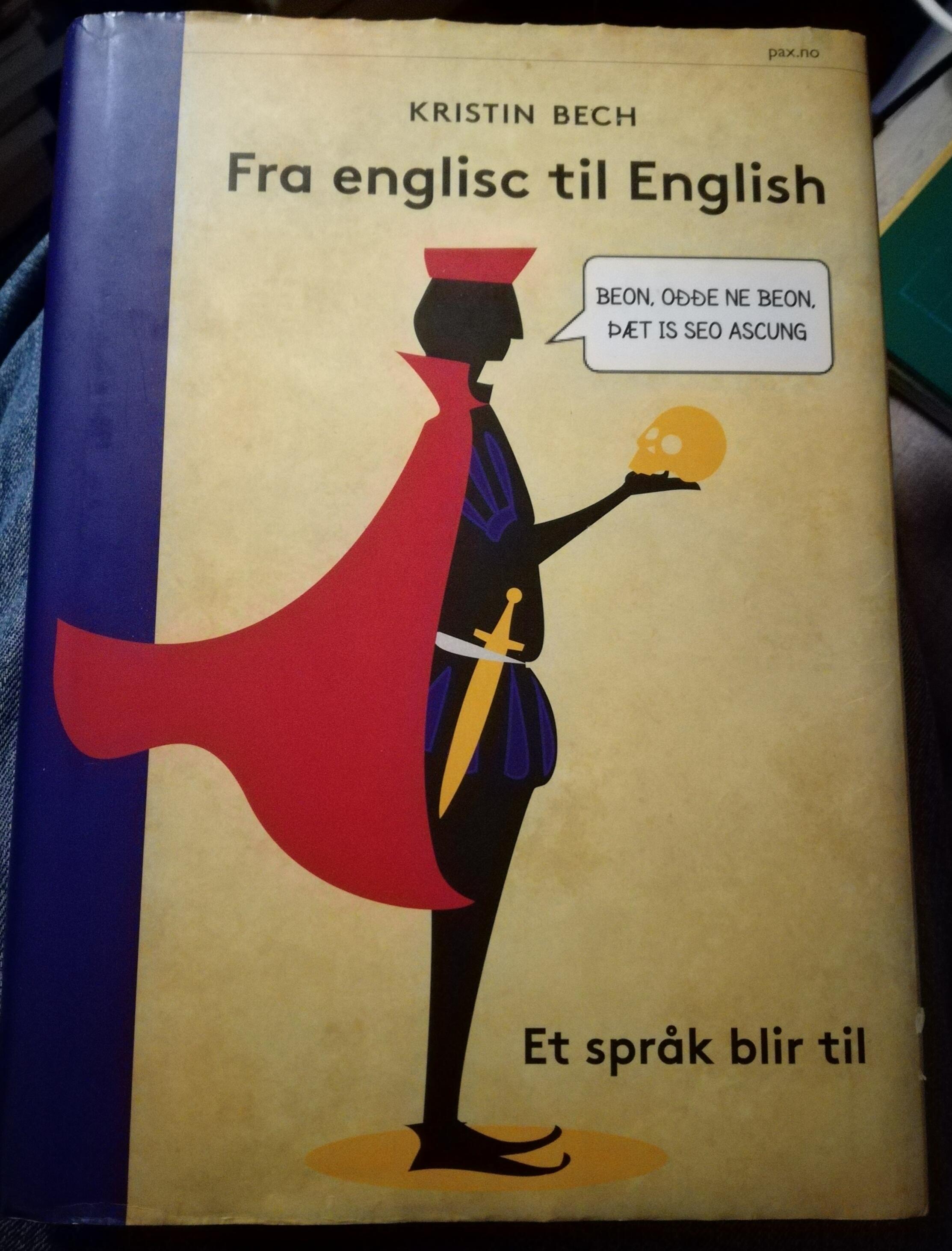
    @katherine_montalto @dancingtreefrog That's an interesting looking title! The information I'm half remembering was somewhere in this, which I was reading to combine learning more Norwegian with learning about the history of English (and of connections between the two).

    Book cover in Norwegian.

"Kristin Bech
Fra englisc til English:
Et språk blir til"

The title translates as "From englisc to English: a language comes into being".

A stylised character is depicted contemplating a skull and saying "Beon, oððe ne beon, þæt is seo ascung"—that is, "To be, or not to be, that is the question" translated into Old English.
    💬 1🔄 0⭐ 0
  • katherine montaltokatherine_montalto@zirk.us
    Oct 9, 2026, 8:13 PM

    @timtfj that book looks amazing! I wish I understood Norwegian. The book-makers is an excellent book. Especially if your interested in language history

    💬 2🔄 0⭐ 0
  • Oct 10, 2026, 11:24 PM

    @katherine_montalto Do you have more details of the book about printing? It sounds like one I'd enjoy reading, especially if it goes into the history of types of printing press and so on.

    💬 1🔄 0⭐ 0
  • 💬 1🔄 0⭐ 0
  • 💬 1🔄 0⭐ 0
  • katherine montaltokatherine_montalto@zirk.us
    Oct 14, 2026, 11:12 PM

    @timtfj very nice! it was first published in the UK so they must have got the paperback sooner. Let me know if you read it. I really liked it.

    💬 1🔄 0⭐ 0
  • Oct 14, 2026, 11:44 PM

    @katherine_montalto I actually tried to order it from that page this evening, but couldn't get the payment to go through! I've a feeling that happened previously when I tried to order something from them. I'll definitely let you know if I manage to get hold of it. :-)

    💬 1🔄 0⭐ 0
  • 💬 1🔄 0⭐ 0
  • 💬 1🔄 0⭐ 0
  • 💬 0🔄 0⭐ 0
  • Oct 10, 2026, 11:50 PM

    @katherine_montalto It's a nice language. I didn't learn it a very conventional way, because I couldn't find a tutor book or similar at the time. I did find a basic grammar book though, and set about learning it through interacting on Twitter! It was an interesting process.

    I think the grammar is simpler than English in some ways. E.g. verbs just have one form for each tense, so there's no "ich bin, du bist, er/sie/es ist"—present tense is just "jeg er, du er" etc., with "er" for each person.

    💬 1🔄 0⭐ 0
  • 💬 0🔄 0⭐ 0