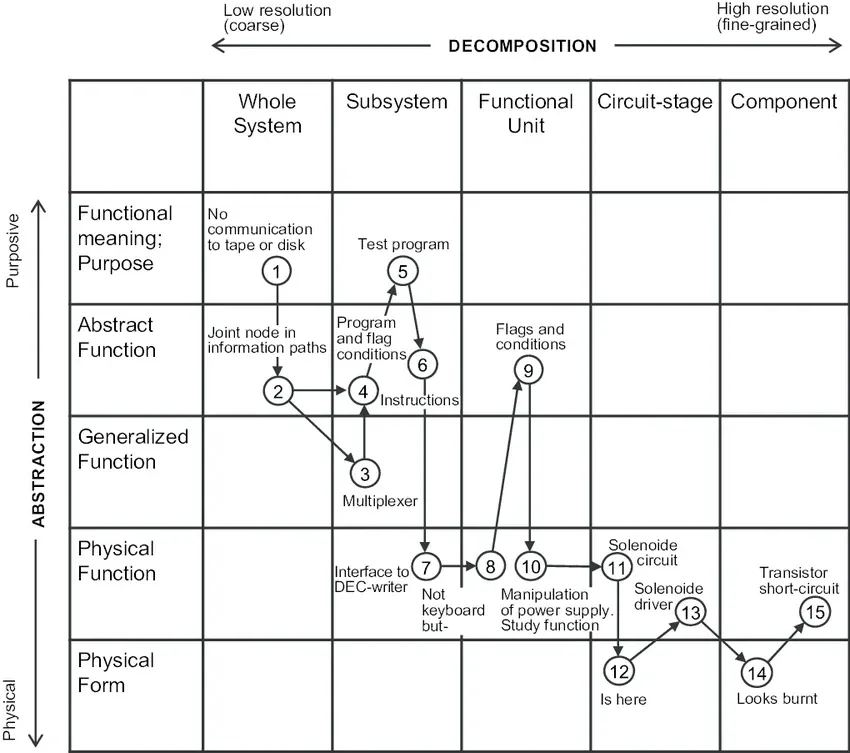
Rasmussen maps these as a space across two dimensions: abstraction (purpose to physical) and decomposition (whole-system to individual components). Each component can have a physical set of properties, but also a high level purpose it is connected to; so do aggregated portions of a system.
He then describes how workers do their work by skipping around abstraction layers, going up and down the hierarchies based on both purposes (high-level goals and functions) and reasons (bottom-up signals) but also across various aggregations (whole systems vs. components).
The cool thing though is that he then maps a problem-solving path as a line walking that conceptual path within a "conceptual reasoning space" of operators that is event-independent. Neelam Naikar (https://doi.org/10.1016/j.apergo.2016.06.001) re-renders diagrams Rasmussen had made in a few publications in the mid 80s:
This is the "abstraction-decomposition space". It maps a troubleshooting workflow from a system symptom ("no communication to tape or disk") via a diagonal walk to isolate a faulty component ("short-circuited transistor").
This is such an incredible visualization of so many complex elements!