
Login
You're viewing the functional.cafe public feed.
  • Sep 24, 2026, 7:17 AM

    Have you wondered how bad CO₂ emissions, and therefore global heating, could really get if the AI industry gets its way?

    I modelled the emissions based on their projections:

    "The growth the AI industry wants is disastrous for climate change"

    limited.systems/articles/ai-da

    #FrugalComputing

    (this is based on my peer-reviewed paper published in the proceedings of 2nd International Workshop on Low Carbon Computing, linked in the article)

    💬 3🔄 40⭐ 13

Replies

  • Sep 24, 2026, 7:23 AM

    This is what my most critical reviewer commented:

    "This is a provocation that might have the potential to stimulate debate but it is problematic in itself because it arrives at estimates of carbon footprints that are both highly uncertain as well as extreme. Extreme, because they estimate they are a lot higher than previous estimates. Uncertain because they make claims about a fast-changing technology many years into the future.
    I would regret if these claims are being picked up in the media. "

    💬 1🔄 1⭐ 0
  • Sep 24, 2026, 7:26 AM

    They are right that the estimates are highly uncertain, the 5% -- 95% confidence interval is very wide.
    But my mean estimates are not extreme. If they are higher than previous ones, that is because my model is more detailed and takes into account more factors, esp. embodied carbon growth, than previous models.

    (In any case, even that reviewer accepted the paper.)

    #FrugalComputing

    💬 1🔄 1⭐ 2
  • Sep 24, 2026, 7:45 AM

    Let me get a bit more technical about the estimate of the trend in embodied carbon.
    Embodied carbon is dominated entirely by the chips. The trends follow Moore's law because the chip industry strives to adhere to it. Therefore, the time evolution of all factors in the equation is exponential.
    In other words, it's a straight line in a log-log plot, but the uncertainty on the trend of that line is quite high.
    (1/n)

    💬 1🔄 0⭐ 0
  • Sep 24, 2026, 7:48 AM

    If you compound this over a number of years, the uncertainty grows exponentially (same as the factors; so in relative terms it is not so dramatic).

    I used a sampling approach because the distribution is skewed, so normal mean and stdev are not usable, and the usual approach to uncertainty propagation is not valid.
    So I sample the distribution for every time iteration and calculate the 5th, 50th and 95th percentile.
    This is what the graphs show.
    (2/n)

    💬 1🔄 0⭐ 0
  • Sep 24, 2026, 7:50 AM

    This is also why for the best-case estimate, the embodied emissions per Watt decrease over time, whereas for the mean and worst-case they increase.
    The most likely scenario is that they increase.
    (3/n)

    💬 1🔄 0⭐ 0
  • Sep 24, 2026, 9:28 AM

    The trends I modelled are for embodied carbon per Watt. This is because the AI data centres are power-bound, not compute-bound. This means they fill the server halls with as many servers as the power budget can take. So that is what determines the embodied emissions.
    (It is different for HPC centres, as they typically aim for max compute per Watt, so they are compute-bound. In that case, it would be something like embodied carbon per HEPScore unit.)
    (4/n)

    💬 0🔄 1⭐ 0
  • Sep 24, 2026, 10:08 AM

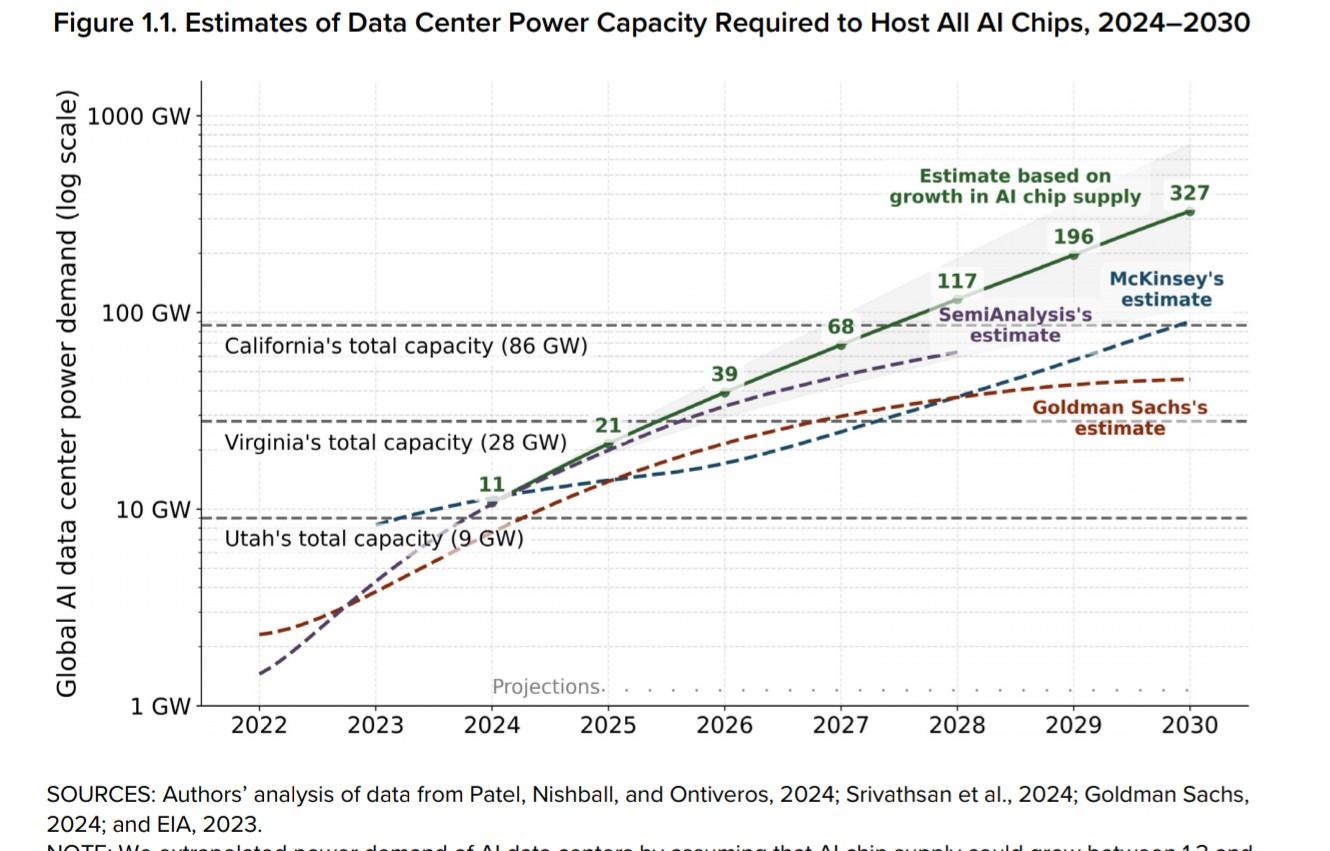
    @wim_v12e something that makes me very anxious is that McKinsey's 2024 projections were already quite conservative: I might be wrong here but if I remember correctly the energy consumption for planned hyperscale data centres for 2030 follows RAND's projections much more closely at the moment ("AI’s Power Requirements Under Exponential Growth", Konstantin F. Pilz, Yusuf Mahmood, Lennart Heim, 2025)

    Figure 1.1. Estimates of Data Center Power Capacity Required to Host All AI Chips, 2024–2030

Log scale chart showing four projections of global AI data centre power demand between years 2022 and 2030. By 2028 SemiAnalysis estimates ~60GW. By 2030 Goldman Sachs' estimates ~40GW, McKinsey's ~90GW, and RAND 327GW median.

California's total capacity: 86GW
Virginia's total capacity: 28GW
Utah's total capacity: 9GW

SOURCES: Authors’ analysis of data from Patel, Nishball, and Ontiveros, 2024; Srivathsan et al., 2024; Goldman Sachs, 
2024; and EIA, 2023.
    💬 1🔄 0⭐ 0
  • Sep 24, 2026, 10:20 AM

    @trobador Thanks for that link. I will look in detail as soon as I can find the time. McKinsey is 100x growth in 20 years. If it goes faster, we burn the planet even sooner.

    💬 1🔄 0⭐ 0
  • 💬 1🔄 0⭐ 0
  • Oct 20, 2026, 3:26 PM

    @trobador I had not seen this, thanks very much. I had been looking at projections for the UK though, and they are indeed much steeper than those by McKinsey. Very grim indeed.

    💬 0🔄 0⭐ 0