
David Schmidtindividual8@mastodon.social
Aug 25, 2026, 8:19 AM@jaffathecake I believe major social media platforms are a key factor holding back AVIF adoption.
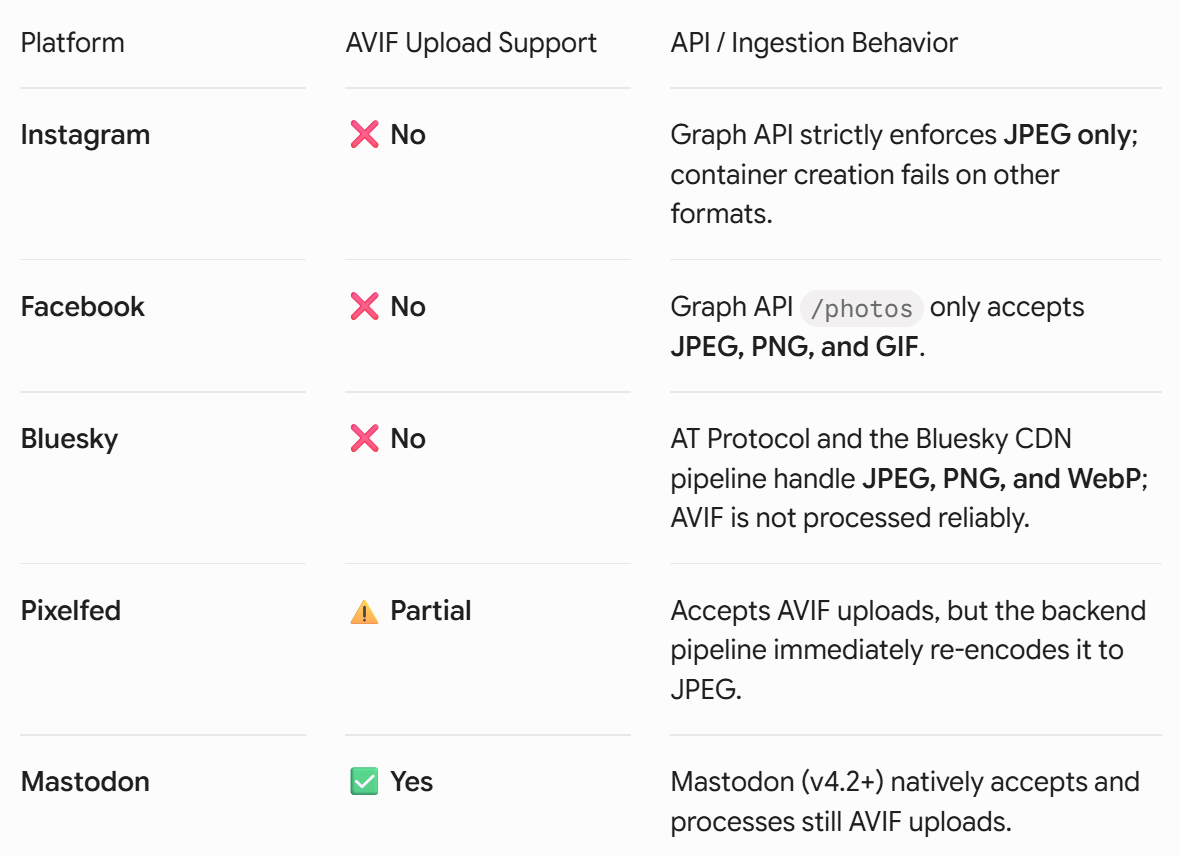
@jaffathecake I believe major social media platforms are a key factor holding back AVIF adoption.
@jaffathecake If browser vendors began phasing out legacy image formats, it would accelerate the adoption of modern alternatives.

@individual8 this will never happen. Compatibility is way more important.
@jaffathecake If browser vendors aren’t the ones driving the impulse toward modern image formats, who actually takes the lead? Without clear direction and coordination, adoption just fragments in random directions for arbitrary reasons.

@individual8 @jaffathecake You see sites like YouTube fairly aggressively adopting new video codecs. The marginal bandwidth savings per-stream add up when you look at the whole user base.
The same kind of economics could make sense for a service that primarily serves images.
As a downside, web browsers will be adding ~ 10 bytes to the Accept header of image HTTP requests, no matter whether the website can serve the format. Hopefully that turns out to be worth it.
@jamesh @jaffathecake My guess is it comes down to compute cost vs. bandwidth. The platforms definitely have an interest in better formats, but AVIF is notoriously CPU-heavy to encode.
Saving a few dozen kilobytes on an image that might only get viewed a couple hundred times probably doesn't offset the extra server compute and ingest latency. Someone – especially at Meta – likely ran the numbers and figured that, at least for now, the trade-off simply isn't worth it.
@individual8 @jamesh I think the encode-cost info out there is out of date (and came from JPEG XL folks in the first place)