QuasitQuasit@beige.party
10/10/2026A jar of Rao's spaghetti sauce has gone from $8 two months ago to $11 now. That's a nearly 30% increase.
What will it take to get the people into the streets?
A jar of Rao's spaghetti sauce has gone from $8 two months ago to $11 now. That's a nearly 30% increase.
What will it take to get the people into the streets?
I've started a new account at https://social.vivaldi.net/@Quasit . Or is it @Quasit@vivaldi.net ?
In either case I'll be posting there from now on. If you follow me here on Beige.party or kolektiva.social, please consider following me on social.vivaldi.net. I won't be posting here any more.
Thanks to the heavy-handed censorship practiced by beige.party and kolektiva.social, I'm leaving both accounts. If anyone can recommend an instance that ISN'T run by authoritarians, please let me know—but at this point I've been burned twice.
I'll continue to post any future book recommendations over on my DreamWidth account. DreamWidth has never censored me. You can comment there without an account, although accounts are free.
My account on DreamWidth is:
https://bobquasit.dreamwidth.org/
If that link doesn't work, try this one. https://bobquasit.dreamwidth.org/2152016.html
I'd like to think I contributed something of value here including 170 daily book recommendations. I did that for the friends I've met here. You write good stuff, and I've enjoyed it.
But I see no future for Mastodon as long as censorship runs rampant here. Good luck to you all, and happy reading! 🤓📖
#Books #Bookstodon #BookRecs #BookRecommendations #DailyBookRecs #QuasitBookRecs
I'm leaving Mastodon. Two censoring instances in a row is two too many. If I find an instance that DOESN'T censor, I may come back. Feel free to recommend one if you know one!
For now I'll be posting on my old DreamWidth account. It's pretty empty, but at least there's freedom of speech there.
Here's a link to my DreamWidth account.
https://bobquasit.dreamwidth.org/
And here's a post I just made over there about all this.
https://bobquasit.dreamwidth.org/2151774.html
DreamWidth is free. I've never been censored there. I plan to post future book recommendations there. It goes way back; it's a fork of the old LiveJournal code, and it's run by two former LiveJournal staffers. It has a lot more features than Mastodon, including text formatting and groups.
I hope Mastodon finds a way out of its censorship addiction. But until it does, there's no point in posting here.
#Mastodon #Censorship #BeigeParty #kolektivaSocial #SocialMedia
Quasit's Daily Book Recommendations: "The Nine Billion Names of God" (1967) by Arthur C. Clarke
Age Range: 14 to adult
Genre: Science Fiction
When I was a young science fiction fan, we had the "Big Three"–Isaac Asimov, Robert A. Heinlein, and Arthur C. Clarke. They were widely considered the greats; I hope they still are.
"The Nine Billion Names of God" is a collection of the best short science fiction of Arthur C. Clarke. Or rather, they're •his• favorites of his stories from the first thirty years of his career. They're well worth reading!
Of course "The Nine Billion Names of God" is also the name of the first story in the book. I've already recommended it, as it's included in "The Science Fiction Hall of Fame, Volume 1", which I recommended on 4/24/2026. If you haven't read it, I'll refrain from spoiling it for you. Suffice it to say that these are some of the greatest stories in science fiction.
In "Rescue Party" a crew of aliens lands on a planet whose sun will go nova in a few hours; they hope to rescue some survivors, if possible. But the planet, despite showing clear signs of an advanced civilization, seems uninhabited.
[As soon as his colleagues had entered the air lock, Orostron hurled his tiny machine into the sky and set the controls to home on the S9000. Then he turned to his friends.
"Well, what have you found?" he asked.
Klarten produced a large roll of canvas and spread it out on the floor.
"This is what they were like," he said quietly. "Bipeds, with only two arms. They seem to have managed well, in spite of that handicap. Only two eyes as well, unless there are others in the back. We were lucky to find this; it's about the only thing they left behind."
The ancient oil painting stared stonily back at the four creatures regarding it so intently. By the irony of fate, its complete worthlessness had saved it from oblivion.
When the city had been evacuated, no one had bothered to move Alderman John Richards, 1909-1974. For a century and a half he had been gathering dust while far away from the old cities the new civilization had been rising to heights no earlier culture had ever known.
"That was almost all we found," said Klarten. "The city must have been deserted for years. I'm afraid our expedition has been a failure. If there are any living beings on this world, they've hidden themselves too well for us to find them."]
Another story is "The Sentinel", which was the original basis for "2001: A Space Odyssey".
The final story is "The Star". Again, I don't want to spoil it for you–but it's another one that packs a real wallop in the final line. Clarke really was a master of the form!
As far as I can tell the collection's no longer in physical print, but it's available from the usual providers as an ebook or audiobook (please don't use Amazon). You can also borrow it at no cost from the Internet Archive.
https://archive.org/details/ninebillionnames0000arth
Happy reading! 🤓📖
Here's a complete spreadsheet of all the books I've recommended on Mastodon to date (along with links to each post):
#Books #Bookstodon #ScienceFiction #Classic #ShortStories #BookRecs #BookRecommendations #DailyBookRecs #QuasitBookRecs
Decades ago, when I was a teenager, I was in Pennsylvania with my family. There was something going on; I don't think it was a festival, it seemed more like a full-time tourist destination. Kind of like a permanent Oktoberfest, know what I mean? They had beer, chicken, pretzels, and hot dogs boiled or steamed in beer.
Does anyone know a place like that? I know about Frankenmuth, but that's in Michigan. And there's a great big all-you-can-eat chicken restaurant near me, but they're in Rhode Island and they're not particularly German.
Just curious!
Autumn is coming on fast!

Jupiter and Mars turned six months old today.


Quasit's Daily Book Recommendations: "Berserker" (1967) by Fred Saberhagen
Age Range: 16 to adult
Genre: Science Fiction
Fred Saberhagen's "Berserker" series is one of the classics of science fiction (and not the only one that Saberhagen created). It's one of the earlier series that other authors wrote for, with good reason.
Berserkers are ancient self-replicating machines, many of them huge spaceships. Remnants of an ancient interstellar war between alien species, they destroyed their creators long ago. Now their purpose is the destruction of all organic life. And humanity is their primary target.
[THE MACHINE WAS a vast fortress, containing no life, set by its long-dead masters to destroy anything that lived. It and many others like it were the inheritance of Earth from some war fought between unknown interstellar empires, in some time that could hardly be connected with any Earthly calendar.
One such machine could hang over a planet colonized by men and in two days pound the surface into a lifeless cloud of dust and steam, a hundred miles deep. This particular machine had already done just that.]
Berserkers come in other sizes and shapes, including ones that can pass for human. Their technology is highly advanced, much of it beyond the technology possessed by the surviving species of the galaxy. Humans, as the most aggressive technological species, lead the fight against the Berserkers—although not all humans are on the same side.
This book collects the first Berserker short stories. There are many more, both by Saberhagen and other authors—many of them outstanding. They're in various collections and anthologies. There are also ten novels.
Not sure if the book is in physical production or not, but it's available as an ebook from the usual providers. And you can borrow it for free from the Internet Archive.
https://archive.org/details/berserker00fred
Happy reading! 🤓📖
Here's a complete spreadsheet of all the books I've recommended on Mastodon to date (along with links to each post):
#books #bookstodon #ScienceFiction #Classic #BookRecs #BookRecommendations #DailyBookRecs #QuasitBookRecs
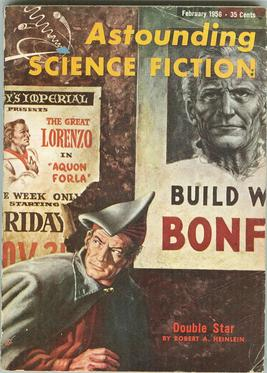
Quasit's Daily Book Recommendations: "Double Star" (1956) by Robert A. Heinlein
Age Range: 14 to adult
Genre: Science Fiction
Here's a great book. It was Heinlein's first novel to win a Hugo award. As such, it's as far from Heinlein's...what shall I call it? His "self-indulgent" era? His "post-Stranger In A Strange Land" period? Suffice it to say that eventually Heinlein became a victim of his own success, and went berserk with incest, political preachiness, and self-indulgence.
Long ago I dreamed up the idea of a Heinlein parody in which every "good" character was just another copy of Heinlein, right down to the dogs and cats. And they'd all have sex with each other, all the time. I think the whole thing was going to end in a massive all-Heinlein orgy which would end in a Big Bang. Luckily I never wrote it.
But this was VERY far from that phase of his career. It's a classic story that draws upon "The Prince and the Pauper" and "The Prisoner of Zenda"; an actor is recruited to temporarily play the part of a major politician who has been drugged and badly hurt by his opponents.
[The lights in the compartment died out and a sound and stereo image built up in front of my eyes. I recognized the central figure-just as any of the billions of citizens of the Empire would have recognized him-and I realized at last how thoroughly and mercilessly Dak Broadbent had tricked me.
It was Bonforte.
The Bonforte, I mean-the Right Honorable John Joseph Bonforte, former Supreme Minister, leader of the loyal opposition, and head of the Expansionist coalition-the most loved (and the most hated!) man in the entire Solar System.
My astonished mind made a standing broad jump and arrived at what seemed a logical certainty. Bonforte had lived through at least three assassination attempts-or so the news reports would have us believe. At least two of his escapes had seemed almost miraculous. Suppose they were not miraculous? Suppose they had all been successful-but dear old Uncle Joe Bonforte had always been somewhere else at the time?
You could use up a lot of actors that way.]
This is arguably the most •artistic• book that Heinlein ever wrote, in that it doesn't include the self-representations that blighted so many of his later works. You can tell that Heinlein did some acting, or at least knew some actors well; the main character, Lorenzo Smythe ("The Great Lorenzo") discusses his craft often in his narration. It's engaging and believable.
And he shows a sense of compassion that's quite unlike Heinlein's later works. It's a touching story, one that will stay with you.
I think it's still in print, and I've seen it in libraries and used book shops fairly often. It's also available as an ebook (please don't use Amazon). And it's available to borrow for free from the Internet Archive.
https://archive.org/details/doublestar0000robe_o3n1
Happy reading! 🤓📖
Here's a complete spreadsheet of all the books I've recommended on Mastodon to date (along with links to each post):
#Books #Bookstodon #ScienceFiction #Classic #BookRecs #BookRecommendations #DailyBookRecs #QuasitBookRecs
Who else hates Sunday night because it means going back to work tomorrow morning?
Quasit's Daily Book Recommendations: "Split Infinity" (1980) by Piers Anthony
Age Range: 17 to adult
Genre: Science Fiction, Fantasy
I haven't run out of books in my collection of recommendations, but I HAVE used a lot of the best options; most of the rest are books which are still quite well-known, so I'm holding off on those.
But I still have options. My memory, for one. I can also go to the basement and go through boxes of books for ideas. Some of them are stacked pretty high, which makes getting to the lower ones difficult. Still, I can always find something!
Today's book is "Split Infinity". Or rather, it's "Double Exposure", since "Split Infinity" isn't available to borrow on the Internet Archive. "Double Exposure" is a collection of the first three books in the "Apprentice Adept" series, of which "Split Infinity" was the first.
This was one of the earlier science fiction/fantasy crossovers, although by no means the first. It begins on Proton, a human-colonized planet in a spacefaring, science fiction universe. Proton is the only source of Protonite, an energy ore which powers starships–among other things.
But the culture of Proton is pretty strange. It's based on near-absolute inequality. At the top are Citizens, people who own some share of the planet's wealth of Protonite. Everyone else is a serf, essentially a slave: forbidden to wear clothes, and utterly at the mercy of any Citizen. Yet people all over the galaxy willingly travel to Proton and become Serfs.
Why? Because each year Games are held on Proton, and the winner of an annual Game becomes a Citizen. Among other benefits, they receive health care far beyond what normal mortals can hope to receive. As a result, Citizens live fabulously long lives.
The Game is a clever concept. It's not one game; it's virtually ALL games, anything imaginable. Determining what form a particular Game is going to take is a game in itself, involving strategy and chance. I'd intended to quote a section from the book to illustrate this, but I only have the book on my Nook app and the goddamned thing won't work. Serves me right for buying the book, I guess!
Anyway, the protagonist of the first three books in the series is Stile, a serf. He's highly skilled at the Game, but finds himself under attack by an unknown antagonist. In the process of surviving those attacks Stile discovers that there is an alternate dimension, or "frame"; in that dimension the planet is called "Phaze", and it's a world of magic and fantasy rather than science. There are many parallels nonetheless. The equivalent of Citizens are the Adepts, magicians of surpassing power. There are also intelligent animals of many kinds.
Both frames are under threat, it turns out, and Stile is in the middle of it all. It's actually a pretty good story, albeit with some of the usual sex-related leering that's typical of Piers Anthony. But it's bearable, in this case.
There are four more books in the series after the trilogy, it seems. I haven't read them, so I can't say if they're any good. But the first three are good reads.
The individual books are still in print, I believe, and they're available as ebooks (please don't use Amazon). You can also borrow "Double Exposure" for free from the Internet Archive.
https://archive.org/details/doubleexposure00anth
Happy reading! 🤓📖
Here's a complete spreadsheet of all the books I've recommended on Mastodon to date (along with links to each post):
#Books #Bookstodon #ScienceFiction #Fantasy #ScienceFantasy #BookRecs #BookRecommendations #DailyBookRecs #QuasitBookRecs

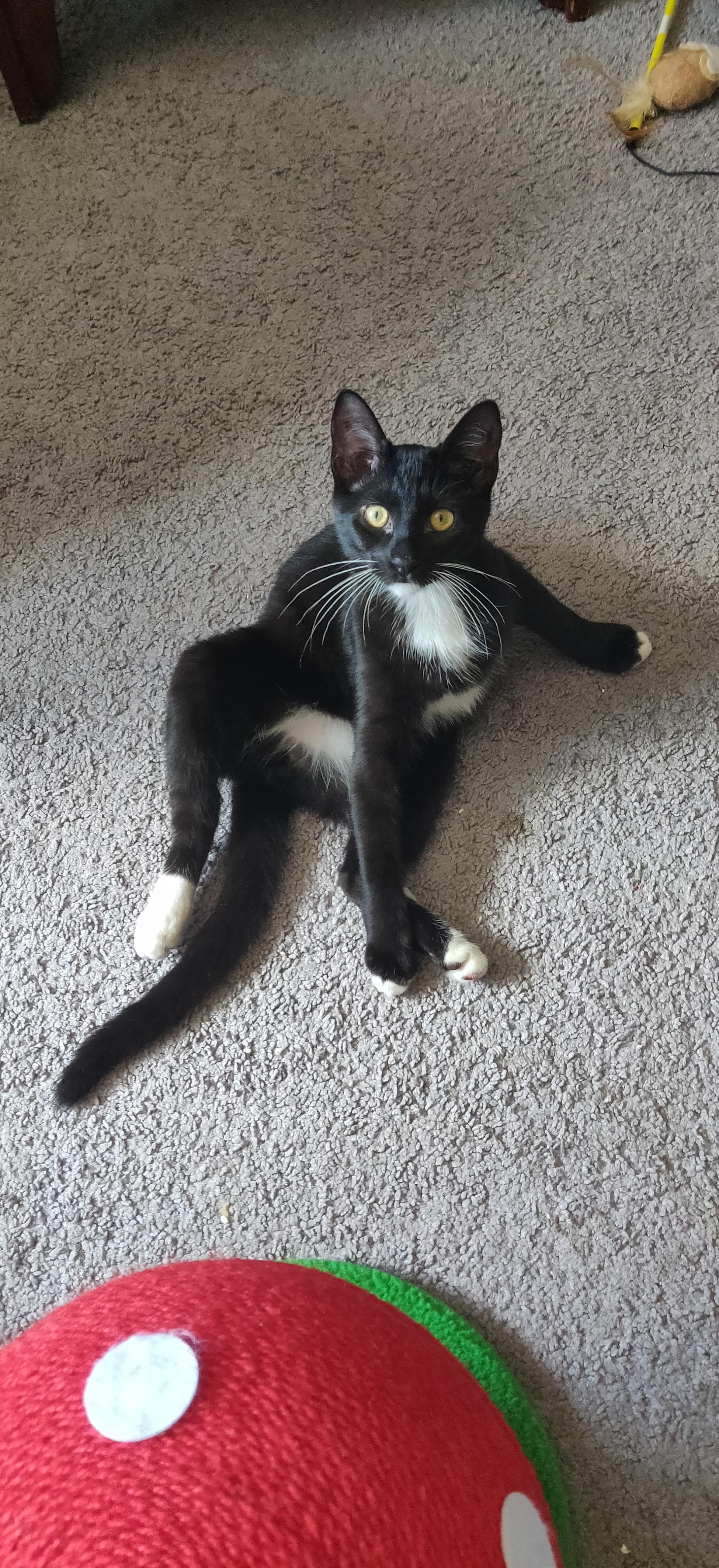
Not a normal cat pose.
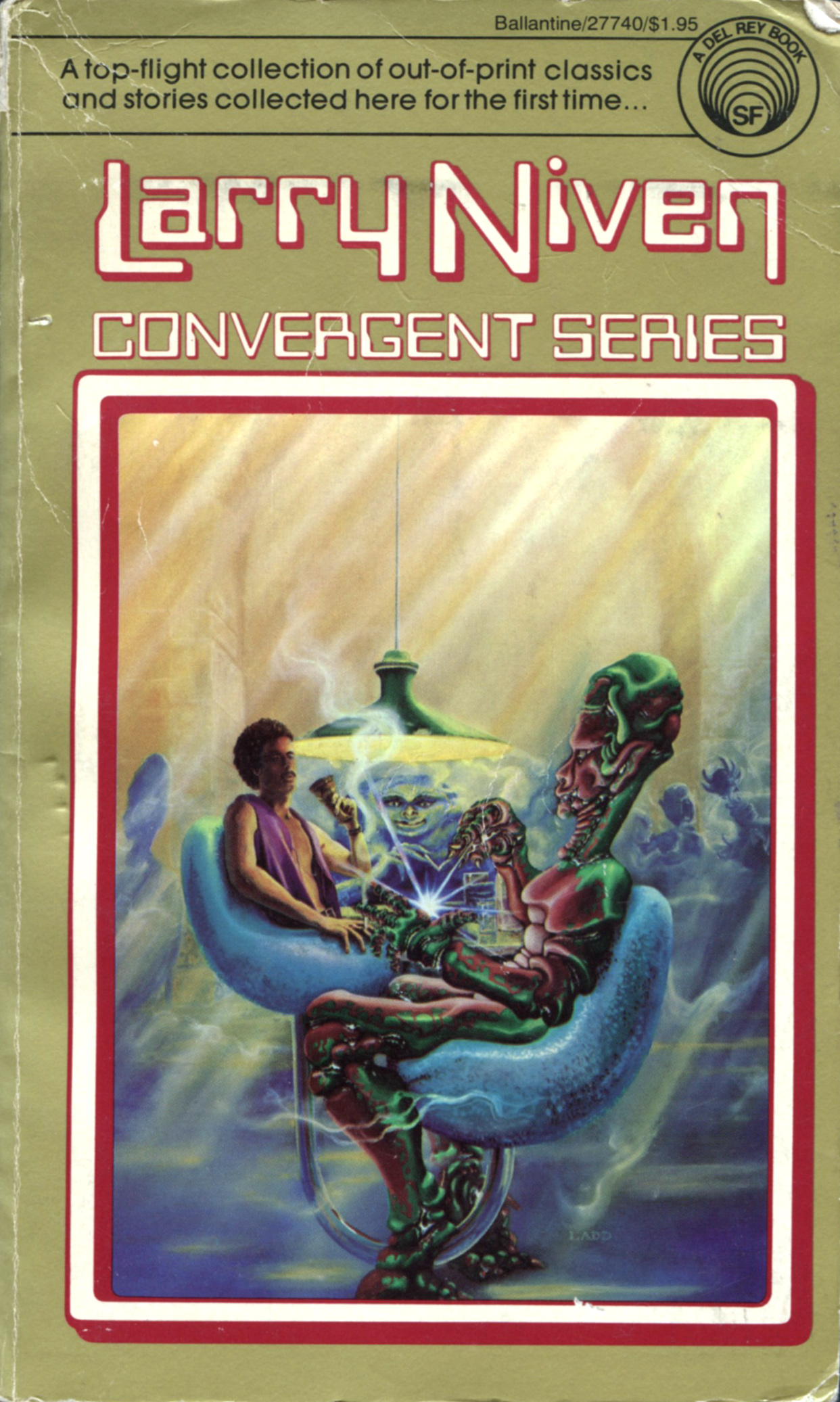
Quasit's Daily Book Recommendations: "Convergent Series" (1979) by Larry Niven
Age Range: 15 to adult
Genre: Science Fiction, Fantasy, Fiction, Short Stories
As I've said before, Larry Niven is probably the top hard-SF author of all time. His "Known Space" stories and novels are outstanding. But he didn't ONLY write SF. "Convergent Series" collects some of his fantasy short stories along with one gem-like piece of ordinary modern fiction and some non-Known Space stories as well. I think many of them are better than some of his Known Space tales!
"Convergent Series" (the story that the book is named for) is a classic pact-with-the-Devil tale. It's striking and memorable.
There are five stories from Draco's Tavern, a bar to which aliens and some humans come to drink or otherwise imbibe. They're clever and different science fiction stories. They're narrated by the proprietor of the tavern.
My favorite story in the collection, though, is "Transfer of Power". Niven wrote it after binging stories set "at the edge of the world" by Lord Dunsany, and it turned me into a Dunsany fan for life. It's a great story!
[Fifty-three men and eight women rode away from the edge of the world. They were a mixed group; that was obvious at a glance. Forty men were armed and armored; they rode on the outside. Thirteen men and eight women rode enclosed within a moving picket fence of spears. They carried only eating-knives, and their horses were loaded with waterbags and provisions, and they were the better riders.
Forty armored men bubbled over with good spirits. They joked among themselves, they reminisced, they told stories. They avoided the subject of a certain bloodless revolution, except that they sometimes forgot, and sometimes it was on purpose. The unarmed group said nothing, and their expressions varied between anger and despair, with one exception.
Ex-King Sarol had lost his home and his status and his profession. He smiled gently as he rode away from the edge of the world, like a man lost in pleasant thoughts.
At first Guppry was relieved. He’d had his transfer of power; all he wanted now was a smooth transition. The sooner Sarol and his hangers-on were over the border in Zarop-Opar, the better. Then he began to wonder what Sarol could have to smile at.
Wondering, he pulled his horse up next to Sarol’s.]
[He glanced sideways to see Sarol’s reaction, and found none, and was annoyed. “I don’t see why your great-great-grandfather built a palace right at the edge of the world,” he said.
“King Charl had his reasons,” Sarol said tranquilly. “Don’t you like the view?”
The palace had been carved—by magic, or by enormous labor; that detail had been lost to time—into a granite knob that was the highest point in Halceen. it was part of the cliff that formed the world’s edge. Bedrooms and breakfast nooks opened onto balconies at the edge, and one great open ballroom, and a door that King Sarol had had plainly labeled; but some of his predecessors had had a brutal sense of humor.
Yesterday, a conqueror surveying his realm, Guppry had stood at the edge of a balcony and become less than a gnat in his own eyes. A stairway with a railed landing ran a little way down; then miles and miles of naked cliff pocked with caves; then no more cliff. Just blue sky swirled with clouds, and flocks of legless birds, and a sinuous cloud-streamer, gilded by sunset, that might almost have been a golden dragon except for its size. Eternity was down there. You could fall until you died of thirst, and who would bury you then?]
I don't know if it's still physically in print, but it's available as an ebook from the usual providers (please don't use Amazon). You might find it in a used book shop or a library. And you can borrow it for free from the Internet Archive!
https://archive.org/details/convergentseries0000unse
Happy reading! 🤓📖
Here's a complete spreadsheet of all the books I've recommended on Mastodon to date (along with links to each post):
#Books #Bookstodon #ScienceFiction #Fantasy #ShortStories #Fiction #BookRecs #BookRecommendations #DailyBookRecs #QuasitBookRecs
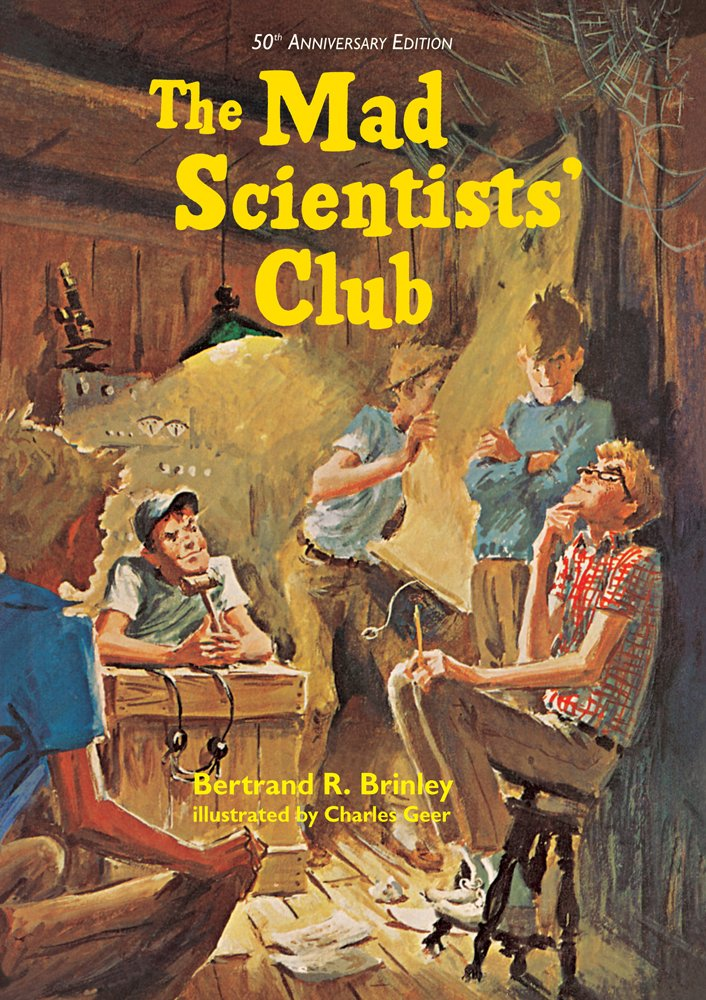
Quasit's Daily Book Recommendations: "The Mad Scientists' Club" (1965) by Bertrand R. Brinley
Age Range: 10 to adult
Genre: Children, Young Adult, Humor
It's Thursday, so I'm recommending a children's book today! This was one of my favorites; I reread it many times over the years. Many of the stories first appeared in "Boy's Life" magazine. Back then they printed great stories, including several by Robert A. Heinlein.
The Mad Scientists' Club is a group of boys who live in a town called Mammoth Falls. As you might guess from the name, they love science and technology. They use their skills for pranks and adventures, and also in struggles with their arch-enemy: Harmon Muldoon, a former member of the club and now the head of his own club which apparently exists only to bedevil the Mad Scientists.
The first story in the collection is "The Strange Sea Monster of Strawberry Lake", in which the boys create a floating mechanical sea monster as a prank. It was filmed as "The Strange Monster of Strawberry Cove" in 1971 and starred Burgess Meredith. It's available on Youtube.
As always, I strongly recommend reading the book before watching the film!
[Since Henry's plan to build a lake monster seemed like a good one, we held a formal meeting of the club that night to take a vote on it. Naturally, we all voted in favor of it, and three days later we had most of it finished. We built it on a small piece of dry land hidden 'way back in the swampy end of the lake. Henry and Jeff had designed a frame of light lumber and laths that had the shape of a big land lizard, and we suspended this across the gunwales of the canoe. Then we hung chicken wire on the frame and stretched canvas over it. With a little paint and a few shiny tin can lids spotted here and there, we soon had a loathsome-looking creature guaranteed to scare the life out of anyone a hundred yards away from it.
Jeff had to keep putting the brakes on Henry's fancy ideas, but he did let him outfit the head with a pair of red eyes -- which were just flashlights with red lenses stuck out through the canvas. Henry installed a switch and circuit breaker in the canoe, so that the "eyes" could be made to blink. After two days of practice back in the swamps we figured we could handle the beast well enough to make a test run out on the lake. The monster's profile stuck up about four feet out of the water, and it was a cinch for four of us to sit upright in the canoe to do the paddling and steering.]
There were four books in the Mad Scientists' series altogether. The second was "The New Adventures of the Mad Scientists' Club" (1968), the third was a novel called "The Big Kerplop!" (1974), and lastly a partial posthumous novel called "The Big Chunk of Ice" (2005).
The stories are VERY readable, funny, and fun. They're great for kids, and I can confirm that they're excellent to read to kids as well. My son loved them when he was young.
Physical copies of the books are available online (please don't use Amazon), along with audiobook versions of some of the books. There don't seem to be ebooks available, for some reason. But you can borrow "The Mad Scientists' Club" for free from the Internet Archive.
https://archive.org/details/bwb_S0-CUF-260
Happy reading! 🤓📖
Here's a complete spreadsheet of all the books I've recommended on Mastodon to date (along with links to each post):
#Books #Bookstodon #Children #Humor #YoungAdult #YA #BookRecs #BookRecommendations #DailyBookRecs #QuasitBookRecs
It kills me that government officials get the best health care for life, paid for BY US, which WE didn't get to vote on. They just gave it to themselves.
While at the same time hundreds of thousands of us die every year because those same officials won't allow a national health care system.
They're literally killing us, while stealing our money to benefit themselves, their families, and their friends. That's what you do to cattle, which is what we are to them.
Explain to me why we're not rising up and giving them what they deserve.
Will the people of the world revolt against the oligarchs when it becomes clear to them that we're all going to die from climate change?
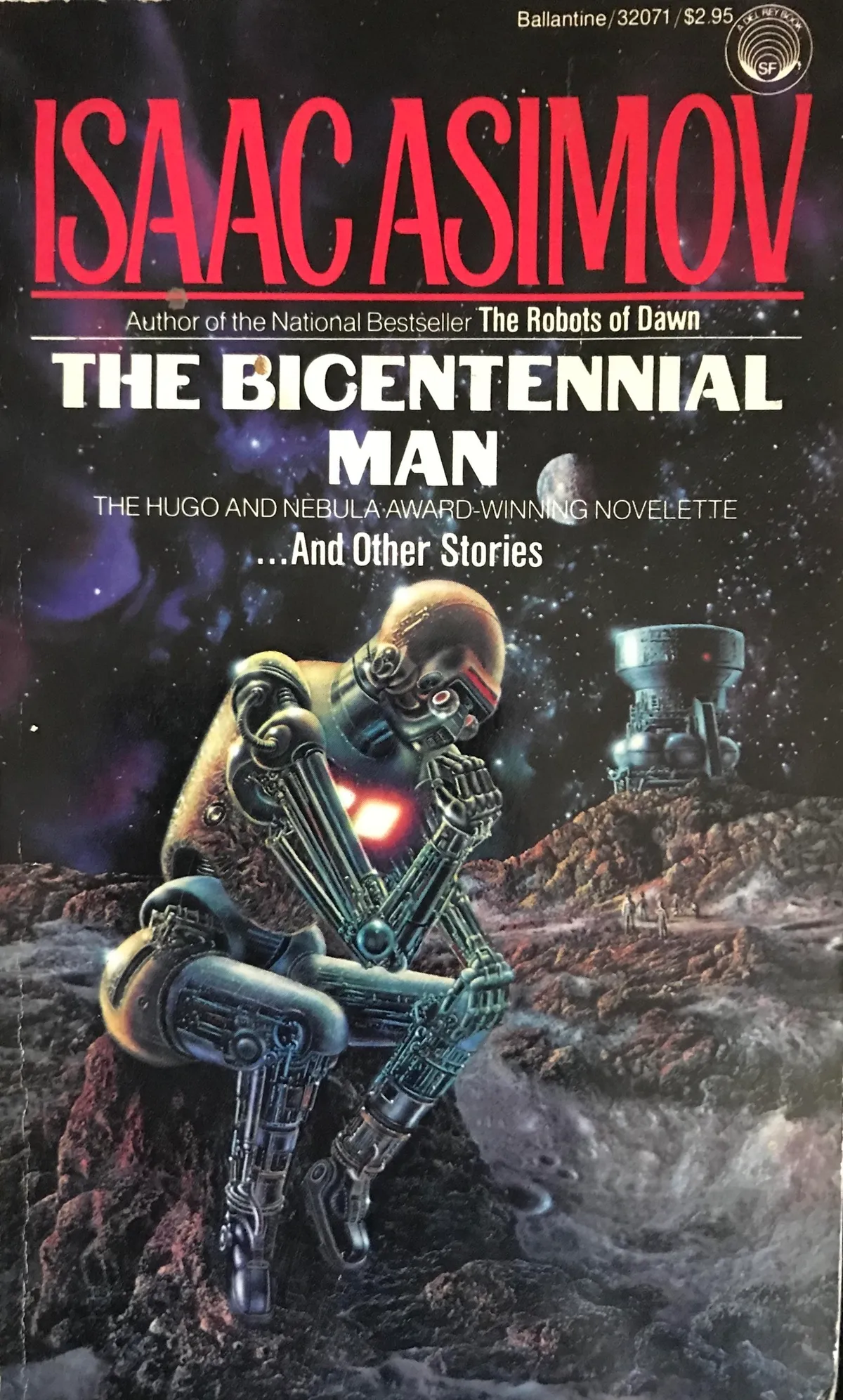
Quasit's Daily Book Recommendations: "The Bicentennial Man and Other Stories" (1976) by Isaac Asimov
Age Range: 14 to adult
Genre: Science Fiction
I started reading around the age of two. I became a science fiction fan when I was about eight or so, when my father brought home two books from the library for me. One was "The Science Fiction Hall of Fame, Volume 1" (1970); that was the fifth book I recommended here. And the other was Isaac Asimov's "Foundation", the first book in the original trilogy.
I went wild for science fiction, and Asimov was my favorite. I read everything I could find of his. My father took me to see him speak at the University of Bridgeport, which is a story in itself.
So how is it I haven't recommended any science fiction actually BY Asimov after 163 daily recommendations? The truth is, I'm reluctant to recommend books that are •too• well known. If you haven't read the original "Foundation" trilogy, I don't know what to say except you're really missing something. But I'm guessing that there are more readers out there who might have missed some of his lesser-known collections. "The Bbicentennial Man and Other Stories" is one of them.
Now this is a collection of Asimov positronic robot stories, among others. It includes the Three Laws of Robotics at the start of the first story, so you could certainly read it as is. But if you haven't read "I, Robot" (1950) and "The Rest of the Robots" (1964), you really might want to read those first. They're true classics, and you can borrow them for free from the Internet Archive.
https://archive.org/details/bwb_Y0-BAQ-106
https://archive.org/details/restofrobots0000isaa
"The Bicentennial Man and Other Stories" includes lively introductions to every story by Asimov himself. That was a custom of his; he really loved to write, so a lot of his collections include at least some additional commentary from him.
The collection starts with an amusing poem, "The Prime of Life"; it's not long, but it's clever and funny.
I suppose I shouldn't go through story by story, but the book obviously includes the novelette "The Bicentennial Man". I don't even want to MENTION this, but yes, it was turned into a movie starring Robin Williams–but please, if you happened to see that movie, don't judge the story on the basis of the movie. Hollywood was very unfair to Asimov, as they always have been. The story is thoughtful, emotional, and proof that Asimov's writing style is anything but robotic. It's straightforward and exceptionally clear, but that's a good thing!
It's hard to be sure if the book is still in print, but it's free to borrow from the Internet Archive.
https://archive.org/details/bicentennialmano0000asim
Happy reading! 🤓📖
Here's a complete spreadsheet of all the books I've recommended on Mastodon to date (along with links to each post):
#Books #Bookstodon #ScienceFiction #ShortStories #BookRecs #BookRecommendations #DailyBookRecs #QuasitBookRecs