Login
You're viewing the assemblag.es public feed.
  • The Ludditetheluddite
    Jul 23, 2026, 1:31 PM

    We go through the history of MBFC's frameworks, arguing that they have their roots in a conservative political project to discredit the press. MBFC then quantifies this propaganda campaign as data and, aided by the work of misinformation scholars, it is inserted back into discourse as scientific fact. MBFC's data is a computationally legible account of hegemony, a specious dataset for uncritical research that mistakes the familiarity of the concepts it quantifies with accuracy.
    💬 1🔄 5⭐ 10

Replies

  • The Ludditetheluddite
    Jul 23, 2026, 1:33 PM

    One of the peer reviewers who rejected this paper put it best, so we will give them the last word on this thread:

    >The authors' comments about the MBFC scores reflecting the "common idea of the liberal media" miss the Okkam's [sic] Razor solution that this is in fact the distribution of bias of media outlets.

    💬 1🔄 1⭐ 16
  • The Ludditetheluddite
    Aug 1, 2026, 3:08 PM

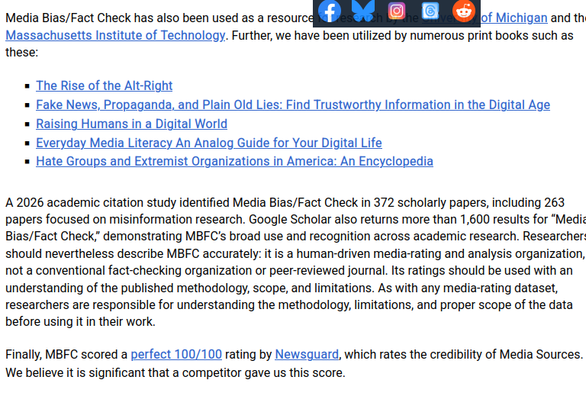
    Media Bias/Fact Check updated their about page to include some cherry-picked results from our study. They show our count of its popularity without including a link to the source, presumably because our study is critical. They do this immediately after linking to studies that use and praise MBFC.

    In other words, the misinformation dataset guy spun our study and didn't bother to cite their source.

    mediabiasfactcheck.com/about/

    Media Bias/Fact Check has also been used as a resource for research by the University of Michigan and the Massachusetts Institute of Technology. Further, we have been utilized by numerous print books such as these:

    The Rise of the Alt-Right
    Fake News, Propaganda, and Plain Old Lies: Find Trustworthy Information in the Digital Age
    Raising Humans in a Digital World
    Everyday Media Literacy An Analog Guide for Your Digital Life
    Hate Groups and Extremist Organizations in America: An Encyclopedia

A 2026 academic citation study identified Media Bias/Fact Check in 372 scholarly papers, including 263 papers focused on misinformation research. Google Scholar also returns more than 1,600 results for “Media Bias/Fact Check,” demonstrating MBFC’s broad use and recognition across academic research. Researchers should nevertheless describe MBFC accurately: it is a human-driven media-rating and analysis organization, not a conventional fact-checking organization or peer-reviewed journal. Its ratings should be used with an understanding of the published methodology, scope, and limitations. As with any media-rating dataset, researchers are responsible for understanding the methodology, limitations, and proper scope of the data before using it in their work.
    💬 1🔄 12⭐ 13
  • The Ludditetheluddite
    Aug 1, 2026, 3:12 PM

    Let this be a lesson to misinformation scholarship on the conceptual limitations of their frameworks. Here we see actual "bias" at work, but a more complex version outside the simple left/right they love to use, and which mostly concerns individual interests.

    💬 0🔄 5⭐ 11