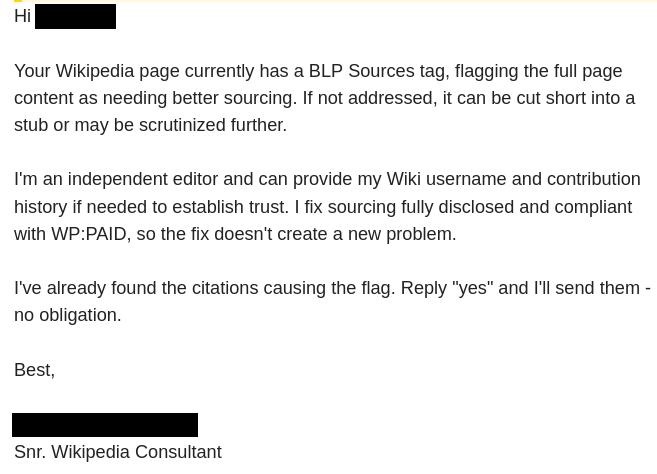
This is a new grift I hadn't seen. It turns out my mum has received at least six messages from different people this year proposing that she pay them to edit her Wikipedia article to add sources. Attached is one of the more forceful ones suggesting the article could be blanked out, with names removed.
On closer reading, the only personalisation other than the greeting at the start. And while they claim to have done some work searching for references, they will only provide evidence on follow-up. It mentions the "BLP Sources" tag, and Wikipedia makes it easy to find all pages using that template (there's about 100,000 of them). It'd then be a simple matter of trying to find email addresses for each of those people (this email was scatter-shot to five addresses, two of which belong to other people).
These days it would seem pretty easy to automate most of this pipeline, only requiring any work if they get a response.
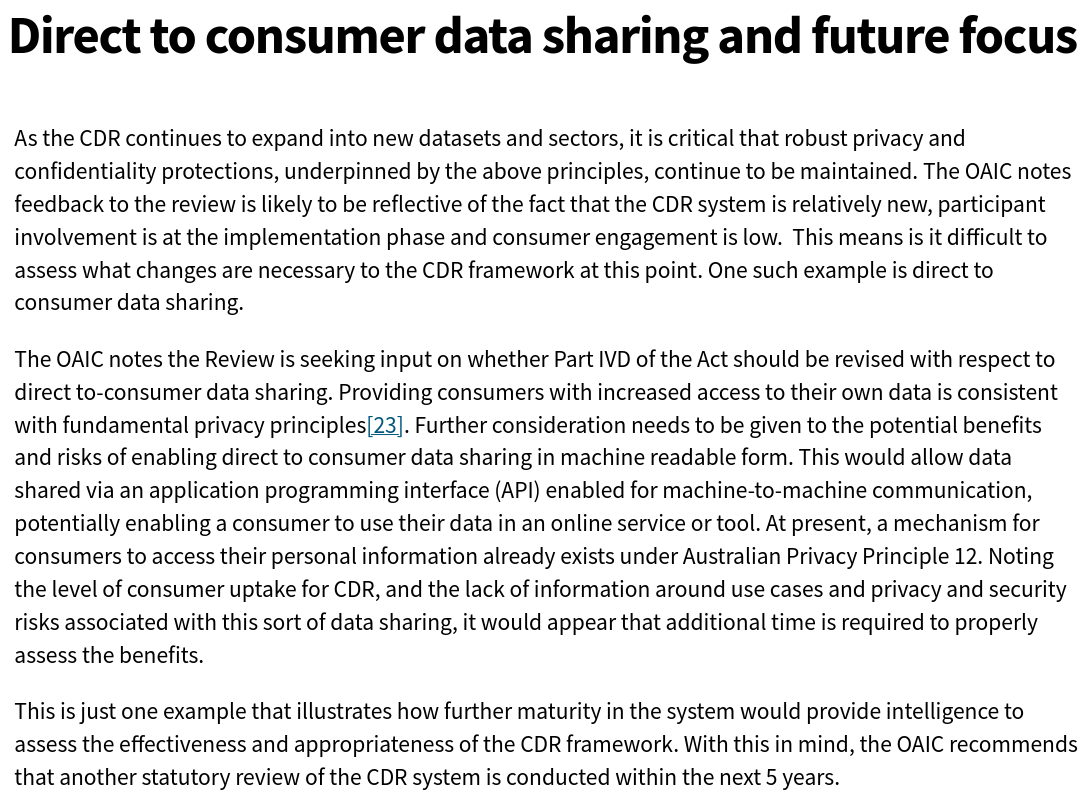
![Direct to consumer data sharing and future focus
As the CDR continues to expand into new datasets and sectors, it is critical that robust privacy and confidentiality protections, underpinned by the above principles, continue to be maintained. The OAIC notes feedback to the review is likely to be reflective of the fact that the CDR system is relatively new, participant involvement is at the implementation phase and consumer engagement is low. This means is it difficult to assess what changes are necessary to the CDR framework at this point. One such example is direct to consumer data sharing.
The OAIC notes the Review is seeking input on whether Part IVD of the Act should be revised with respect to direct to-consumer data sharing. Providing consumers with increased access to their own data is consistent with fundamental privacy principles[23]. Further consideration needs to be given to the potential benefits and risks of enabling direct to consumer data sharing in machine readable form. This would allow data shared via an application programming interface (API) enabled for machine-to-machine communication, potentially enabling a consumer to use their data in an online service or tool. At present, a mechanism for consumers to access their personal information already exists under Australian Privacy Principle 12. Noting the level of consumer uptake for CDR, and the lack of information around use cases and privacy and security risks associated with this sort of data sharing, it would appear that additional time is required to properly assess the benefits.
This is just one example that illustrates how further maturity in the system would provide intelligence to assess the effectiveness and appropriateness of the CDR framework. With this in mind, the OAIC recommends that another statutory review of the CDR system is conducted within the next 5 years.](https://cdn.hosted.spacebear.ee/sb-ab9b494dccbef43e454fccf9f07caa75/cache/media_attachments/files/117/092/524/532/413/226/small/aa58a2c2c2448c97.png)
![Direct to consumer request service
Part 3 of the CDR Rules sets out future requirements for data holders to implement an online service that allows consumers to directly request their CDR data in a human-readable form and in accordance with the data standards. The deadline for data holders in the banking sector to comply with these requirements had previously been set at 1 November 2021.
The Amending Rules remove the compliance date for the Part 3 obligations in the banking sector. [Schedule 5, items 1 and 2, clauses 6.4(3) and 6.6 of Schedule 3 to the CDR Rules]
This deferral was announced by Treasury on 30 April 2021 and will allow a future consultation process to be undertaken about the way in which direct to consumer obligations should be specified, including how the data standards should provide for data in machine-readable form via application programming interfaces.](https://cdn.hosted.spacebear.ee/sb-ab9b494dccbef43e454fccf9f07caa75/cache/media_attachments/files/117/092/524/627/174/721/small/f020c0399af74028.png)