Feak and weeblekauer@aus.social
10/14/2026Open Australia needs support.
https://oaf.org.au/2026/10/13/this-library-is-running-out-of-money-here-is-how-to-keep-it-open/
Please boost for reach! Ta.
Open Australia needs support.
https://oaf.org.au/2026/10/13/this-library-is-running-out-of-money-here-is-how-to-keep-it-open/
Please boost for reach! Ta.
Looking at Torvalds using generative AI for Linux, Andrew Tridgell using it for rsync, and a bunch of other very bright and techically very capable people using it to assist them with various tasks makes me think again about the time a very, very intelligent friend of mine suddenly fell into Scientology.
It started me thinking about why it is that clever people fall for these scams, and I have a theory.
I think clever people learn to trust their minds. They learn that their mind will give them correct answers without much effort, and that it will also show them flaws in arguments with the same ease. Because it generally does!
But it's also a weakness. If something comes long that doesn't trigger the automatic defences, the clever mind may let it in.
The cleverness needs to be combined with vigilance, and that cannot be left to an automated system. I think clever people tend to become less vigilant, because their mind has always stood them in good stead.
Once the scam is in it combines with the general human unwillingness to admit to error. Or even to re-evaluate things just in case they are not true. We have a whole complicated social construct called "science" designed to work around that, and not even that works all the time.
And here's the kicker: The scam that tells clever people how clever they are will have the greatest chance of success, because they ARE clever. No false modesty. The scam they fall for is wrapped in the truth that they are clever people, and presented as a thing that only clever people can truly appreciate. The scams that clever people fall for are built up of details, layers, interrelated things that appear to explain each other and support each other. That hide and distract from the basic falsehood at the bottom.
To avoid such a scam you must take a step back from the complicated, dazzling, fascinating, alluring detail. Look at the whole thing and ask what it is, why it is, who is it from? Where does it connect to the world? Who does it benefit, who does it harm? Is it too good to be true?
Asking those questions about generative AI gets you pretty obvious answers.
Have you PERSONALLY tried out PhotoCraft or LightCraft (AI-assisted clones of Adobe's Photoshop and Lightdesk)?
(please boost for reach)
Yes indeed. Amazing how often selling off a public asset turns out in hindsight to have been a bad idea. Phones, the Post, electricity, Internet, banks...
Oh wait - did I say in hindsight? I should have said "amazing how often it turns out that governments should have fucking listened to the people who told them what a mind-numbingly stupid idea it was when they first mooted selling off yet another public asset".
Writing about the wallaby I met today reminded me of the time some roos decided to have a bit of a rumble under our house.
The house is on poles and the space under it is completely open on three sides. Under the house the ground is on two levels, with about 2.5m vertical space under one half of the house and 1.4m under the other half. There's not much room in the bigger area - it's full of water tanks, trailers, cars and such like. The narrower space is pretty empty though, except there are long steel rods bracing the poles.
Anyway, several roos rampaged into the narrower space one evening, probably males fighting. The roos in our area are Eastern Greys, and even a small one stands easily a metre tall. So there wasn't a lot of space in there. Though roos can walk after a fashion, by shuffling those big long feet, they are built for speed, and for speed they hop. If you are an excited roo, bent on violence or on escaping it, you are going to want to hop. Which is tricky when you only have 1.4m of vertical space to hop in.
So what we startled humans inside the house heard was a sudden cacophony of coughs, barks, growls and grunts, scratching and skidding noises, all punctuated by heavy thumps as an ascending roo met the unforgiving underside of the house, with the odd "bongggg" as someone bounced off a bracing rod.
From the sound of it there were four or five of them, and it took them a good few minutes to take their "discussion" back into the bush.
Roos are not the sharpest tools in any shed.
Walked out onto the verandah today to look into the bush and feel the air. Heard the slightest rustle, looked down to the grass below. About 2.5m below me (the house is on a hill and the downhill side is quite high off the ground) was a wallaby, looking up at me, with a joey hidden in her pouch. She seemed quite unafraid. We exchanged a few pleasantries before I went back inside.
It was unusual. There are wallabies and roos around the place constantly, but they generally like to keep a bit of distance. When we leave the house there is often a sudden THUMP as a roo decamps.
He got an award?!? Is it uncharitable to think it might be the sort of award one gets spam emails about? Yes, it is uncharitable. Would be interesting to look at the award details.
"I was busy" lol. And "I stayed overseas because I had been threatened".
In Merimbula there are tall street lights along the bridge and continuing into town. The poles rise high, then curve to bring the actual light over the edge of the road, so there is a short horizontal piece of support with a big flat light fitting on the end of it.
Pelicans love the street lights. A solid "branch" to perch on, a safe surface to sit on, both far from all but airborne predators. Only space for one, so a solitary space, where a pelican can cogitate undisturbed.
Locals know to glance up before walking below them, and to note and avoid the poo patterns on the ground.
The local council - not the sharpest tool in the shed, at least not collectively - decided that pelicans on street lights was a bad thing, so they took steps. They affixed to the top section of each streetlight a rotating arm, free to rotate horizontally as the wind moves it. The arms, moved by the wind, sweep out a circle maybe a metre in diameter, across the top surface of the light itself and some of the support.
They don't work. At all. The pelicans have broken several, and just stop the others if they want to sit there. One or two still work when there is no pelican present. Some have swivelled to hang sadly below or half-around the support.
People, locals and tourists alike, love the pelicans. They love them in flight, on the water, perched on boats, perched on cables, perched on jetties, perched on poles, on buoys and on street lights. They are painted, drawn, and photographed. Children call to them. There are even sculptures of pelicans sitting on poles. Some arsehole stole one a while ago - if you ever see a pelican made out of scrap steel in someone's back yard, let the police know.
A pelican gliding in to land is majestic. A pelican sitting atop a pole or a streetlight tells you that everything is OK.
That is all.
@WeirdWriter You write in your article that "you can’t give a TED Talk about a ramp". I bet that if anyone could, you could.
Working my way through "Resident Alien" - it takes a while to get into, but genuinely funny with a really horrific twist every now and again. I am really enjoying the sheriff, and waiting for the long-suffering deputy to get a chance to shine.
I'm trying to find a book I read forty years ago. I think it had "X" in the title, but I'm not sure. It is NOT related to an apparently very popular series of books about "Secret Agent X" that infests every internet search I attempt :-(
It is about a man who is NOT a secret agent, but who is mistaken for one and thrust into ever more desperate situations as a result. As the book progresses he hears about (and must perforce demonstrate) an ever increasingly improbable set of talents he is supposed to have (but really, REALLY doesn't). Nonetheless luck and coincidence let him survive against the odds and he begins to suspect by the end of the book that somehow he may actually BE the chap everyone seems to think he is.
There is an episode involving a ridiculously high-powered motorboat that would stick in your memory; it had me in literal tears of laughter. The last chapter involves a fight with axes and other nasty bladed weapons, also memorable.
If you have read this book you will remember it and if you remember the title or author I would love to hear from you!
Please boost for reach :-)
PS: It's also not related to the James Garner movie "A Man Could Get Killed" (nor the book it's based on) which has a sort of similar device, but nothing like the same plot.
No names no pack drill, but gotta love people in business that do not read contracts. Got one here who is making a lot of pre-meeting noises that demonstrate a large gap between what they think they will be doing and what they will actually be doing after we tap the sign.
Oh - and they think they have informed us of something, but they haven't because they didn't informed us in writing as per a clause that they were very insistent on, so a particular countdown that they think started a week ago hasn't started at all and that is going to cost them too.
The fact that they drew up the contract themselves is just the icing on the cake, really.
Its enjoyable to encounter an English word that I have never seen before. It happened today. Do you know, without looking it up, what a "placket" is? Sometimes spelled "placquet". Feel free to boost. And, without revealing the actual answer, feel free to suggest likely meanings :-)
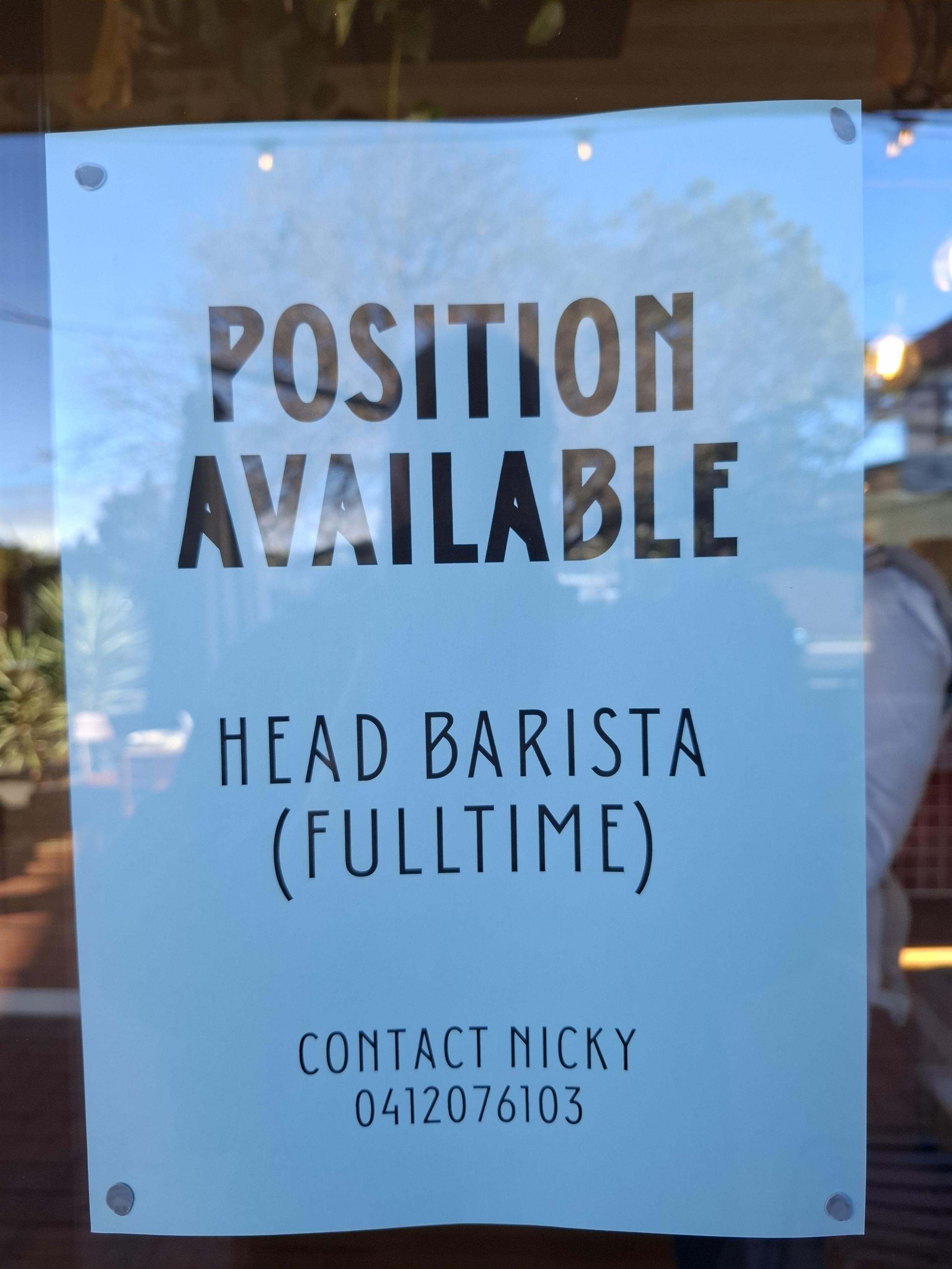
Need a job as a Head Barista? The Eddy in Merimbula (NSW, Australia) is hiring. Seems like a together crew. No relation, just a customer :-)
Details in alt text. Boost maybe?
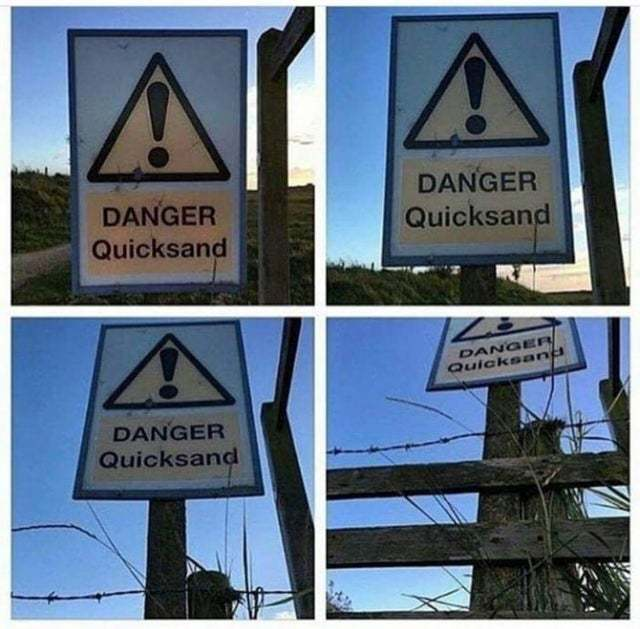
Found this. Sorry, no source recorded. Thought Pauline might be interested.

Google is about to do something extremely nasty to Android phone owners. ALL Android phone owners.
If you didn't know about it, now you do:
Please boost for reach...
It's not a "learning" damn it! It's a "lesson"!
How I hate gerundings.
This is a subtoot. You know who you are.
RE: https://theblower.au/@troberts/116740773276342695
Unreliable tools ARE inherently dangerous, precisely because you don't know when they will fail. AI is a wobbly ladder, a chipped chisel, a cracked hammerhead, an abraded rope, a bent drill bit, a pinched electrical lead. Except with AI the unreliability - the damage - IS inherent.
Might work, might not, but the potential for disaster is there every single time. Only a fool would CHOOSE to use damaged tools.
A lot of people - including me at times - are saying that it is simple to tax billionaires.
Serious question: Aside from the political will to do so, *is* it simple?